
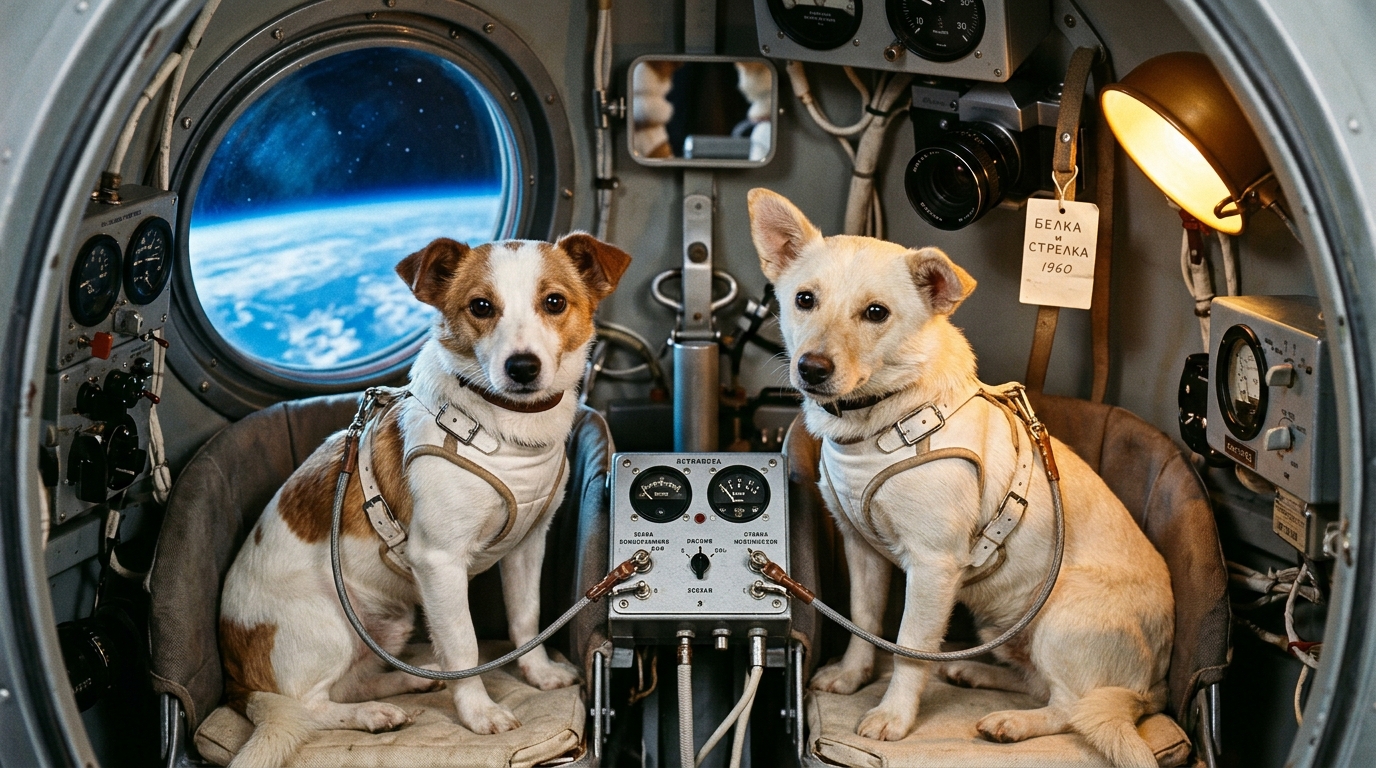
Two female dogs, 42 mice, a gray rabbit, and a handful of rats: that was the most unlikely crew ever sent into orbit. Their mission was far from a simple stroll through space. It would settle a question far more daunting than gravity: can you return alive from space?
- On August 20, 1960, Belka and Strelka became the first dogs to be retrieved alive after an orbital flight, after 17 revolutions around Earth aboard Sputnik 5.
- This success stood in stark contrast to Laika’s fate, dying of hyperthermia in 1957 for lack of reusable re-entry technology.
- Belka’s vomiting in orbit alerted Soviet scientists, who prudently limited Yuri Gagarin’s flight to a single orbit.
- The real feat wasn’t flying, but returning
- Belka and Strelka, guinea pigs turned heroes despite themselves
- What their survival changed for human space exploration
The real feat wasn’t flying, but returning
On August 19, 1960, a Vostok-L rocket lifted off from the Baikonur Cosmodrome with Sputnik 5 aboard, a spacecraft weighing 4,600 kilograms. Inside, Belka and Strelka, two dogs, were about to experience what no living being had yet succeeded in doing: a round trip to space.
The craft completed 17 orbits around the Earth, spending 27 hours in orbit. A respectable figure for the era, yet not extraordinary compared to the feats that would follow in the years ahead. So it isn’t the orbital performance that makes history here.
What changes everything is the landing. On August 20, 1960, the descent module touched the ground and the two dogs emerged alive. Belka and Strelka completed 17 orbits aboard Sputnik 5 in August 1960, becoming the first dogs retrieved alive after an orbital flight. A detail that changes everything when you know the fate of their predecessor.
Belka and Strelka, guinea pigs turned heroes despite themselves
To grasp the stakes of this mission, one must go back to November 1957. Laika, the first living being sent into orbit, died of hyperthermia just hours after liftoff, during her fourth orbit around Earth. There was no atmospheric reentry technology at that time to bring her back. The exact circumstances of her death would only be revealed in 2002, a full 45 years later.
Belka and Strelka were not alone aboard Sputnik 5. Soviet engineers had packed 40 mice, a gray rabbit, two rats, flies, as well as plants and fungi. A miniature Noah’s Ark, designed to test the effects of space travel on a variety of living organisms. The result: every passenger survived the journey.
The flight was far from smooth for the two dogs. Televised transmissions showed no movement during the first three orbits, which unsettled the ground teams. Then, during the fourth orbit, Belka vomited. A seemingly minor incident, but one that would heavily influence future decisions.
What their survival changed for human space exploration
That vomiting episode from Belka in orbit was not mere trivia. For Soviet scientists, it signaled the dangers of prolonged weightlessness. The tangible outcome: Yuri Gagarin’s flight, planned for less than eight months later, would be limited to a single orbit as a precaution.
Without Sputnik 5’s mission, it would be hard to know whether engineers would have taken the same calculated risk with a human. Belka and Strelka, in a sense, opened the path by acting as a biological barometer. Their safe return validated re-entry technologies—a prerequisite before sending a human being.
After their mission, the two dogs became genuine celebrities in the Soviet Union. Their preserved bodies remained on display at the Memorial Museum of Astronautics in Moscow, where they were still shown in 2021. This legacy endures, since Russian biomedical space research continues to use animals: the biosatellite Bion-M No. 2, launched in August 2025 with 75 mice and 1,500 fruit flies, stands as the most recent testament.
That 1960 flight remains a milestone too often eclipsed by Gagarin’s ascent. Yet without this successful return, the story of human space exploration might have followed a different, more cautious route—or a later one. Belka and Strelka did not merely survive: they enabled humanity to take the next decisive step with full awareness of the risks.
