
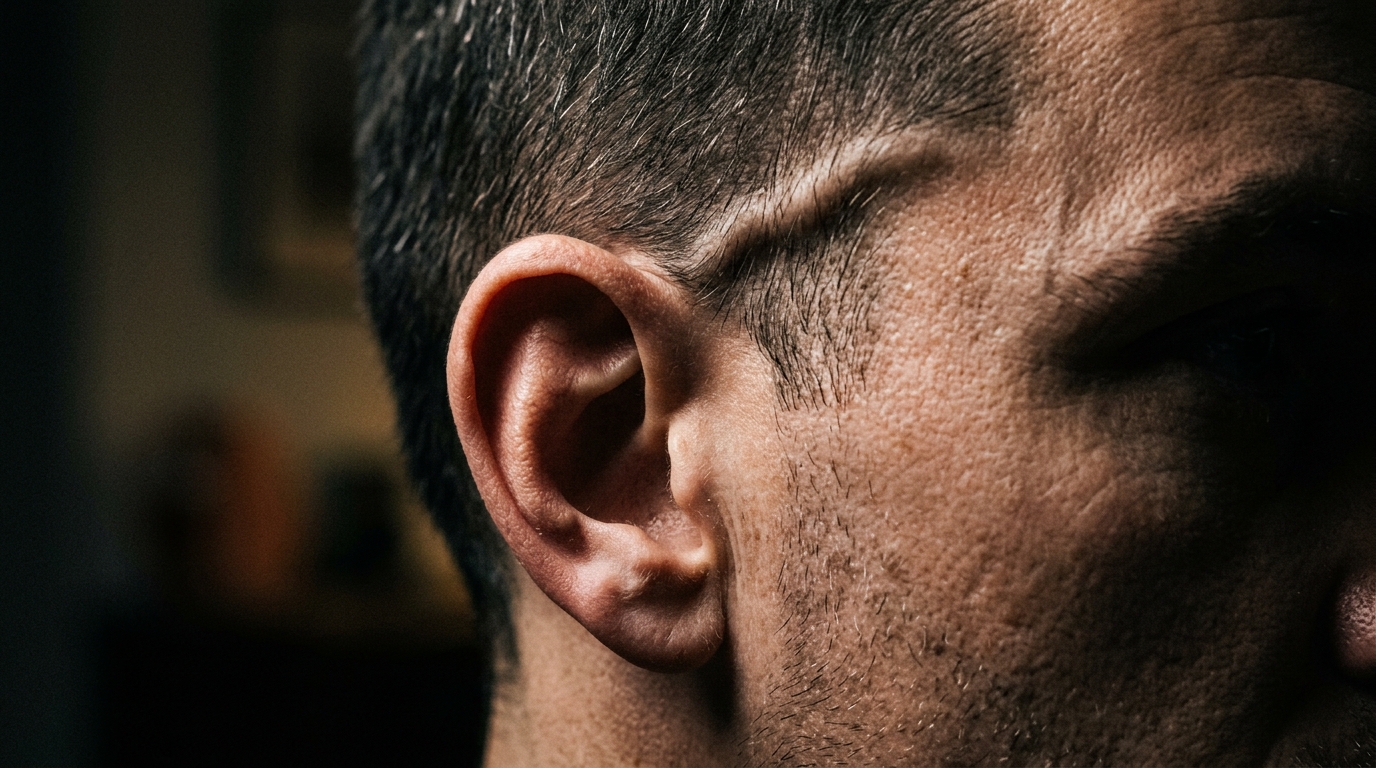
Place two fingers just above your ear and listen toward a distant conversation in a noisy café. You probably won’t feel it, but something moves beneath your skin. German researchers have measured this invisible tremor, the signature of a muscle once believed utterly useless in modern humans.
A Forgotten Muscle, Vestige of Animal Hearing
Watch a cat or a horse on alert: their ears instantly swivel toward the source of a suspicious sound. This reflex relies on a set of auricular muscles that work perfectly, able to tilt the ear like a small parabolic antenna.
- The superior auricular muscle, a vestige of animal hearing that became useless for moving the ear, remains connected to the nervous system in modern humans.
- An electromyography study on 20 volunteers shows that the electrical activity of this muscle increases with listening difficulty, especially in noisy environments.
- This discovery could enable the creation of an objective biological marker of listening effort, useful for the hard of hearing or cochlear implant wearers.
- A Forgotten Muscle, Vestige of Animal Hearing
- Twenty Volunteers, An Electromyography, An Unexpected Signal
- Why Listening Effort Rekindles This Ancestral Reflex
In humans, these muscles still exist. The superior auricular muscle, located just above the ear, is indeed part of them. It has simply lost, through evolution, its ability to produce a useful and visible movement.
Why this regression? Because human evolution has leaned toward other strategies for locating sounds: turning the head, the brain’s processing of timing differences between the two ears, and developed peripheral vision. The auricular muscle thus became a vestige, a bit like the appendix or the coccyx, those organs that testify to our animal past without playing a major role today.
But a vestige is not necessarily dead. It can remain wired to the nervous system, ready to surface under very particular circumstances, as demonstrated by a study conducted across the Rhine.
Twenty Volunteers, An Electromyography, An Unexpected Signal
To test whether this muscle still reacted to a sound stimulus, researchers at Saarland University recruited 20 volunteers. The tool used is electromyography (EMG), a technique that records the electrical activity produced by a muscle’s contraction, even when tiny or invisible to the naked eye.
Participants were subjected to listening tasks of increasing difficulty. Some involved following a simple podcast, others extracting a specific piece of information from amid a complex din, the kind of situation we all know in a crowded restaurant or a lively party.
Result: the harder the listening task became, the greater the electrical activity of the superior auricular muscle. The signal was absent or very weak during easy listening tasks. It rose sharply during the most demanding listens, those that require maximal auditory concentration.
This muscle, once thought purely decorative in humans, thus seems able to wake up under very specific conditions. Not enough to visibly move the ear, but enough to betray an intense cognitive effort.
Why Listening Effort Rekindles This Ancestral Reflex
The researchers’ favored hypothesis is that an ancient auditory attention circuit never fully disappeared. When the brain struggles to disentangle a relevant sound signal amid the noise, it appears to reactivate old neuromuscular connections, vestiges of a time when orienting the ear provided a clear survival advantage.
In other words, this muscle no longer seeks to move the pinna, but it would continue to express, in its own way, the intensity of the effort invested to listen. A kind of neural fossil that shows up only under constraint, like an old reflex thought dead that reappears at the worst moment, or rather at the most revealing moment.
This discovery is of particular interest to hearing specialists, because it could open a path to measuring listening fatigue objectively. People with hearing loss or cochlear implant wearers indeed exert a constant listening effort, often invisible and difficult to quantify.
If this muscle proves to be a reliable indicator, it could one day serve as a simple biological marker to gauge the cognitive load associated with listening, without questionnaires or subjective tests.
While awaiting potential confirmations on larger samples, this experiment reminds us of one essential point: our body still keeps traces of its evolutionary history, sometimes far more active than we imagined. The next time you struggle to follow a conversation in a din, keep this in mind—there may be a small muscle above your ear quietly working for you.
