
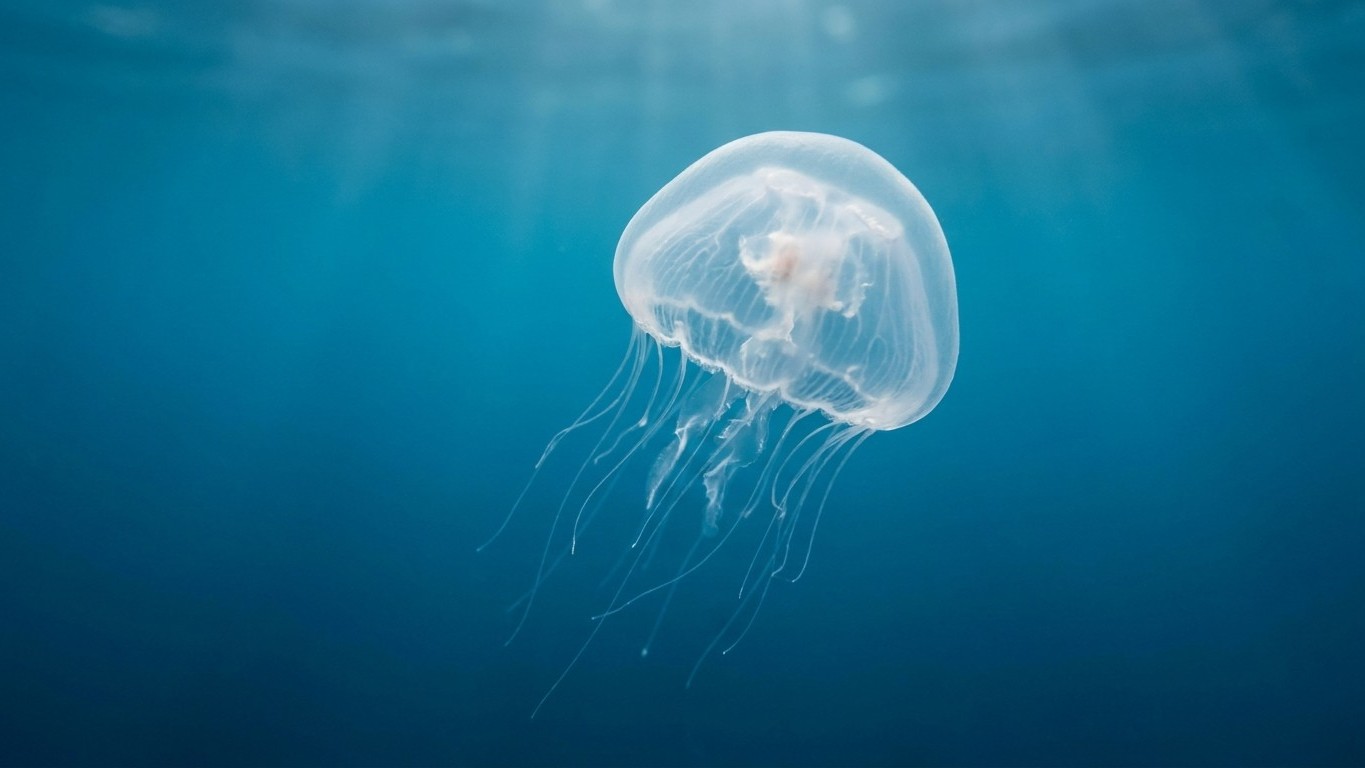
A jellyfish capable of erasing the passage of time: that is what the study of Turritopsis dohrnii, long nicknamed the “immortal jellyfish,” reveals. In the face of danger, injury, or hunger, this millimeter-sized marine creature does not die as the rest of the animal kingdom does. It rewinds. It literally becomes a baby again.
The mechanism has a precise scientific name: cellular transdifferentiation. Concretely, unlike other jellyfish, Turritopsis dohrnii is capable, in case of stress (injury, food shortage, adverse conditions), of reverting to the polyp stage, the first stage fixed to the seabed from which young jellyfish typically emerge. The adult, sexually mature, completely resets its biological clock. This process is called cellular transdifferentiation: mature cells reprogram to become immature cells, which allows the organism to restart its life cycle instead of dying. A specialized tissue, for example a tentacle cell, can thus transform into a stem cell, then differentiate again into a entirely different cell type.
This is not mere regeneration, like a lizard regrowing its tail. It is a true reversal of development. Researchers observed that the specimen aged in reverse, skipping several steps of the cycle to return to an earlier developmental stage directly from the medusa state, then could grow anew and give rise to an entire colony of new individuals through budding of the polyp. A single jellyfish in distress can thus give birth to an entire colony of genetically identical clones.
Key takeaways
- A tiny jellyfish wields a biological power hitherto unique: returning to infancy to escape death
- Researchers have finally decoded the secret genes behind this “biological immortality”
- This mechanism could revolutionize regenerative medicine and aging research
A phenomenon documented since the 1990s, confirmed by the genome in 2022
The observation is far from new. Experiments conducted in 1996 showed that this return to an earlier stage generally occurs when the jellyfish faces unfavorable conditions, whether mechanical stress or food deprivation. But it took the era of genome sequencing to understand what is really unfolding inside the animal’s cells.
In 2022, a Spanish team from the University of Oviedo published in the Proceedings of the National Academy of Sciences a decisive genetic comparison. The researchers report results that could explain how Turritopsis dohrnii manages to live, at least in theory, forever, by sequencing the jellyfish’s genome and that of a mortal close relative to spot relevant differences. Their comparison focused on Turritopsis rubra, a cousin unable to perform this biological trick. Result? Striking. The researchers found that T. dohrnii possessed twice as many genes associated with genetic repair and protection as T. rubra, along with mutations that slow cell division and prevent telomere degradation, those protective caps at the ends of chromosomes that normally shorten with age in most organisms.
Several months later, a Japanese team delivered the complete genome assembly of the species, confirming the scale of the genetic arsenal involved. The study reported the key molecular mechanisms of rejuvenation by comparing the genomes of this biologically immortal jellyfish with a closely related non-rejuvenating jellyfish, notably involving DNA replication and repair, as well as the renewal of stem cells. Two distinct genetic pathways thus converge on the same outcome: an extraordinary capacity for cellular repair.
Immortal, but not invincible
The word “immortal” deserves nuance, and that’s important. The jellyfish does not escape death in general; it escapes only death by aging. It is not immortal in the strict sense, because it is not immune to disease, predation, or an accident. A fish swallowing it, a disease that weakens it, a too-severe wound: none of that is prevented by transdifferentiation. What the animal has removed is only senescence, the progressive and inevitable degradation of tissues over time.
This distinction changes everything in how we understand the phenomenon. We are not talking about a superpower that would render the animal invulnerable, but a survival strategy in the face of environmental stress, a kind of biological reset button. Scientists think this transformation could in fact offset certain environmental constraints by changing function to make the organism better able to overcome the situation. It would appear that the species has, through evolution, developed an exit hatch that almost no other multicellular animal possesses.
Keeping these jellyfish in captivity is, by the way, an extremely challenging technical feat. Maintaining T. dohrnii in captivity is quite difficult; currently, only one scientist, Shin Kubota of Kyoto University, has managed to keep a group of these jellyfish going for an extended period, with the plankton needing daily checks to ensure it has properly digested its food. In a colony tracked for two years, Kubota reported that his colony had renewed itself eleven times. Eleven cycles of death-avoidance, eleven returns to square one, for a creature that would fit in the hollow of a fingernail.
What this jellyfish could reveal about our own aging
Left is the question that truly interests laboratories: can part of this mechanism be transposed to more complex organisms, humans included? Researchers remain cautious, but hope is real. Deciphering its internal mechanisms and its unique ability to come back to life through transdifferentiation could radically transform several research fields in the future, notably regenerative medicine, aging control, cellular rejuvenation, and tissue repair.
Modern tools accelerate this exploration. CRISPR genetic editing offers possibilities to manipulate the jellyfish genome to test which genes are essential to reversing its life cycle, while single-cell sequencing helps researchers track precisely how individual cells change their expression profiles during transdifferentiation. There is no guarantee that a human might one day transdifferentiate their own cells to rejuvenate a damaged organ. But the very existence of this mechanism in a living being demonstrates that senescence is not a fixed physical law etched in the stone of life, only a trajectory followed by the vast majority of species, jellyfish included in its mortal kin. The remaining question is how long it will take to understand, gene by gene, how this tiny creature accomplished what neither humans, nor sharks, nor the long-lived tortoise ever did.
Sources: trustmyscience.com | presse-citron.net
