
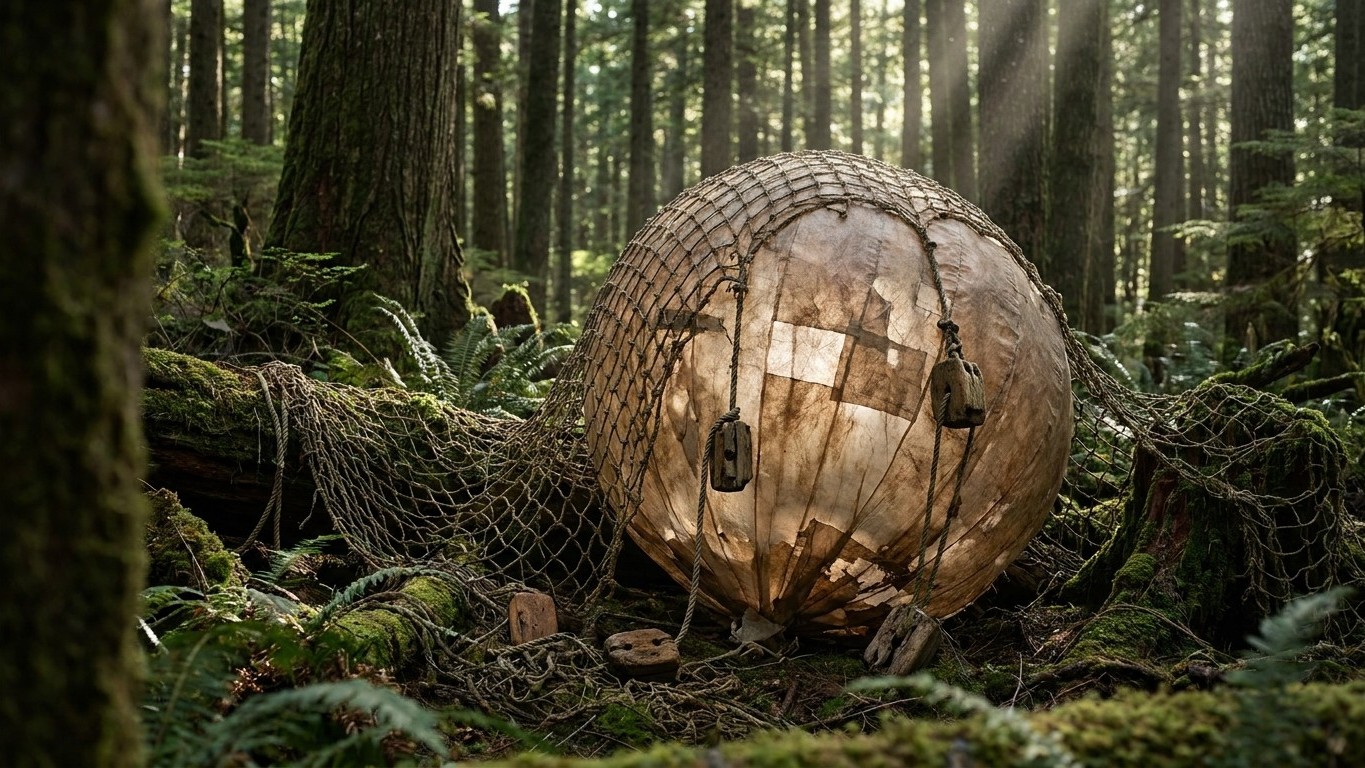
Nine thousand three hundred. That is the number of balloons released by the Imperial Japanese Army toward the United States between November 1944 and April 1945, in the hope of sowing fire and panic across American soil. They carried no engines to propel them, no sails to steer them. What bore them aloft was a meteorological phenomenon newly identified at the time: the jet stream, that high‑altitude river of air blowing from west to east, capable of speeds over 250 km/h.
Key takeaways
- Why did a besieged nation entrust its hopes to mulberry paper balloons?
- How could an automatic altimeter system keep these weapons within an invisible air current?
- What military secret nearly neutralized this campaign, before the tragedy in Oregon?
A Wind Current as the Only Engine
Viewed from 2026, the idea may seem almost absurd, but it rested on solid science for its era. To reach a target more than 10,000 kilometers away, the balloons drifted within powerful upper‑air currents, known as jet streams, identified in the 1920s by Japanese meteorologist Ōishi Wasaburō. The Japanese high command, unable to strike the American continent by conventional air raids, turned to this invisible, free resource. Japan’s capacity to hit the American continent directly was severely limited: it lacked landing strips close enough to launch bombers even for a one‑way flight, and it could not afford another Pearl Harbor‑style assault.
The calculation was simple on paper: release a balloon from Honshu’s shores, let it rise above ten kilometers in altitude, and let it drift toward America in barely three days. In total, the Japanese launched 9,300 balloons between November 1944 and April 1945. An industrial-scale effort for a project that rested on a remarkably humble material.
Mulberry Paper and Sandbags
There was nothing high‑tech about the envelope itself. These unmanned gas balloons, called fūsen bakudan, were released from Honshu beaches and were made from mulberry paper (washi) bonded with konnyaku glue. A fragile material, handmade, yet tight enough to hold hydrogen across thousands of kilometers. The balloons measured ten meters in diameter and carried 540 cubic meters of hydrogen.
The real technical tour de force lay elsewhere: in the ballast system. A balloon that cools at night loses altitude and exits the life‑sustaining jet stream. The engineers designed an automatic mechanism that used an altimeter to trigger the release of sandbags whenever the balloon descended below a critical altitude; once all the ballast was jettisoned, each craft released its bombs and then self‑destructed. A precarious, clockwork arrangement, but it worked more often than one might expect. Each balloon carried a deadly payload: typically either a 33‑pound high‑explosive bomb, or a 26‑pound incendiary device accompanied by explosive charges.
Of the 9,300 launched, only a fraction truly crossed the ocean. To this day, about 300 of these aging weapons have been found, scattered from Alaska and California to the Canadian prairies, and as far inland as Michigan. Most fell into winter‑soaked forests, unable to ignite a blaze. The project, militarily speaking, was an almost complete failure.
Bly, Oregon: The Only Lethal Assault on the Continent
Almost complete. The one remaining piece was Bly. On Saturday, May 5, 1945, Reverend Archie Mitchell, his wife Elsie, who was pregnant, and five children from his Sunday school went on a picnic near Leonard Creek on the wooded slopes of Gearhart Mountain. The group spotted a strange object hidden in the brush, a large deflated balloon. A child called out to the pastor. According to Mitchell’s account, he moved closer to inspect it, standing about forty meters away when the object exploded, killing the entire group on the spot.
Six deaths in a few seconds: Elsie Mitchell and five teenagers aged eleven to fourteen. They remain to this day the only victims of an enemy attack on the continental United States during World War II. A figure small in the grand scope of the war, yet the scene is all the more haunting: these children did not die in a classic bombing, but from an object that came from the sky, propelled toward them by a simple air current, with no Japanese pilot or gunner aiming at anything specific.
The Silence That Disarmed the Weapon
The paradox of this story is that American censorship probably saved lives before it cost them. U.S. authorities imposed an almost total information blackout about the balloons; hearing of no successes, the Japanese commanders concluded the weapon had failed and shut the program in April 1945. The silence had quietly disarmed it. Yet that same silence deprived the public of any landmarks: the blackout that had blunted the campaign meant ordinary Americans knew nothing of these devices, so a group of children playing in Oregon’s woods had no reason to suspect them.
After the tragedy, the army mobilized an unlikely unit to hunt down the unexploded devices: on May 5, 1945, the 555th Parachute Infantry Battalion, an African‑American unit, received orders to report to Pendleton Air Base for a classified mission named Operation Firefly, tasked with fighting forest fires sparked by the Japanese incendiaries. These paratroopers had to learn to jump in dense forests, becoming the country’s first airborne firefighters, just months before the war’s officially declared end in the Pacific. Even today, dozens of Fu-Go balloons are still buried somewhere between Alaska and Michigan, their mulberry paper long since vanished, but their metal charges still theoretically capable of firing a payload.
Sources: citizenside.fr | migflug.com
