
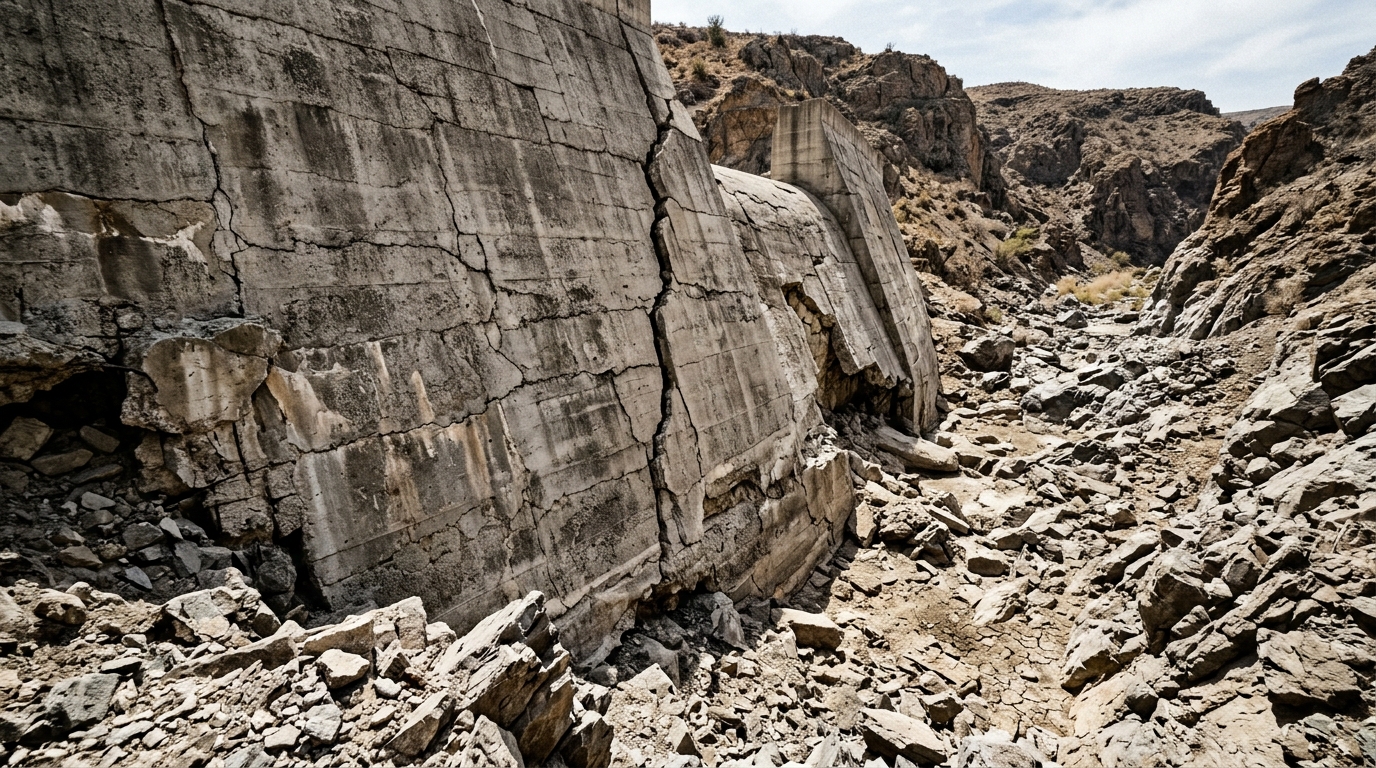
A titanic construction project, a water storage facility meant to irrigate Tarn’s farmlands, and yet not a single drop ever stored behind its concrete walls. This paradox captures, in essence, one of the most emblematic dossiers in the management of major public works in France. This dam, whose name had graced national headlines years ago, now appears set to meet an unusual fate: its demolition, paid for by local taxpayers, after it had already cost a fortune without ever fulfilling its primary function. This piece looks back on a case that perfectly illustrates the drift that can occur when infrastructure projects are launched without sufficient consultation or rigorous risk assessment.
- The Sivens Dam, built for 8.4 million euros, never stored water after work was suspended due to environmental and social opposition.
- The court ruled: the structure must be demolished at the department of Tarn’s expense, effectively making local taxpayers pay a second time.
- This case, spanning more than a decade, highlights failures in consultation and risk assessment when launching large public infrastructure projects.
- A dam costing 8.4 million euros that has never served any purpose
- How the Sivens project turned into a financial abyss
- The court’s ruling: demolition mandatory at the department’s expense
- What this failure reveals about the management of large public projects
A dam costing 8.4 million euros that has never served any purpose
Imagine a hydraulic infrastructure designed to retain the water of a river, intended to supply nearby farms with water during drought periods. On paper, the idea seems virtuous. In practice, this Tarn project, known as the Sivens dam, never achieved its objective. Despite a colossal investment of 8.4 million euros drawn from public funds, the structure stayed empty, unable to fulfill its storage function for which it had been conceived.
That figure alone is dizzying. It corresponds to years of preparatory work, technical studies, earthworks, and construction, for a final result that resembles more of an abandoned industrial site than a functional monumental work. The contrast between the initial ambition and the field reality is striking, and it has fed the controversy since the project began.
How the Sivens project turned into a financial abyss
Originally, the project aimed to address a real problem in Tarn: ensuring a sufficient water supply for agricultural irrigation, especially during the summer months when rivers struggle to meet all needs. But opposition quickly grew. Environmental advocates highlighted the ecological consequences of the chantier on a valuable wetland, while local tensions erupted into confrontations of unusual intensity for a regional irrigation project.
These mobilizations, widely echoed at the national level, eventually forced the authorities to suspend works before the structure could even be put into service. The result: a completed yet unutilized asset, left to deteriorate for years. Public money already spent thus served no tangible purpose, beyond fueling debates over the relevance of major infrastructure projects launched without proper anticipation of social and environmental risks.
The court’s verdict: demolition required at the department’s expense
After years of uncertainty and stalemate, the case was resolved by a judicial decision. The ruling is unequivocal: the dam must be demolished, and this operation will be funded by the Tarn department, hence ultimately by local taxpayers. A double penalty for the region’s residents, who will have paid twice for a structure that never served its purpose: first for its construction, then for its destruction.
This judicial outcome brings to an end a saga that lasted more than a decade. It also underscores that public infrastructures, once built, cannot always be kept as they are when their legality or relevance is questioned. Deconstruction itself represents an additional cost, which will be added to the already staggering bill incurred since the project began.
What this failure reveals about the management of large public projects
Beyond the Sivens case, this affair raises a broader question about how major development projects are conceived, financed, and assessed upstream. Far too often, environmental and social impact studies seem to have been insufficiently considered, or at least inadequately prepared against the scale of opposition they could generate. The result is an evident waste of public resources, in a context where every euro spent should, in principle, respond to a clearly identified and validated need.
This type of dossier also illustrates the difficulty for local authorities in reconciling economic development with the preservation of ecosystems. Wetlands, in particular, play a crucial role in regulating water cycles and protecting local biodiversity, a challenge that grows in importance as drought episodes increase across France. The lesson from this Tarn episode goes well beyond the local context: it invites a reevaluation of consultation and assessment methods before launching any large-scale project.
This Tarn affair will likely remain in memory as the emblematic example of a project whose original ambition utterly escaped its designers. Between the millions spent, the human and environmental tensions, and the final demolition forced by justice, the Sivens dam embodies the limits of a public administration sometimes disconnected from the realities on the ground. It remains to be seen whether this example will serve as a safeguard for decision-makers in the future when faced with similar choices.
