
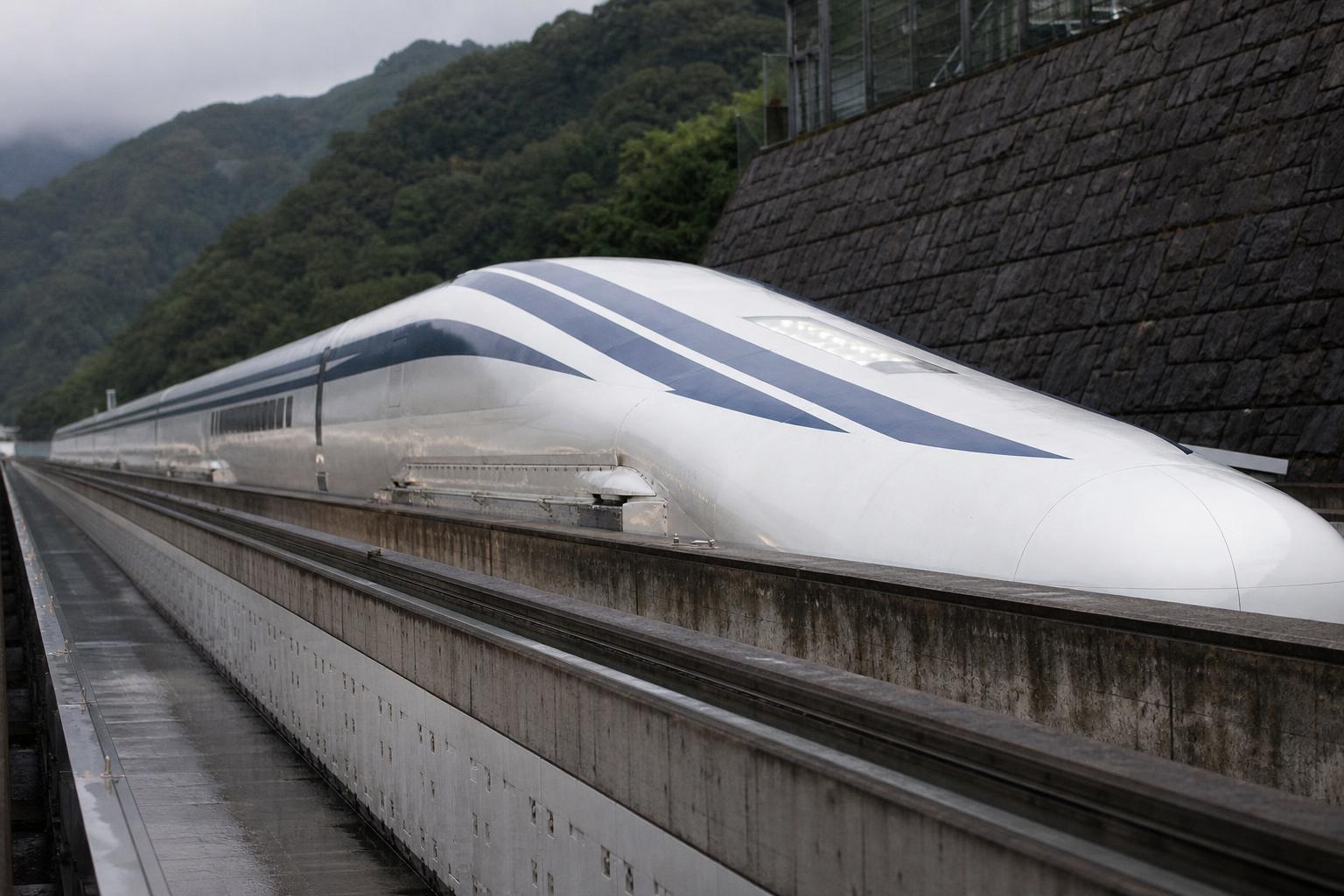
Japan’s next leap in rail is no longer a sketch on a whiteboard; it’s a humming, low-slung arrow already eating up test tracks at nearly 375 mph. The train doesn’t just go fast — it floats, silently, on a magnetic cushion that makes steel wheels feel quaint. For short and medium routes, that kind of speed turns airports into detours, not gateways. As one tester put it, “when the train lifts, you feel the weight of time lift with it.”
How the floating trick actually works
Under the skin, the technology is elegantly brutal: superconducting magnets lock onto coils in a specially built guideway. At low speeds it rolls like a classic train, but pass a threshold and the body levitates, trimming friction to almost nothing. The gap is small — roughly a finger’s width — yet the stability is rock-solid. With drag mostly gone, acceleration feels linear, not frantic, as the cabin glides toward extreme velocity. Engineers call this marriage of magnets and concrete “controlled flight on rails.”
Why short flights should start to sweat
Door to door, city-center rail can crush short-haul aviation, even if a jet’s peak speed is higher. You skip remote terminals, lengthy security, and taxi times that burn precious minutes. At these velocities, a 200–350 mile corridor flips from “maybe fly” to “definitely train” for most travelers. “It isn’t just speed,” one planner said, “it’s the way speed meets proximity.” When both stations are central, the clock tilts decisively toward rails.
The ride you actually feel
Inside, the experience is oddly calm, more hush than howl. There’s a faint, aerodynamic sigh, but little rumble, little clatter — because there’s almost no direct contact. Acceleration is smooth, like a plane climbing without the engine roar, and curves feel measured, not mischievous. Designers talk about “quiet speed,” backing it with wider aisles, big windows, and luggage flows that actually flow. “You sense motion,” a test rider noted, “but not the struggle against the rails.”
The engineering race behind the curtain
To run at these speeds, the guideway must be exact, with tolerances that border on the surgical. Japan’s seismic reality adds layers of redundancy, from active monitoring to power and braking backups. Aerodynamics matter, too: pressure waves in tunnels can thump like drums unless carefully tamed. The train’s nose is sculpted to knife through air and manage microbursts that bash eardrums. Every kilowatt and kilogram is counted like a line of code under deadline.
Costs, constraints, and the long game
There’s no dodging the bill: dedicated maglev corridors are expensive, with tunneling that reads like fantasy until the invoices land. Land acquisition is politically fraught, and construction timelines stretch beyond a single election. Energy use per passenger can be competitive — especially against short-haul flights — but only when trains run full. Still, durability and throughput can pay back in decades, not quarters, especially where demand is already dense. The calculus is national, not quarterly, and that changes what “worth it” means.
What this unlocks for travelers
For business trips that devour mornings, same-day returns become casually possible. University towns, research parks, and regional hubs knit into a single commute, not a fragmented odyssey. Tourism shifts, too, because “two cities in a day” stops sounding like a brag and starts sounding normal. And with trains powered by a greening grid, the climate ledger tilts toward steel, not kerosene.
- Faster door-to-door times on regional corridors where airport time is the real tax
- High capacity in busy corridors, easing runway and highway bottlenecks
- Quieter, smoother rides that reduce travel fatigue and raise on-board productivity
- Potential to shift short hops from sky to rails, cutting per-trip emissions
Beating planes isn’t the only story
Speed is thrilling, but reliability is the quiet revolution, the thing that makes plans feel solid. With minute-level punctuality, meetings can start earlier, wrap faster, and skip the “just in case” buffer. Freight-like punctuality for humans sounds banal, but it’s how economies breathe easier. “Time is the scarcest infrastructure,” one analyst noted, “and this is a way to build more.”
The export question
Could this model jump oceans to knit together other fast-growing corridors? Technically, yes; politically, it’s always complicated. Rights-of-way, geology, permitting — they’re local, stubborn, and slow. Yet every finished segment becomes a living demo, not a glossy render. In transit, proof wins more friends than pitch, especially when riders can try the future and then go get lunch.
Japan’s bet is simple and bold: if travel must be fast, let it also be near. Put the terminal where lives are already lived, and make the arrival feel like a continuation, not a reset. The machine that floats is really a machine for time, turning scattered hours back into something you can actually spend.
