
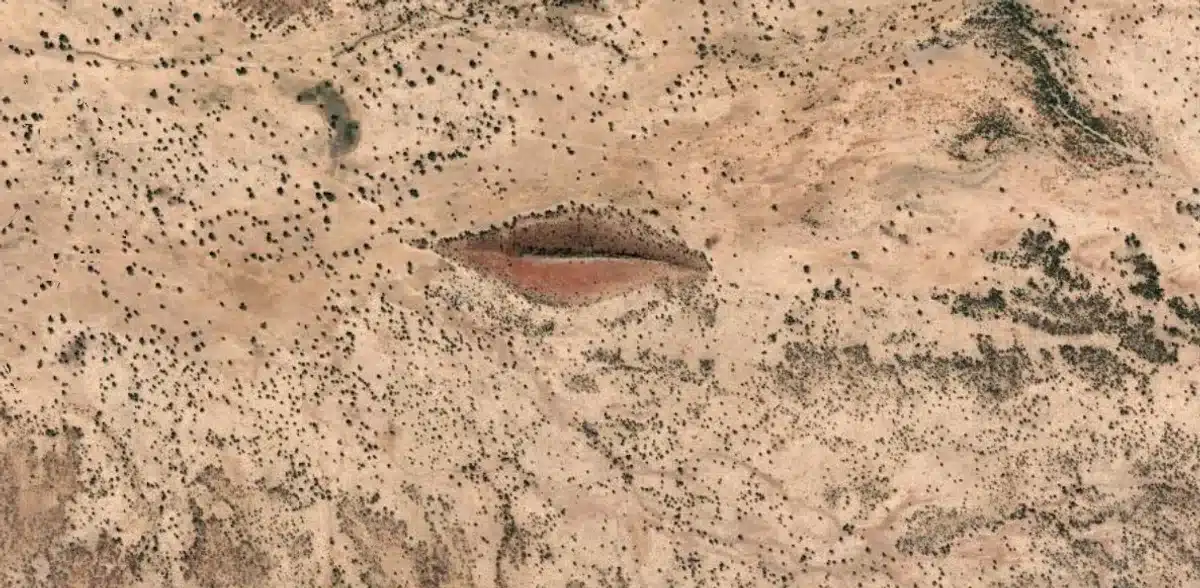
The Sahara desert loves playing with our senses. After the famous “Eye of the Sahara” in Mauritania, another geological curiosity captivates Internet users on Google Earth. Venturing into the remote reaches of western Darfur, in Sudan, satellite images reveal a rock formation that bears a troubling resemblance to a pair of pinched human lips. Dubbed the “Enclaved Lips,” this one-kilometer-long formation results from a perfect alchemy between prehistoric volcanic eruptions, wind erosion, and a brain mechanism inherited from our evolution.
What you will learn
-
How a vertical volcanic dyke shaped the relief of this giant mouth.
-
Why the human brain is wired to see faces everywhere (pareidolia).
-
Why it is impossible to photograph this formation from the ground today.
Anatomy of a Stone Kiss: the “Toothpaste Tube” Effect
Measuring just under a kilometer in length and about 350 meters wide, this formation is clearly not human. The optical illusion is produced by an oval hillside flank topped by a sharp central crest that perfectly delineates the junction between the two lips.
The relief results from a precise geological process:
-
Magmatic intrusion: Millions of years ago, molten magma from deep within the Earth percolated vertically through a crack in the surface rock, much like paste being squeezed from a toothpaste tube.
-
The creation of a dyke: As it solidified, this lava vein formed a dyke (an ultra-hard magmatic rock vein inserted vertically into a softer sedimentary layer).
-
Differential erosion: Over millennia, the harsh Sahara winds swept away the surrounding soft hill. The harder, more resistant rock vein remained intact, creating the central raised ridge that gives the site its full relief.
Pareidolia: a survival heritage etched into our DNA
If our brain immediately identifies a human mouth when viewing this hill, it is due to a universal psychological phenomenon called pareidolia. It is the natural tendency of the brain to structure its environment by spotting familiar shapes—especially faces—in entirely random arrangements (such as Jesus’ face on a piece of toast or animal shapes in clouds).
Neuroscientists suspect that pareidolia is a direct legacy of evolution. In prehistoric times, the ability for a hominin to instantly recognize two eyes and a mouth at a distance, even camouflaged in tall grasses, could mean life or death when facing a predator or an enemy tribe. Our brain thus developed an over-sensitivity to facial patterns, even if that means seeing them in rocks.
A Geological Wonder Trapped by War
Although the most spectacular satellite images of this formation date back to 2006 (when an extreme drought intensified the relief contrast against the flat ground), the site remains today a blind spot in field science.
Located in western Darfur, near the borders with Chad and the Central African Republic, the site sits at the heart of a major armed conflict zone. Since the onset of the Sudanese civil war in 2023, the region has suffered a dramatic humanitarian crisis and extreme political violence.
Because of this grim geopolitical context, no scientific expedition has been able to study the hill from the ground, and there is no ground-level photograph of the structure. In any case, geologists remind us that the magic of the “Enclaved Lips” operates only from space: from ground level, this marvel likely looks like a perfectly ordinary hill of rocks.
👉 A small gesture for Space Group? Follow us on Google, add us to your bookmarks, and find us on Google News so you won’t miss any discoveries.
