
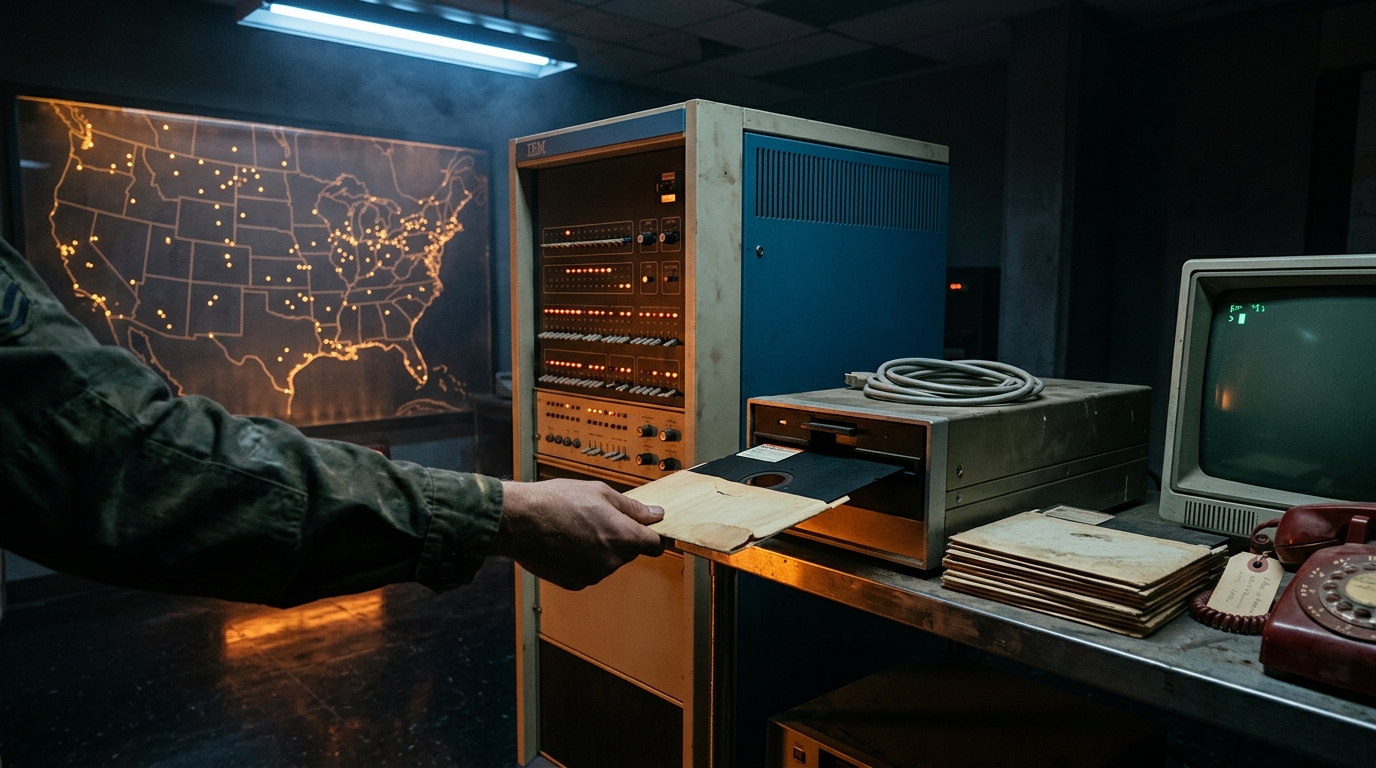
People often imagine the American nuclear arsenal steered by science-fiction-worthy supercomputers, bristling with the latest processors. The reality is quite different: until 2019, the Pentagon coordinated its nuclear forces with an IBM computer dating from 1976 that still read 8-inch floppy disks. That temporal gap is truly surprising.
- Until 2019, the Pentagon relied on a 1976 IBM Series/1 computer to coordinate its nuclear forces through the SACCS system.
- A Government Accountability Office report published in 2016 revealed this obsolescence, while underscoring the security advantage of being offline from the internet.
- The replacement of the system with a secure semiconductor storage solution was realized in June 2019, at an estimated cost of $60 million.
- A 40-year-old system, guardian of the world’s most powerful weapon
- Why 8-inch floppy disks survived five decades of technological progress
- 2019, the year the Pentagon finally said goodbye to floppy disks
A 40-year-old system, guardian of the world’s most powerful weapon
Hard to believe, yet the fact is laid out plainly in an official report. The Government Accountability Office, the American equivalent of our Court of Auditors, published in May 2016 a document that stirred notable discussion among specialists. It reveals that the Pentagon’s command-and-control system ran on an IBM Series/1 computer, a machine designed in the 1970s and commercially released in 1976.
This apparatus bears a long military-sounding designation: the Strategic Automated Command and Control System, or SACCS for insiders. Its role is far from superficial since it coordinates the operational functions of all American nuclear forces. Intercontinental ballistic missiles, strategic bombers, tanker aircraft: the entire fleet relies on this infrastructure to receive and transmit urgent-action messages.
In other words, if a command were issued regarding the most destructive weapon ever crafted by humanity, it would pass through a machine older than most readers’ parents. A striking paradox when one considers that our smartphones today boast computational power far in excess of this venerable IBM.
Why eight-inch floppy disks survived five decades of technological progress
The question naturally arises: how could such an anachronism persist for so long at the heart of a strategic institution like the Pentagon? The answer lies in a single sentence spoken by the institution’s spokesperson, Lieutenant Colonel Valerie Henderson, to AFP. According to her, the system remains in service because, in short, “it still works.”
That pragmatic logic conceals a more troubling reality highlighted by the GAO report: replacement parts for this hardware have become exceedingly hard to come by, as the technology has been obsolete for years. Picture trying to repair an old car whose manufacturer stopped producing spare parts thirty years ago. That was the predicament facing the technicians tasked with keeping SACCS operational.
It’s worth noting that the mere existence of these eight-inch floppy disks wasn’t entirely unknown to the public. A 2014 segment of the American TV program 60 Minutes had already shed light on this technological curiosity, two years before the government report officially confirmed the facts. By way of reminder, these storage media, distant ancestors of today’s USB drives, could hold barely 80 kilobytes of data—roughly the amount of a handful of photos on a modern smartphone.
Lieutenant Colonel Jason Rossi, who commanded the 595th Strategic Communications Squadron of the US Air Force, offered a telling perspective on this apparent technological weakness. In his words, such antiquity could be an asset for cybersecurity, because, as he put it, “you can’t hack something that doesn’t have an IP address.” A reminder that a system completely isolated from the internet automatically escapes an entire category of cyber threats.
2019, the year the Pentagon finally bid farewell to floppy disks
The GAO report did more than merely call out this oddity; it also urged urgent modernization. According to document GAO-16-468, the Pentagon planned to replace the entire system by the end of the 2020 fiscal year, with an estimated cost of $60 million. A first, more modest step was planned for earlier: Henderson noted that the floppy-disk readers would be replaced by Secure Digital devices, those familiar SD cards found in cameras, by the end of 2017.
In practice, the schedule was met, and even slightly ahead of the more pessimistic projections. The actual replacement of SACCS occurred in June 2019, when the antique disks gave way to a highly secure semiconductor-based digital storage solution. It was Jason Rossi himself who confirmed the transition, marking the end of an era for the American nuclear command.
This technological shift is not trivial for a system of such sensitivity. Moving from a forty-year-old mechanical medium to modern flash memory represents a leap in reliability and speed of data access. Yet, as the international press observed at the time, the story also underscored how slowly even the most powerful governments upgrade their critical infrastructures.
Ultimately, this anecdote goes beyond mere tech folklore. It reminds us that between proven reliability and the need for modernization, choices are rarely as simple as they appear, especially when it concerns the world’s most sensitive arsenal. The eight-inch floppy disks of SACCS will likely remain, for some time to come, one of the most telling illustrations of the gap between past and present within military institutions.
