
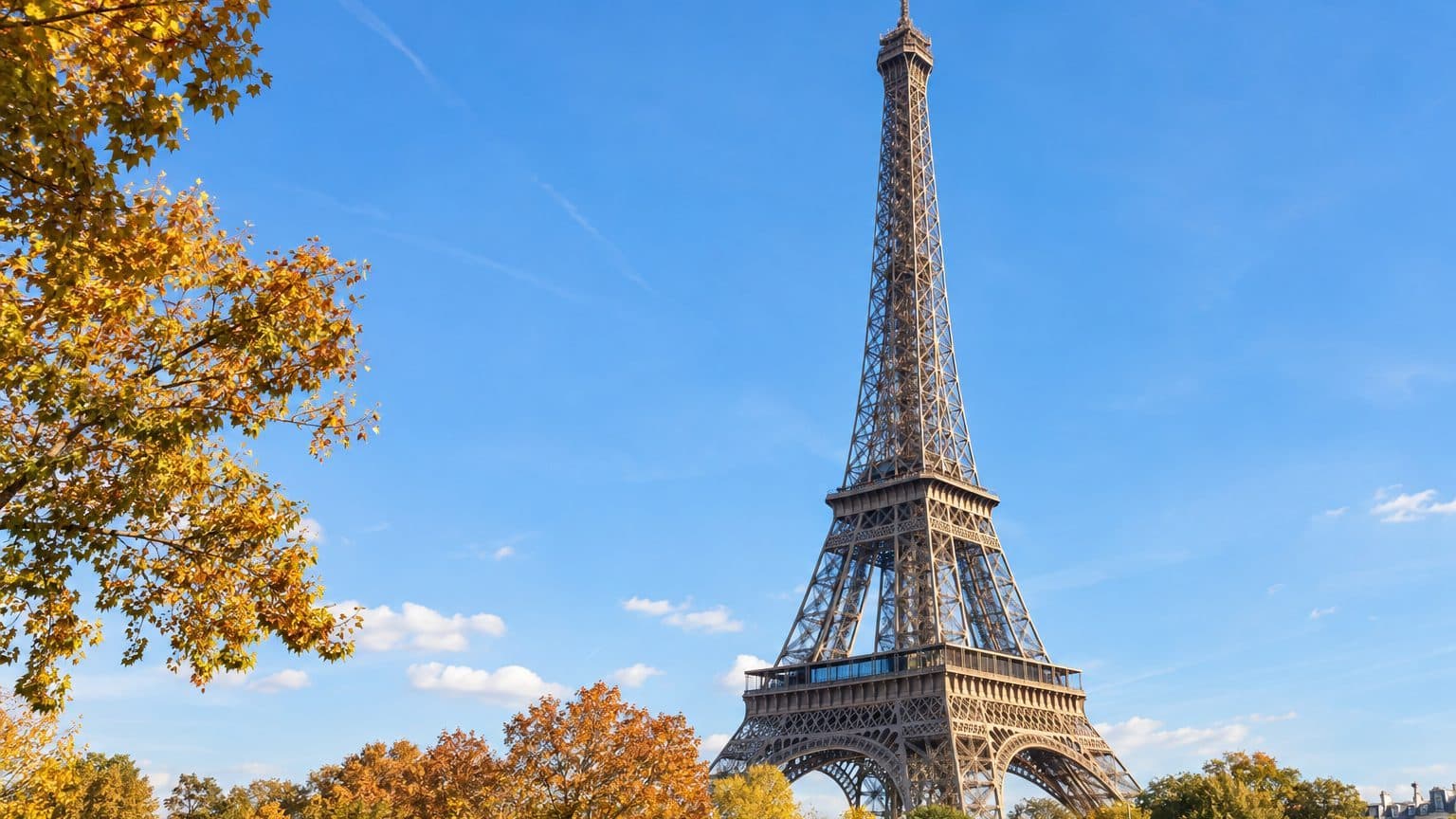
On December 26, 1999, gusts reached 214 km/h at the top of the Eiffel Tower. According to the monument’s official site, the summit swayed by 9 cm. A windless summer day, the same summit can move by 19 cm.
The sun thus moves the tower twice as much as that storm.
- The summit of the tower swayed by 9 cm during the December 1999 storm.
- On a windless summer day, the summit can move by 19 cm.
- The tower’s iron heats to 60–70 °C and tilts as it moves away from the sun.
- The tower returns to its original position at night.
9 cm at 214 km/h: the tally of a stormy night
On a windy evening, television news outlets cut to images of the tower, and along the bridges of the Seine, passersby pull up their collars to watch it. The December 1999 event was noteworthy: 214 km/h measured at the top of the monument, well above the 130 km/h allowed on highways. One would expect the summit to swing like a ship’s mast. The official reading of December 26, 1999, however, reports 9 cm of oscillation, not one centimeter more.
Some sources, including RTL, put the figure at 13 cm for that day. The figure retained here is the official site’s, 9 cm, barely more than the width of a hand.
This motion is the one the public naturally imagines. A gust pushes, the structure bends, then it returns. But it isn’t the only displacement record.
19 cm without a gust: the summit that flees the sun
The mechanism can be summed up in one sentence: the iron heats up, so it lengthens. The sunlit face lengthens more than the shaded one, and the tower twists. Historian and architect Bertrand Lemoine explained it on Europe 1: it curves slightly, as if it wanted to move away from the star.
The tower’s official account, cited by RTL, uses a similar expression: the summit “flees the sun.” It can thus shift up to 19 cm. Since the sun moves across the sky, the illuminated face changes over the hours, and the curvature follows the movement. The summit therefore traces a curve throughout the day, slow and without abruptness, which Bertrand Lemoine describes as imperceptible and progressive.
At night, it returns to its initial position.
In the heatwave of late June 2025, Le Parisien mentioned about 20 cm of movement on a hot day. The difference with RTL’s 19 cm is probably due to rounding, since the order of magnitude remains the same across sources.
Metal at 60 °C and a shorter tower in winter
Why does a ferrous monument react so much? Because its metal withstands temperatures much higher than the air. According to a calculation by The Conversation, picked up by the Swiss magazine Batimag, the tower’s iron can reach 60 to 70 °C when exposed to full sun. Its coefficient of thermal expansion is about 12 millionths of a meter per meter per degree. A 300 m beam could theoretically lengthen by 36 cm for a 100 °C difference, but the structure does not heat uniformly, which limits the actual effect.
This uneven heating explains why the tower does not simply grow taller: it tilts. The same calculation yields a dilation of 12 to 15 cm in hot seasons, with the summit slightly offset from the sun. Figures vary from one article to another, but the mechanism remains the same.
The phenomenon also has a seasonal aspect. In winter, the tower can lose up to about ten centimeters, according to Le Parisien. Between a scorching day and a frosty morning, the Parisian silhouette thus does not have exactly the same height.
Let’s put the magnitudes side by side. The worst storm cited here produced 9 cm of oscillation, an ordinary hot summer day yields 19 cm, and the cold season removes about ten centimeters of height. Wind acts in gusts, seconds at a time. The sun, by contrast, works for hours, face after face, on several hundred tons of metal.
The next time a weather bulletin announces a heatwave, the figure to remember should be the thermometer reading, not the anemometer. One caveat: these 19 or 20 cm are measurements of the summit, taken from one position to another, and RTL as well as Le Parisien remind that the tower returns to its starting position once night falls.
Sources: europe1.fr | letribunaldunet.fr
