
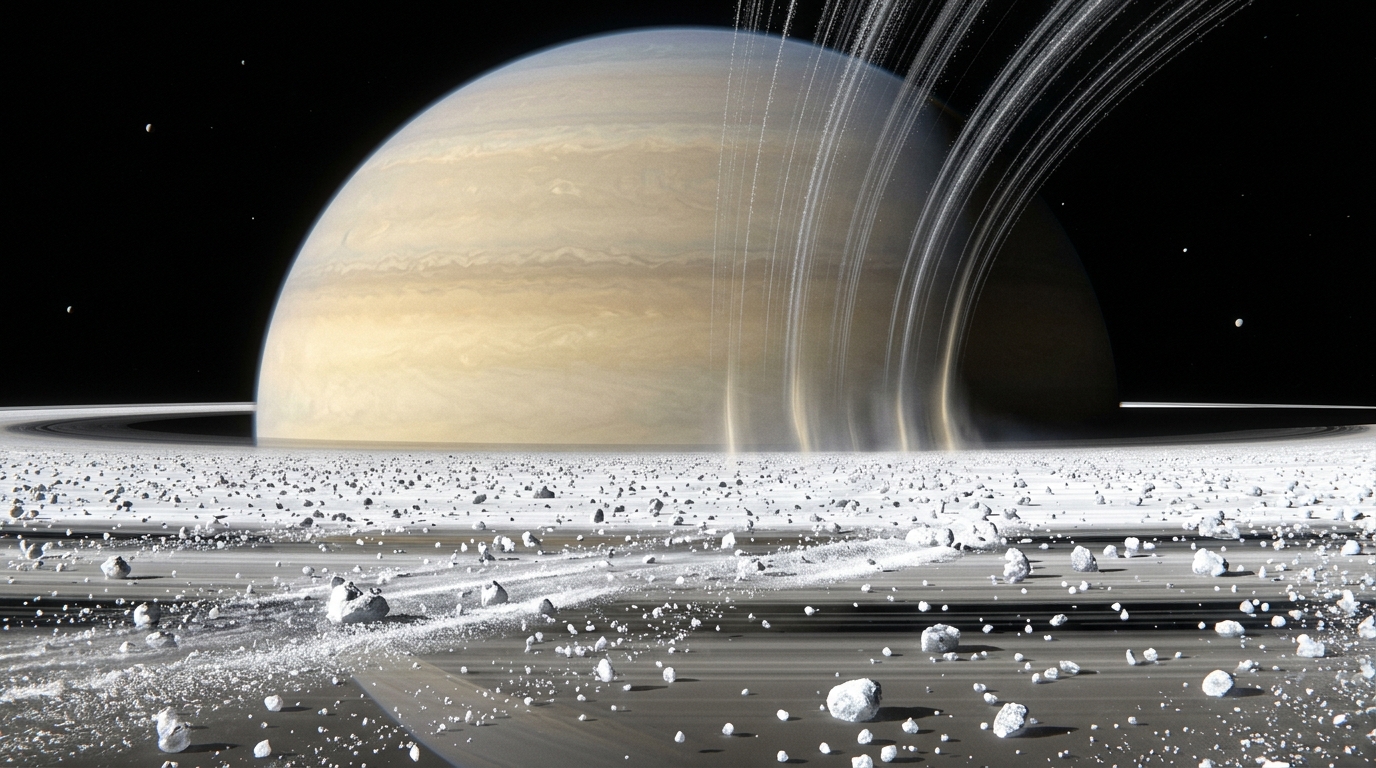
Before worrying, let’s be clear about one thing: no, Saturn’s rings aren’t going to disappear tomorrow morning. But the countdown has indeed begun. According to NASA, this photogenic ice adornment is literally draining into the planet’s atmosphere, at a rate that finally gives it an expiration date.
- The “ring rain” drops toward Saturn the equivalent of an Olympic-sized swimming pool of ice every half hour, i.e., between 432 and 2,870 kilograms per second.
- By combining this erosion with data from the Cassini probe, scientists estimate less than 100 million years remain before the rings disappear completely.
- Not to be confused with this slow physical erosion, the rings also become temporarily invisible from Earth about every 15 years, when viewed exactly edge-on.
- A rain of ice that engulfs Saturn live
- 100 to 300 million years: the countdown revealed by Cassini
- Why the rings seem eternal even as they languish
A rain of ice that engulfs Saturn live
The phenomenon has a nearly poetic name: the ring rain, or annular rain. Behind this image lies a real mechanism, confirmed by NASA. Saturn’s gravity draws the ice particles that make up its rings toward the planet, while its magnetic field guides a portion of the charged particles toward the atmosphere.
James O’Donoghue, a researcher at NASA’s Goddard Space Flight Center, tried to give a concrete image to this otherwise abstract phenomenon. His estimate is dizzying: the equivalent of an Olympic-sized pool of water falls from the rings toward Saturn every half hour.
Concretely, the estimated mass flux ranges from 432 to 2,870 kilograms per second. A broad range, but it gives a measure of a continuous phenomenon, invisible to the naked eye, and yet already well underway. The rings, made up of 98% ice, have been quietly eroding for millions of years.
100 à 300 millions d’années : le compte à rebours révélé par Cassini
It was in the journal Icarus that James O’Donoghue and his colleagues published their results, in 2018. Based solely on ring rain, they calculated that it would take about 300 million years for the rings to disappear completely.
But this figure tells only part of the story. By adding the material from the rings detected directly by the Cassini probe, which also falls toward Saturn’s equator, the deadline tightens considerably. The system would therefore have less than 100 million years left before its total extinction.
Cassini’s final orbits, just before its plunge into the planet’s atmosphere, allowed refining the mass measurements of the rings. These data suggest an age of less than 100 million years, perhaps as young as 10 million years.
A 2023 study published in Science Advances, led by Sascha Kempf, adds to this picture. Using Cassini’s onboard cosmic dust analyzer, the team measured the influx of micrometeorites onto the rings. Result: an upper limit of a few hundred million years for their existence.
Pourquoi les anneaux semblent éternels alors qu’ils agonisent déjà
From a human lifespan, talking about millions of years almost amounts to eternity. That is the paradox: Saturn’s rings will continue to shine in our telescopes long after us, and yet their fate is already sealed.
To reach these conclusions, researchers combined several data sources. The Keck Observatory on the island of Hawaii provided precise observations of Saturn’s ionosphere, cross-referenced with the Voyager mission archives and Cassini’s thirteen years of data in orbit around the planet.
There is also another form of disappearance, purely optical, that has nothing to do with ring rain. About every 15 years, Saturn’s tilt places its rings exactly along the line of sight from Earth. When seen edge-on, they become almost invisible from our telescopes for the duration of that passage.
This transient eclipse is therefore not dramatic, unlike the slow gravitational erosion that truly gnaws away at the ring material. The two phenomena sometimes appear together in the news, which fuels confusion between a temporary optical disappearance and a physical, slower but definitive disappearance.
So Saturn still retains its rings for a long time, at least on the scale of our existence. But these data remind us of one essential truth: even the most spectacular structures in the Solar System are never fixed. They tell a story in motion, and the tale of the rings is slowly but surely approaching its final page.
