
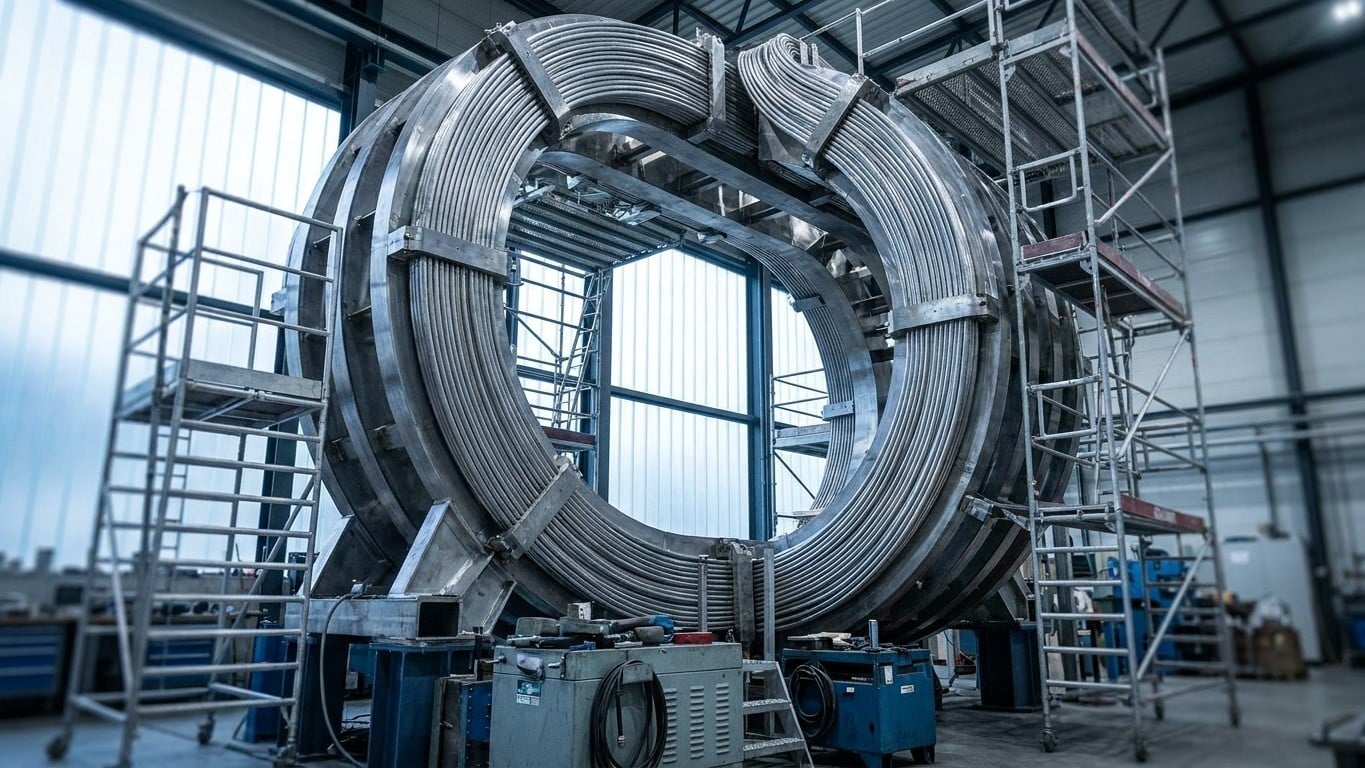
A steel ring of superconducting cables has just been successfully tested in Hefei, in eastern China, and it alone carries the hopes of an entire segment of fusion research. The Institute of Plasma Physics of the Chinese Academy of Sciences completed, at the end of June, the full tests of a toroidal magnet weighing 582 tonnes, a D-shaped structure measuring 21 meters in length and 12 meters in width, with about 1.3 times the volume and three times the stored energy of magnets comparable to those of the International Thermonuclear Experimental Reactor installed at Cadarache. Its destination: the heart of the BEST, the Burning Plasma Experimental Superconducting Tokamak, whose completion is planned for late 2027.
Key takeaways
- A Chinese coil three times more powerful than ITER has taken a decisive step
- The secret: cables cooled to -269°C to confine a plasma hotter than the Sun
- China aims for the world’s first fusion-powered electricity production, but not before 2030
A giant weighing about 300 Ford F-150 pickups and occupying two tennis courts
To grasp the scale of the object, you have to abandon conventional units. The coil amounts to roughly 300 Ford F-150 pickups melted into a single ring. It is destined to join fifteen identical companions one day: a researcher from ASIPP explained on Chinese television CCTV that sixteen of these coils will ultimately be assembled to form the full magnetic field, each carrying 100 kiloamperes and generating 6.5 teslas at its center. By comparison, a standard hospital MRI tops out around 1.5 tesla. The field targeted here surpasses that intensity by more than four times, on a structure as wide as a four-story building laid on its side.
The construction site is no accident. According to Song Yuntao, the director of the institute, the coil required six years of development and boasts the largest energy-storage capacity of its kind in the world, with a special steel, insulation, and superconducting cables entirely manufactured in China. A detail that matters in a sector where the supply chain has until now been limited to a handful of Western countries and Japan.
Why you must brush against absolute zero to tame a plasma
The physics behind this object rests on a simple constraint: no conventional conducting material can withstand such a strong magnetic field without melting under its own electrical resistance. A copper wire carrying a current of comparable magnitude would heat up in seconds, dissipating energy as heat instead of converting it into a magnetic field. The solution, known since the 1980s but rarely deployed at this scale, is to cool the cables to around -269 degrees Celsius, in contact with liquid helium. At that temperature, some alloys lose all electrical resistance: the current flows without loss, indefinitely, and can reach extreme intensities without generating parasitic heat.
It is this principle that allows the coil to generate a magnetic field powerful enough to levitate a plasma without ever letting it touch the reactor walls. The plasma, heated to about 150 million degrees, is hotter than the Sun’s core itself. No physical wall could contain it; it would vaporize instantly. The magnetic field then acts as an invisible cage, a contactless mold shaping the cloud of charged particles into a stable torus. The magnetic cloud thus confines matter several times hotter than the Sun’s core, without any physical contact being needed.
What a threefold higher stored energy changes
Storing three times as much energy as ITER in a volume only slightly larger is not merely an industrial feat of strength. The more magnetic energy a coil stores, the more stable the field it produces and the better it can resist the instabilities of the plasma—these small perturbations that, in fusion, can rapidly degenerate into a loss of confinement. A poorly contained plasma does not merely cool; it can literally crash into the walls within a few milliseconds, a dreaded phenomenon known as a disruption. A deeper reservoir of magnetic energy thus provides extra room to absorb disturbances without losing confinement, a crucial parameter when the ultimate goal is to operate a plasma continuously, not just for a few seconds.
This robustness gain is accompanied by an equally significant economic advance. The team responsible for the central coil, engaged for six years to reconcile performance and cost, has overcome more than ten key technologies and slashed the price of high‑temperature superconducting ribbon from 400 yuan to 100 yuan per meter, a fourfold reduction. An ostensibly technical detail, but one that conditions the economic viability of future commercial reactors: without affordable superconducting cables, no fusion plant will ever come to market at a reasonable cost.
BEST is not a power plant, but the ante-chamber to the electricity grid
We must guard against hype. This coil, as impressive as it is, does not generate any electricity by itself. The test did not involve power production; it confirmed the development and successful testing of reactor-scale components intended to sit between experimental plasma devices and future demonstration systems. An ASIPP official quoted by Global Times tempered the enthusiasm by noting that these tests represent about 80% of the task, with the full assembly of the machine and long-term endurance tests still to come.
Still, China’s timetable is laid out in black and white. The three-stage plan foresees completing BEST by the end of 2027, with fusion-based electricity production targeted around 2030, followed by a demonstration reactor intended to become the world’s first fusion power plant. BEST will therefore never be a commercial plant in the strict sense: it is the machine charged with proving, for the first time, that a burning plasma can truly drive a turbine and inject energy into the grid. A detail worth noting: China has invested at least $6.5 billion in fusion-related commercial projects between 2023 and September 2025, according to estimates from an American think tank specializing in technology policy. All of which serves to remind that this 582-ton coil is only one spectacular piece of a multi-decade industrial gamble.
Sources : autonocion.com | neimagazine.com
