
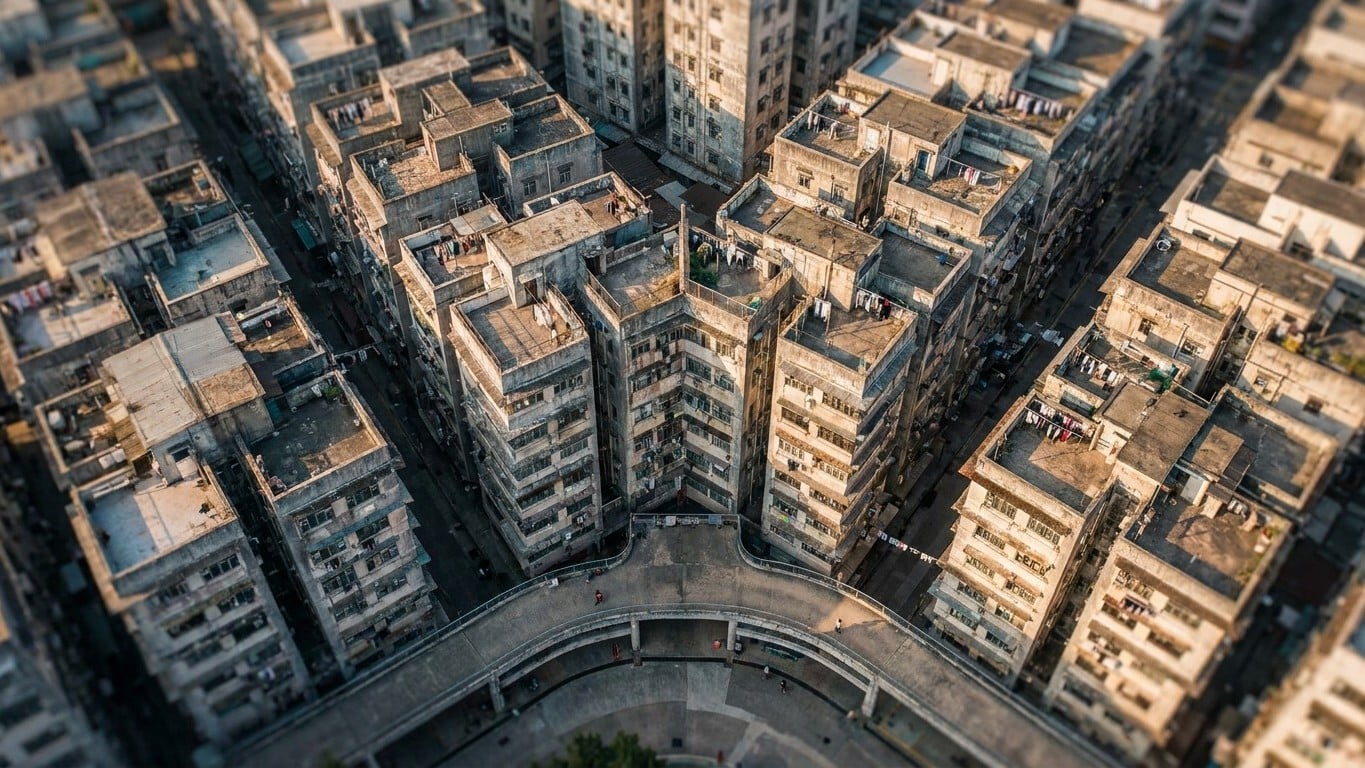
Two point six hectares. Barely the size of four football pitches laid side by side. And yet, at this precise spot in Hong Kong, as many as 33,000 people lived packed into 350 buildings that no architect, urban planner, or building inspector had ever signed off on. Welcome to Kowloon Walled City, the most densely populated place the world has ever known.
The story begins with a diplomatic misstep. When Britain secured the extension of its Hong Kong territory in 1898, the convention deliberately left out an old Chinese fort perched on the Kowloon Peninsula. The 1898 convention, which leased the New Territories to Britain, excluded the old Chinese fort, leaving a micro-territory claimed by two governments and governed by none. Beijing still regards this patch of land as Chinese. London, in practice, lets it drift outside its administration. Result: neither the Hong Kong colonial police nor the Chinese authorities ever truly set foot there for decades.
À retenir
- A diplomatic accident left a governmentless zone for nearly a century
- Without building permits, the structures stacked upon one another to stay upright
- Population density was thirty times that of Manila, the current largest megacity
A Legal Vacuum That Becomes a Permanent Construction Site
This no-man’s-land of administration first drew refugees fleeing China’s civil war, then grew relentlessly after the Japanese occupation. With no authority to issue building permits and no building code to observe, residents did what no one else would elsewhere: they stacked. With little real intrusion from lawmakers, elements such as housing and construction regulations were ignored, and developers continued adding new structures atop the old ones, wherever space allowed. The city thus expanded vertically, floor by floor, without any master plan guiding anything.
The result bordered on architectural absurdity. Buildings were so tightly packed that apartments often faced wall to wall, alleys were made as narrow as possible, and only two elevators served the entire city. Two elevators for tens of thousands of residents spread across thirteen- or fourteen-story towers. Some residences never saw daylight, trapped between neighboring structures that had, in effect, become their supporting neighbors.
For indeed, the paradox of Kowloon lay in this total anarchic system producing an involuntary structural coherence. Lacking solid individual foundations for each tower, the whole 350-building complex leaned on one another, forming a compact block that stood exactly because no single structure could bear the load alone. No engineering firm would have dared sign such a plan. And yet, it held.
1.2 Million Inhabitants per Square Kilometer
The numbers are dizzying. In 1987, roughly 33,000 people lived within just 2.6 hectares of interconnected buildings, yielding a population density of about 1,255,000 inhabitants per square kilometer. To grasp the scale: Manila, today’s densest megacity, tops out around 44,000 inhabitants per square kilometer. Kowloon housed almost thirty times that figure. Even the planet’s most overcrowded slums today, such as Dharavi in Mumbai, reach only a fraction of this level of human concentration.
This extreme proximity did not deter a vibrant social and economic life. Inside this concrete labyrinth, you could find dental clinics adjacent to restaurant kitchens, clandestine plastic workshops, mahjong parlors, and, more grimly, near-total control exerted by local triads. The trade in prohibited goods thrived, ranging from narcotics to dog meat, and from 1950 to 1970 the district was controlled by local triads, experiencing high rates of prostitution, gambling, and drug use. The absence of police did not signal an absence of power: it simply changed its face.
Demolition, Between Relief and Nostalgia
As the handover of Hong Kong to China approached, the enclave became a political headache for everyone. Neither London nor Beijing wanted to inherit—or leave behind—this symbol of urban anarchy. In January 1987, the British colonial government announced plans to demolish the fortified city, and after a difficult process of expulsion and the transfer of de jure sovereignty of the enclave from China to Britain, demolition began in March 1993 and ended in April 1994. Seven years elapsed between the announcement and the first bulldozer blade: time needed to census the residents, negotiate relocations, and compensate families sometimes centered there for three generations.
On these ruins, Hong Kong chose to plant a garden. Kowloon Walled City Park opened in December 1995 and now occupies the site of the former fortified city. The contrast could hardly be greater: where there were blind towers, there are now ponds and pavilions inspired by southern Chinese imperial gardens. The Yamen building was preserved and restored, offering visitors a glimpse of the physical appearance of the fortified city of yesteryear. Today it stands as the sole tangible remnant of one of the strangest places a modern city has ever housed.
There remains a difficult irony in this story: the landscape project that replaced Kowloon even earned an award at an international horticultural exhibition in Stuttgart, as if the void left by this extraordinary urban experiment had to be filled with the most meticulous order possible. Today, tourists strolling between the park’s ponds walk, often unknowingly, on the very foundations of one of humanity’s greatest unintended laboratories of spontaneous urbanism.
Sources: gohk.gov.hk | nationalgeographic.com
