
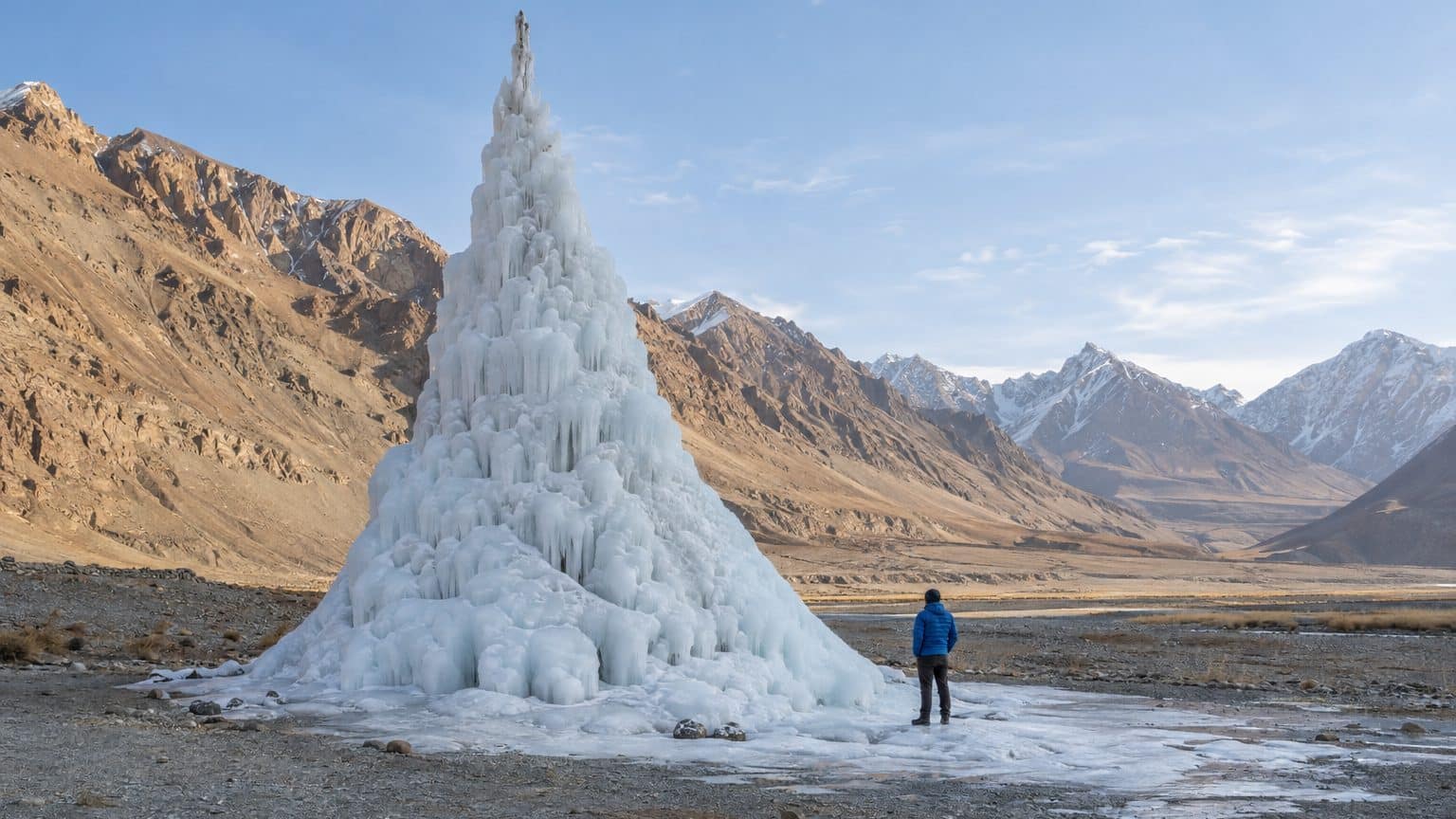
In Ladakh, engineers are hand-crafting glaciers, and the next ones are expected to reach heights of 30 to 40 meters. Each would store about 16,000 cubic meters of water, or 16 million liters, roughly the volume of six Olympic-sized swimming pools. This ambition stems from a far more modest trial conducted more than a decade ago on a high-altitude plateau.
The initial prototype did not exceed 6 meters in height.
- In Ladakh, winter water arrives when the crops do not yet need it.
- Sonam Wangchuk’s prototype stood about 6 meters tall and stored 150 m³ of water.
- A cone melts slower than a frozen pond because it exposes little surface to the sun.
- Subsequent projects aimed for heights of 30 to 40 meters and about 16,000 m³ each.
A Cold Desert Where Water Arrives at the Wrong Moment
The Ladakh region, in northern India, is a high-altitude cold desert. In spring, when farmers sow their crops, the streams run dry. The water, by contrast, flows during the winter, when no one needs it. This offset of a few months is enough to endanger entire harvests.
The idea of storing this winter water is not new to the region. Civil engineer Chewang Norphel popularized, starting in the late 1980s, terraced, artificial glaciers. These flat-ice reservoirs laid the groundwork, but their large surface areas leave them exposed to melting.
Sonam Wangchuk, a Ladakhi engineer, revisited the problem from a different angle: shape. In the winter of 2013-2014, he built a prototype of an “ice stupa,” an artificial glacier shaped like a cone. It is named after dome-shaped Buddhist monuments and measures about 6 meters in height, built in two levels. The site sits at roughly 3,200 meters above sea level.
A Water Jet Transformed into a Mountain by the Night
The principle is simple in a few steps. Water is collected upstream, then carried by a pipe from a point higher than the building site. Upon arrival, it is projected vertically. In the air of a winter night in Ladakh, the droplets freeze before hitting the ground and gradually pile up into a cone.
No ice-making machine participates in the freezing: the nighttime cold handles the process.
The prototype stored 150,000 liters, or 150 m³, enough to fill about 1,000 bathtubs. It melted five times more slowly than a frozen pond. The geometric reason is that a cone has a small surface area relative to its large ice volume. A pile of ice cubes melts faster than a single block of the same mass for the same reason, and this principle is extended upward in the cone.
This shape also offers a scaling advantage. Doubling the height of a cone increases its volume by a factor of eight, while its exposed surface grows only fourfold.
One caveat remains. Researchers who studied the region note that there are still missing comparative measurements of water production among the different types of artificial glaciers. Wangchuk regards his cone as more compact and durable than the ice terraces, but this superiority has not yet been quantified by these studies.
40 m and 16,000 m³: The Scale-Up Target
The next stupas were intended to change in dimension. The announced objective was a height of 30 to 40 meters, with around 16,000 m³ of water in each.
These figures are goals, not results. A cone of 40 meters would be roughly equivalent to a 13-story building, erected in a desert above 3,000 meters. Such height requires blasting the jet high into the air, and thus relies on an appropriate water supply.
The targeted volume is about 107 times that of the prototype.
Be mindful of units, often miscopied: 16,000 m³ equals 16 million liters, not “16,000 liters cubes.” As for the actual height reached by the later stupas, it is not established here: the 30 to 40 m figures describe what the builders aimed for, and the press mentions heights lower than anyone can verify from the data available.
👉 A small gesture for Space Group? Follow us on Google, add us to your bookmarks, and find us on Google News so you don’t miss any discoveries.
Sources: colorado.edu | qeprize.org | ceew.in
