
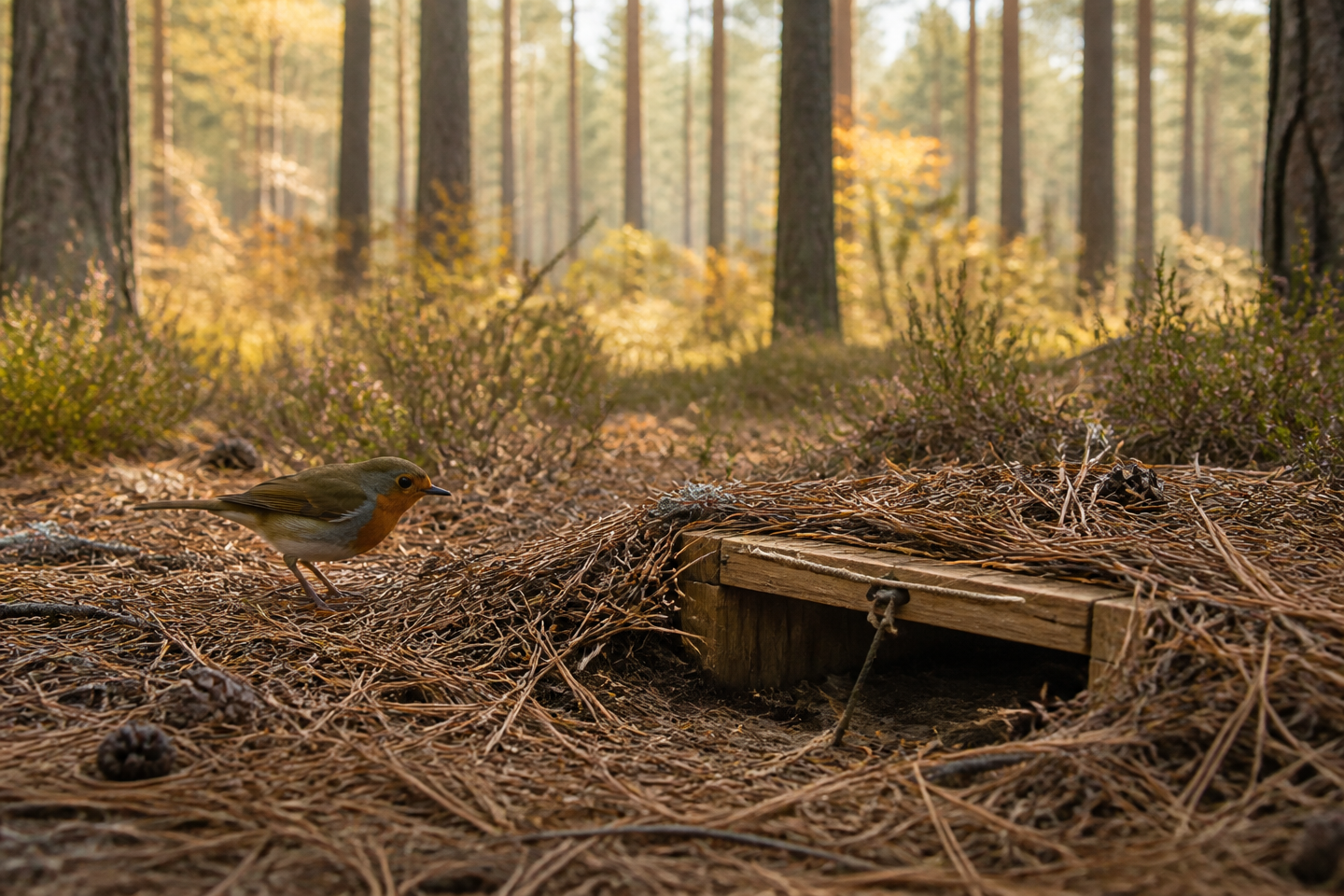
Each year, from mid-August to the end of September, the pine forests of the southern Landes become the scene of a silent, meticulous hunt. Wooden cages called matoles close around a tiny migratory bird, the ortolan bunting, whose weight hardly exceeds two sugar cubes. Officially protected for nearly thirty years, this animal continues to feed an illegal trade where every capture is negotiated at a premium. A practice that, according to conservation groups, could spell the final end of the species on French soil.
- Each autumn, 30,000 to 50,000 ortolan buntings are captured alive in cages called matoles, then fattened before being sold for between 100 and 150 euros each.
- Protected in France since 1999 and by a European directive since 1979, the species is effectively targeted by poaching tolerated in practice by the Landes prefectural authorities.
- The French population of ortolan buntings has fallen by more than 80% in forty years, threatening the species with disappearance from the territory.
- A trap three centuries old still active despite the ban
- Twenty grams of flesh that fetch a fortune on the black market
- Forty years of decline, a species at the brink of a point of no return
- Between Gascon tradition and ecological urgency, a conflict with no simple resolution
A trap three centuries old still active despite the ban
The matole has hardly changed since its invention. This rudimentary cage, placed on the ground in clearings and at the edge of pine forests, allows capturing the bird alive and intact, a necessary condition for the next step of fattening. The know‑how is passed from generation to generation in certain villages of southern Landes, between Mont-de-Marsan, Dax and Capbreton, an area that the League for the Protection of Birds regards as the historical heart of poaching, extending to the Gers region.
What makes this practice particularly hard to curb is its perfect synchronization with the species’ biological calendar. The ortolan bunting leaves northern Europe at the end of summer to reach sub-Saharan Africa, and its passage through southwestern France coincides precisely with the period when the traps are installed. Each autumn, 30,000 to 50,000 individuals end up trapped in this small slice of the national territory, a staggering figure given the fragility of the remaining populations.
Twenty grams of flesh that fetch a fortune on the black market
Once captured, the bird does not immediately end up on a plate. It is first fattened for several weeks out of the light, a method intended to artificially reproduce the fat accumulation the animal would perform naturally before its migration. This treatment, combined with a nearly mythical gastronomic reputation, allows each ortolan bunting to be sold for between 100 and 150 euros, a significant price for a passerine weighing barely twenty to twenty-five grams.
This culinary fantasy, sustained by almost ritualistic tasting narratives, largely explains the persistence of the poaching despite legal risks. Faced with this parallel economy, militants from Germany and Italy, members of the Committee Against Bird Slaughter, regularly roam the department to locate and dismantle the traps. Their presence, though symbolic, underscores how the fight against ortolan poaching has crossed borders to become a European concern.
Forty years of decline, a species at the brink of a point of no return
Behind the poaching figures lies a worrying demographic reality. In forty years, the French population of ortolan buntings has fallen by more than 80%, a dramatic drop for a species that recently still numbered nearly five million pairs across Europe, all migrating each winter to Africa. Available demographic projections leave little doubt: if the harvests continue at the current pace, the species could simply vanish from the Landes landscapes in the near future.
The paradox is striking, because it is the very hunters who, in the end, would lose their activity if the population continued to dwindle. A bird that has become almost impossible to find cannot sustain indefinitely a tradition that rests entirely on its abundance. Of the 300,000 birds that pass through this southwest French migratory corridor each year, a growing share will never reach the African shores.
Between Gascon tradition and ecological urgency, a conflict with no simple resolution
Yet the European directive on the conservation of wild birds has protected the ortolan bunting since 1979. France, long reluctant, refused for years to place the species on its national list of protected species, before finally doing so in 1999. But this legal victory quickly turned into de facto tolerance, with the Landes prefectural authorities turning a blind eye to a practice anchored in local identity. The European Commission, fed up with this inertia, even filed a case before the Court of Justice of the European Union in 2016, without the situation really changing on the ground.
Thus this dossier crystallizes a broader tension between preserving a local cultural heritage and the imperatives of biodiversity conservation. On one hand, families who perpetuate an ancestral gesture seen as part of Gascon identity; on the other, naturalists who warn of the urgency to act before it is too late. At the start of autumn, as the matoles close once again in the Landes pine forests, this clash between two visions of heritage hasn’t felt this difficult to resolve for a long time.
One question remains that goes far beyond Landes: how long can a tradition survive if the thing that sustains it disappears? As biodiversity quietly erodes elsewhere, the Ortolan bunting reminds us that some rituals, however ancient, can end up turning against themselves.
