
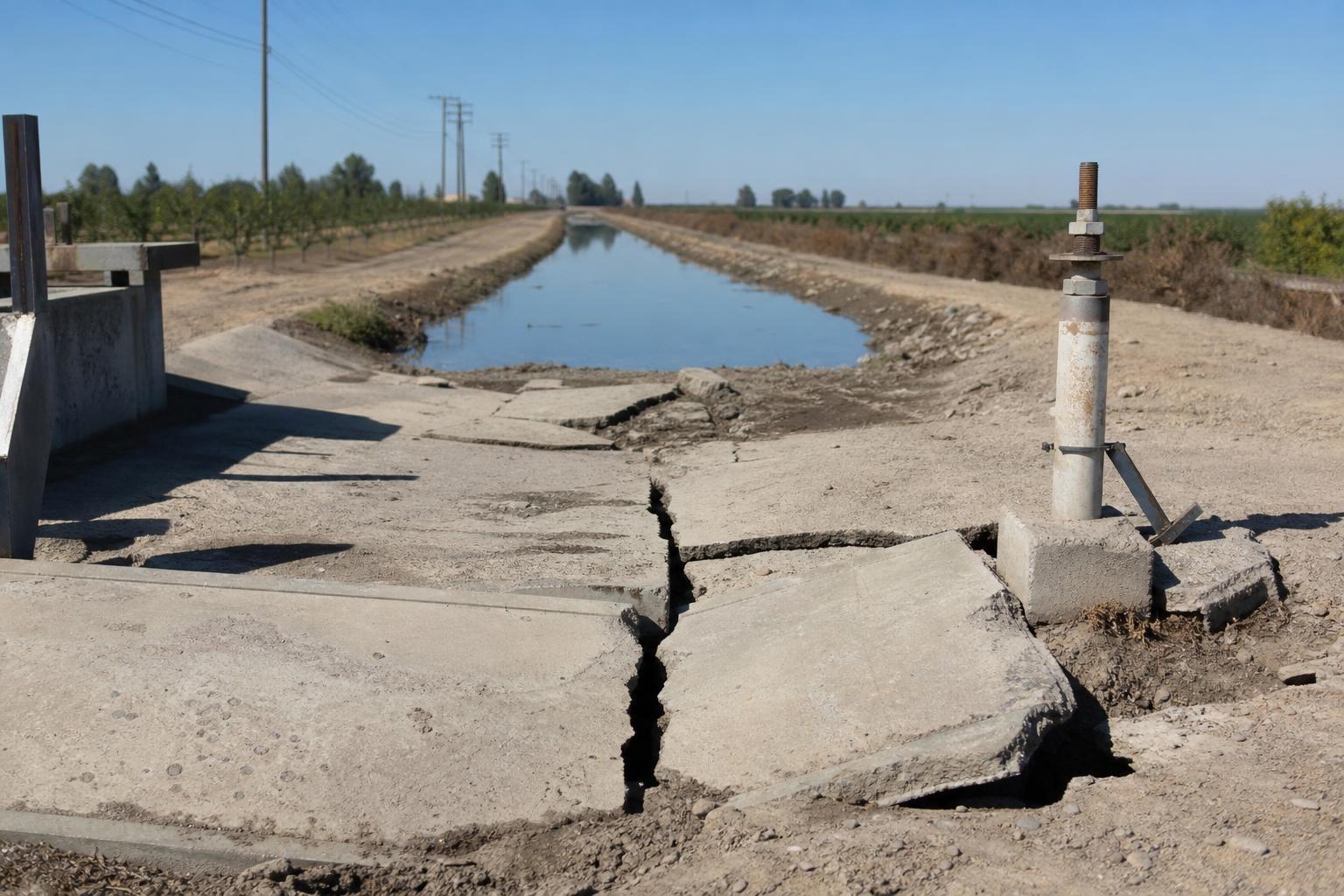
The valley floor has been quietly sinking, and the story it tells is one of ambition, scarcity, and physics. Over decades, parts of this vast farm belt have dropped nearly 28 feet, a visible imprint of water pumped faster than it could be replaced. “We weren’t stealing water,” said one grower, “we were borrowing from tomorrow.” The bill, however, has now arrived.
The land is falling: why it happens
Aquifers are not bottomless lakes; they are sponges of sand, silt, and clay. When groundwater is withdrawn, the weight of overlying soils squeezes those pores. In clay-heavy layers, that compaction can be permanent. The ground surface then drops, slowly or in sudden lurches.
Engineers call it subsidence, a word that sounds gentle until canals lose their slope, bridges warp, and wells run dry. “Once the clay collapses, you can’t pump the space back open,” a hydrologist explained. The aquifer’s storage capacity shrinks, and future droughts bite harder.
A century of thirsty growth
The region’s powerhouse crops—almonds, pistachios, grapes, and dairy feed—turned sun and soil into global exports. Canals and dams spread surface water, but groundwater became the silent backstop. In dry years, pumps roared to keep orchards alive.
Historical records show pulses of extreme overdraft in the 1920s, the mid-century boom, and the recent droughts. Satellite and radar measurements from NASA mapped bowls of subsidence that deepened during the 2012–2016 and 2020–2022 dry spells. Some zones near Corcoran sagged enough to force canal retrofits, each inch a costly reminder.
The hidden costs underfoot
Subsidence does not simply lower the horizon; it breaks the plumbing of a water economy. Gravity-fed canals lose capacity; pumps must lift higher; energy bills climb. Rail lines and roads buckle, and flood levees settle into uneasy angles.
Rural communities feel the sharpest edges. Domestic wells serving low-income towns can fail when water levels plunge. “We watched the faucet spit air,” said a resident, “while fields next door stayed green.” Inequity deepens when emergency tanks and well deepening are out of reach for the most vulnerable.
Farmers on the edge
Permanent crops demand permanent water, even in parched winters. That financial lock-in encouraged heavier pumping during drought years. “We chased certainty with pumps,” a grower told me, “and the ground chased us down.”
Many producers are already adapting with drip systems, deficit irrigation, and crop shifts. Others are weighing orchard removals and seasonal fallowing. The calculus mixes bond payments, commodity prices, and a new law that limits groundwater to what the basin can endure.
What it takes to stop sinking
California’s Sustainable Groundwater Management Act set a deadline: balance inflows and outflows, or watch the basin’s bones keep settling. That balance isn’t just less pumping; it’s more smart recharge.
When big storms come, floodwaters can be steered onto fields and dedicated basins to soak into aquifers. The practice—often called Flood-MAR—turns winter chaos into summer resilience. It works best with permeable soils, good permits, and a network ready before the skies open.
Here’s what a durable portfolio can look like:
- Managed recharge on farms and floodplains during high flows
- Converting marginal acres to habitat or solar to reduce demand
- Groundwater trading with strict guardrails and real-time data
- Lining canals and fixing leaks where it truly pencils out
- Incentives for crops that bend with variable water budgets
Monitoring is the quiet hero. Better meters, telemetry, and shared dashboards help agencies spot trouble early and prove what’s actually working. Without transparent numbers, hope becomes a risky policy.
Science, law, and the human factor
Geology sets the limits, but people decide how close to ride those edges. Local agencies must knit together hydrology, economics, and equity. Community voices matter, because the pain of adaptation lands unevenly on farmworkers, small towns, and indebted growers.
“We can’t keep chasing the last drop,” said a water manager. “We need to build room for the next storm.” That means reconnecting rivers to floodplains, restoring wetlands that recharge and blunt floods, and designing rules that reward long-term thinking.
A new relationship with water
The climate is delivering whiplash—deluges, heat waves, and abrupt droughts—and the aquifer can no longer serve as an elastic bank. The path forward is neither doom nor denial but disciplined respect for the ledger under our feet.
The ground has already told us what happens when we overspend the account. Now the region is writing a different story—one of diversified supplies, smarter demand, and landscapes that bank water when the rivers run fat. If that story holds, the land can steady, and tomorrow’s wells may find a deeper kind of security.
