
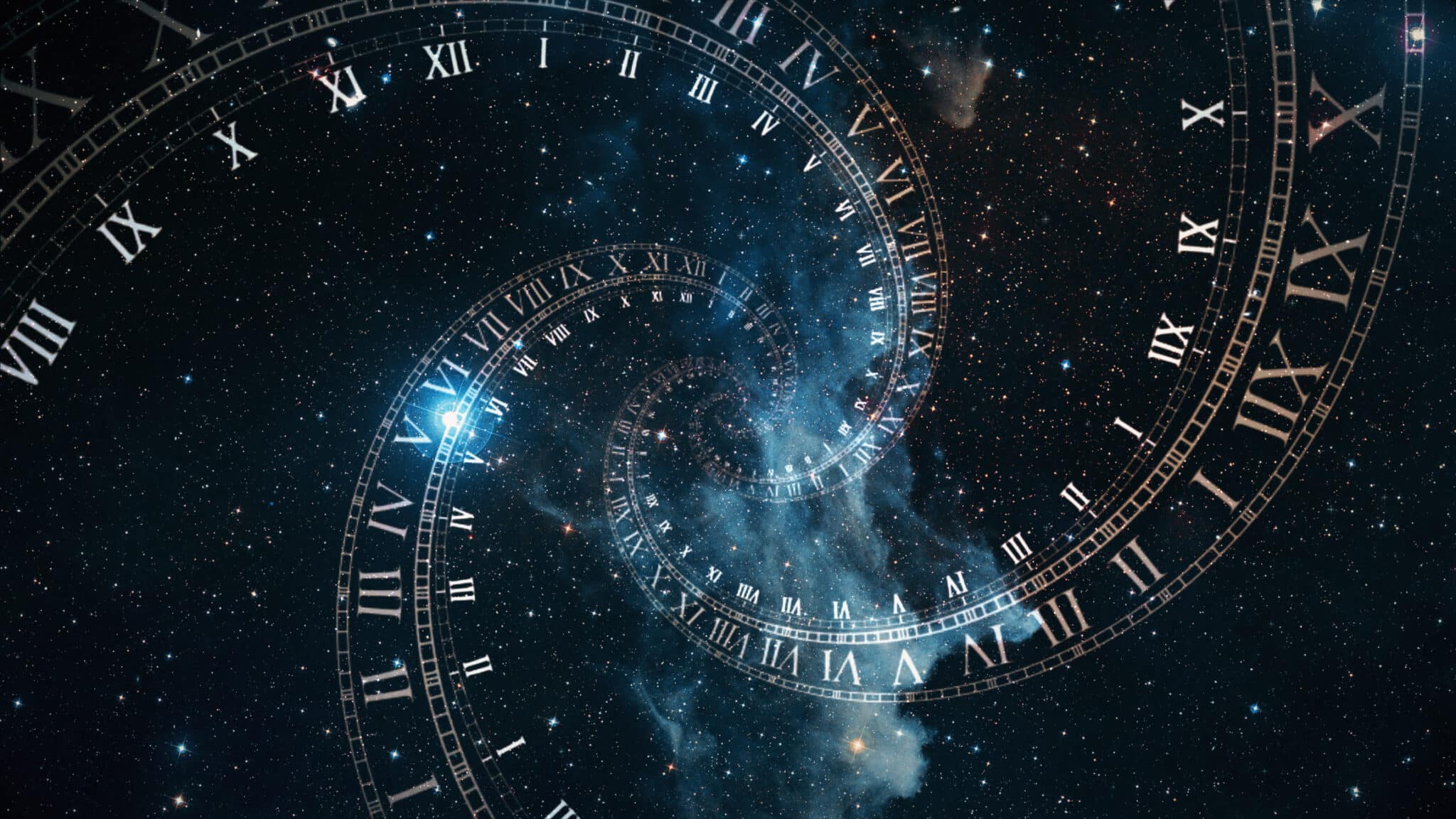
We all have the intuition that time flows like a river: the past has vanished, the future does not yet exist, and only the “present” is real. This is our everyday experience. Yet, for the vast majority of modern physicists, this view is a total illusion. According to Einstein’s equations of Relativity, we live in a “Block Universe” where dinosaurs, your birth, and your death all exist simultaneously within a frozen structure.
The Death of the “Now”
To understand why time does not flow, one must abandon the idea of a universal clock ticking for the entire universe at once. In 1905, Albert Einstein shattered this notion with Special Relativity.
He showed that “simultaneity” is relative. What is happening “now” for you depends on your motion through space. If you could travel at speeds close to that of light toward the Andromeda galaxy, your “now” could correspond to an event that, for a stationary observer on Earth, will occur in 1000 years.
If two observers cannot agree on what constitutes the “present,” that means the distinction between past, present, and future is subjective. As Einstein wrote in a famous condolence letter: “For us, believing physicists, the distinction between past, present and future holds only the value of an illusion, however tenacious it may be.”
The Universe as a Giant Slice of Bread
This is where the theory of the Block Universe enters, supported by figures such as physicist Brian Greene or science philosopher Huw Price.
Imagine the universe not as a sequence of images scrolling by, but as a gigantic 4-dimensional block of ice (3 spatial dimensions + 1 time). In this block, everything is already there, engraved in the ice.
-
At one end of the block lies the Big Bang.
-
In the middle, Julius Caesar crossing the Rubicon.
-
A little further along, there is you reading this article.
-
Even farther ahead, there is the end of the solar system.
In this “eternalist” vision, time does not pass. All of spacetime is a static object. We, as conscious observers, “traverse” this block a bit like a flashlight illuminating a section of a long dark corridor. The corridor (the future) is already built, but we do not yet see it.
“The passage of time is probably an illusion of consciousness, linked to how our brain processes information and creates memories,” explains the physicist Carlo Rovelli in his work on loop quantum gravity.
Why Do We Feel Time Passing?
If the future is already here, why can we not remember tomorrow? Why doesn’t a broken glass ever reassemble itself? The answer lies in Thermodynamics and the concept of Entropy.
The universe shifts from an ordered state to a disordered one. This is the “arrow of time.” Our brain, which is a biological machine, requires energy to function and to create memories. This process increases disorder. We perceive time as passing not because time “moves,” but because our mental state changes in step with the rise of entropy. We have traces of the past (memories, fossils) because entropy was lower “before,” but we have no traces of the future.
The Dizziness of Free Will
This theory is scientifically robust, but psychologically terrifying. If the Block Universe is real, it suggests that the future is as fixed as the past. Your decision to finish this article or to go to bed is, from a physical standpoint, already inscribed in the geometry of spacetime.
Nevertheless, do not despair. Quantum mechanics (the infinitely small) introduces a degree of randomness that Relativity (the infinitely large) does not yet handle perfectly. The future may be written, but the ink may not be fully dry yet.
Sources: Time’s Passage is Probably an Illusion (scientificamerican.com) | Is Time an Illusion? (scientificamerican.com)
Article prepared with the help of AI · Our method
