
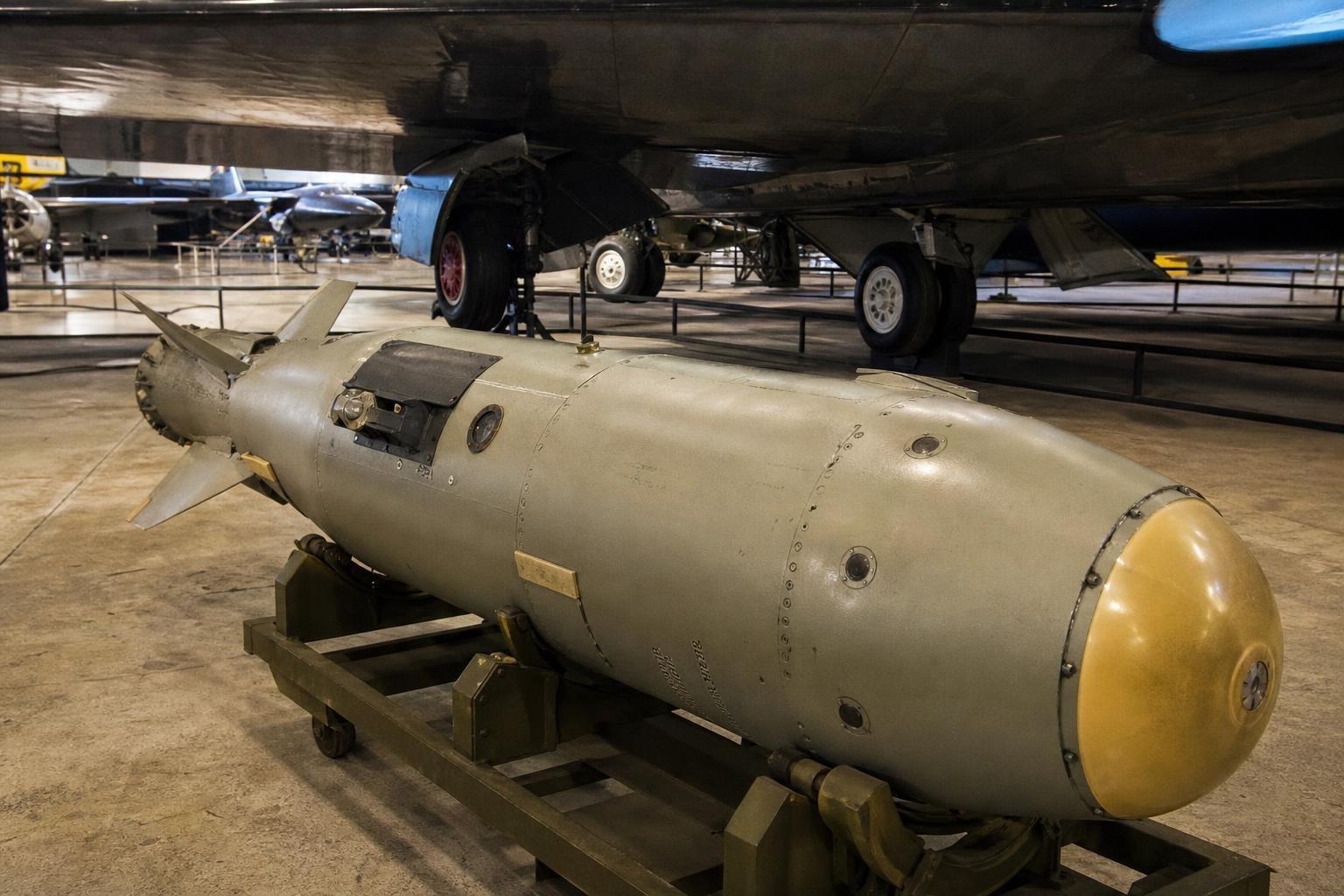
On a cold January night in 1961, a U.S. bomber came apart over rural North Carolina. In the darkness, two thermonuclear weapons fell toward farmland, one drifting beneath a white parachute, the other plunging straight into the earth. What followed was a precarious dance of human error, mechanical design, and sheer luck—an episode later summed up starkly: “a single low-voltage switch” stood between the country and devastation.
Night Over North Carolina
The B-52G, on an airborne alert mission from Seymour Johnson Air Force Base, had developed a serious fuel leak. As the crew fought to stabilize the aircraft, the massive bomber began to break apart. Eight crew members ejected; five survived. Below, two Mk 39 thermonuclear bombs, each capable of multi-megaton yield, fell free of the wreckage.
One bomb’s parachute deployed, allowing a relatively controlled descent. The other free-fell and smashed into swampy ground near Goldsboro, scattering components and burying critical parts deep in the muck.
Two Bombs, Seven Steps
These were not crude, early devices. The Mk 39 carried layered safeguards intended to prevent accidental detonation. Yet, as later investigations made plain, multiple barriers failed in a cascade of contingencies.
- Barometric and impact switches aligned under descent conditions
- The parachute-equipped bomb’s arming sequence advanced far beyond safe expectation
- Six of seven internal steps toward a full nuclear initiation were completed
- Only a single, still-safe switch kept the firing circuit from delivering the final energy
As one declassified analysis later put it, “we were a single point away from a major calamity.”
The Switch That Saved a State
At the heart of the near-miss was a deceptively simple component: the ready/safe switch that withheld crucial current from the bomb’s firing chain. Every other relevant safeguard on that weapon either failed, was bypassed by the sequence of events, or was rendered irrelevant by the unusual break-up dynamics. The switch held at safe, and the final surge never reached the detonators.
A weapons-safety engineer later wrote that “a single low-voltage switch” prevented a catastrophe of unimaginable scale. In modern parlance, it was the ultimate single-point vulnerability—one tiny stopgap between ordinary night and irreversible history.
Ground Zero That Wasn’t
Recovery teams moved with disciplined urgency, cordoning fields and swamps as helicopters beat the winter air. The parachuted bomb was largely intact, its systems painstakingly secured and removed. The other weapon proved more stubborn: it had struck the ground at high speed, cratering the site and driving components deep beneath the surface.
Crews dug, pumped, and probed, retrieving fission materials and sensitive hardware. Some elements—most notably parts of the weapon’s heavy secondary—remained irretrievable, embedded in saturated soil. The government ultimately acquired a subsurface easement, monitoring groundwater and restricting excavation to this day.
What The Accident Changed
The incident became a case study for nuclear safety, reverberating through policy circles and engineering labs. It raised hard questions: How many independent safeguards are truly independent? What if structural breakups or oddball impacts align switches in ways designers never imagined?
In the years that followed, the U.S. tightened systems that authorize and enable nuclear use. Coded controls—eventually known as Permissive Action Links—moved from concept to more universal practice. The idea was simple yet vital: no single failure, no single human error, and no single freak accident should be able to bring a weapon to the brink of detonation.
Memory, Mystery, and Accountability
The story faded for decades, half-buried like the bomb’s elusive components. Then declassifications and investigative work rekindled public attention. “We came close to a continental catastrophe,” one commentator later observed, reflecting the sober tone of the archival findings. The episode became emblematic of Cold War risk, where minute decisions and modest switches carried existential stakes.
Local memories never fully dimmed. For people in rural communities around Goldsboro, the event became a kind of shadow history—a reminder that global strategy can land, without warning, in a neighbor’s field. The landscape itself keeps a quiet vigil, marked by monitoring wells and bureaucratic easements, a faint administrative echo of that harrowing night.
The Message That Endures
What endures is not just technical detail, but a moral imperative. Complex systems fail in complex ways; only layers of truly independent safeguards, relentlessly tested, can manage risk we barely comprehend. In this case, a small switch was the hinge of national fate. “Redundancy is mercy,” one safety engineer once remarked; the North Carolina near-miss explains why.
The episode is a Cold War parable written in real hardware and frozen breath: a chain of improbable events, a design stretched to its limits, and one steadfast component that refused to budge. Sometimes history turns not on grand rhetoric, but on a stubborn little click that never came.
