
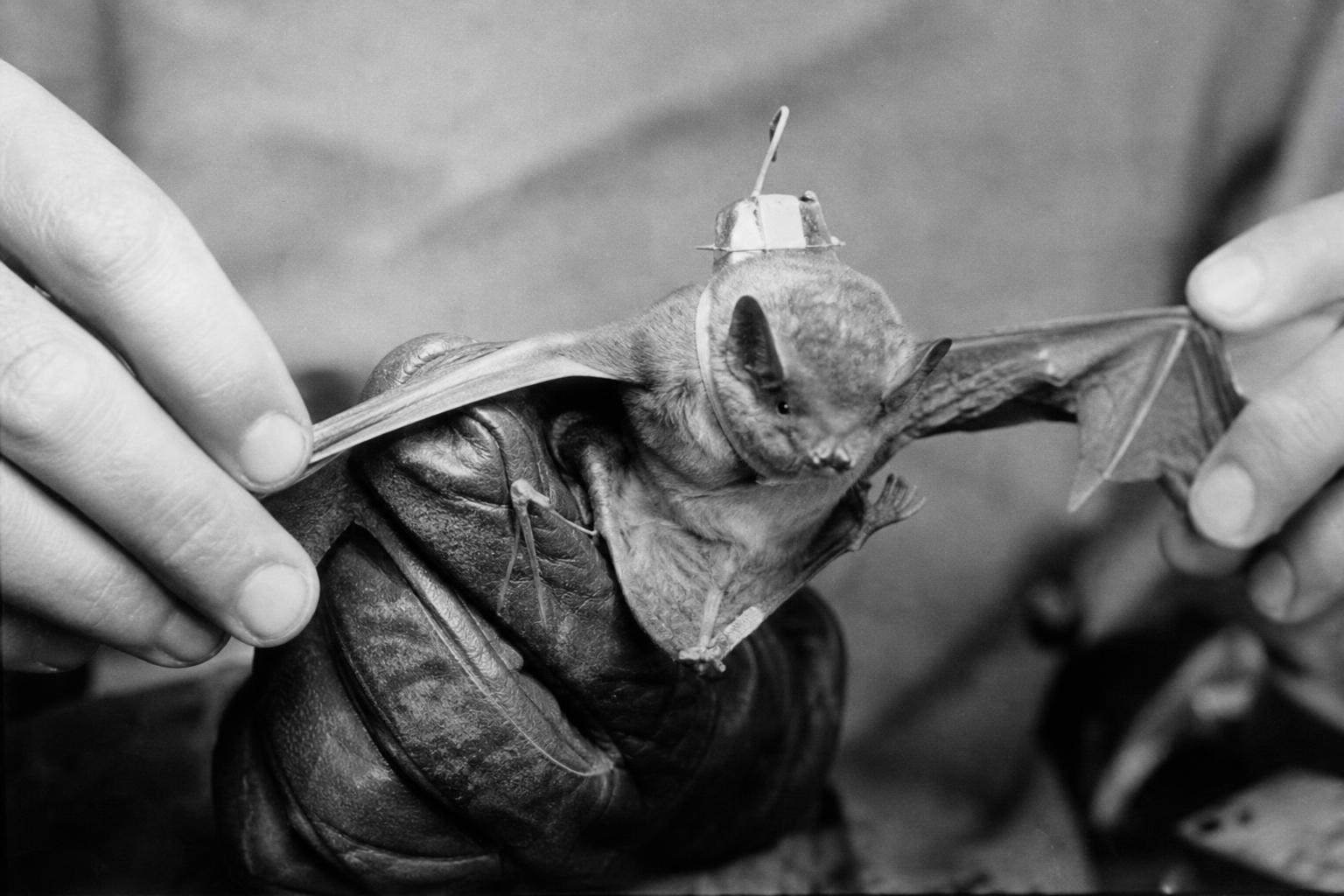
It began as one of those wartime notions that oscillate between brilliance and folly. In a moment of American improvisation, planners imagined the sky rippling with bats, each one carrying a fingertip-sized incendiary. The logic felt unassailable and also absurd: let nature slip into attic eaves, temple rafters, and factory beams and then set strategic fires from within. Somewhere in the desert, the idea leapt from paper to practice—and then, with a hiss and a spark, it misbehaved. During a test in New Mexico, several of the auburn-winged saboteurs roosted where they shouldn’t have, and the “controlled” experiment stopped being controlled at all. “This will be fine,” someone must have said. A few beats later, it wasn’t.
A dentist with a dangerous idea
The unlikely architect was a dentist, Lytle S. Adams, who drove home from Carlsbad Caverns after Pearl Harbor and couldn’t shake a single guiding image: millions of tiny backs, warm in the dark, waiting to scatter across wooden Japanese cities before dawn. He wrote to the White House, pitching bats as silent, self-guiding delivery systems. “Think miniature incendiaries, innumerable and invisible,” he urged in spirit if not exact words. In the teeming confusion of early 1942, the government said yes. Thus, “Project X-Ray” took flight under an oddly American blend of improvisation, science, and audacity.
How the plan was supposed to work
The team selected the Mexican free-tailed bat, a fast, high-flying species that thrives in colossal colonies. Each bat wore a lightweight incendiary—an aluminum capsule with a timed fuse packed with a napalm-like gel—glued to a loose skin fold on its chest. The bats would be chilled into torpor, stacked in paper “bombs,” dropped from altitude, then warmed by the dawn’s air as they fluttered into buildings to roost. Minutes later, dozens—maybe thousands—of small fires would bloom across a wide area, outpacing any single firefighting response.
Why bats appealed to planners:
- Sheer numbers and stealthy behavior: disperse naturally, hide instinctively, ignite everywhere at once.
The vision was unsettling and elegant: instead of one big blast, a constellation of embers crawling into the bones of flammable urban infrastructure. In models and memos, you could almost hear the quiet footsteps of inevitable outcomes.
New Mexico’s unintended burn
Then came the tests at a new Army Air Forces installation near Carlsbad, where “controlled” quickly became conditional. A handful of armed bats slipped free, did precisely what bats do, and tucked themselves into the coziest crevices they could find—including under a fuel tank and inside building eaves. Moments later, thin threads of smoke turned into rude, cracking flames. Fresh construction—hangars, sheds, and other facilities—was suddenly a tour of unforeseen consequences. A car reportedly met the same fate, paint blistering into char and ash. Technically, the system had worked; strategically, it had worked in exactly the wrong place.
People remember that day with a kind of grim smile: “We proved the principle,” some said, staring at blackened timbers and a shimmering heat haze. The base wasn’t reduced to a lunar plain, but parts of a brand-new installation were scorched by America’s own invention.
The science, the timing, the scramble
The device’s heart was a miniature incendiary, a craft-and-chemistry marriage of timers, gels, and thin casings just sturdy enough to travel and then fail on cue. Bats don’t carry payloads with military punctuality, though; they carry instinct, which rarely honors a schedule. “What could go wrong?” isn’t a question so much as a forecast, and field crews learned to run faster than a match racing into wind. They tinkered with fusing delays, improved the paper containers, and kept testing in ever more controlled conditions.
Proof of concept, and the plug gets pulled
Later trials at test ranges with mock villages hinted the idea had tactical teeth. Dozens of small ignitions could overwhelm response crews, and the bat’s natural roosting choices targeted hidden voids that firefighters hate. But the timeline sagged under wartime urgency. The project slipped between agencies, from Army Air Forces to Navy hands, and by mid-1944 the clock had simply run out. Bigger projects cast longer shadows—and the atomic program redefined “decisive” in a single, blinding stroke. “Promising, but too late,” was the quiet, administrative epitaph.
What the caper still teaches
This episode lives at the bright edge of innovation and the dim basement of unintended effects. It reminds us that complex systems—ecosystems, cities, militaries—fail in complex ways. The best ideas come with feral variables that refuse to sit, heel, or fetch. When you enlist nature as your partner, you inherit its uncooperative genius. And when you test that partnership in the real world, the real world sometimes bites.
Today’s engineers court similar temptations with swarms, autonomy, and biomimicry. The lesson isn’t “don’t be bold,” but “be bold with layered safeguards.” The desert mishap wasn’t purely a failure; it was a successful demonstration of a principle, misapplied by chance and circumstance. In a few stray wings, you can read a whole era’s appetite for speed, novelty, and decisive means—and the smoke rising from a bright, brand-new place that learned the hard work of thinking two steps ahead.
