
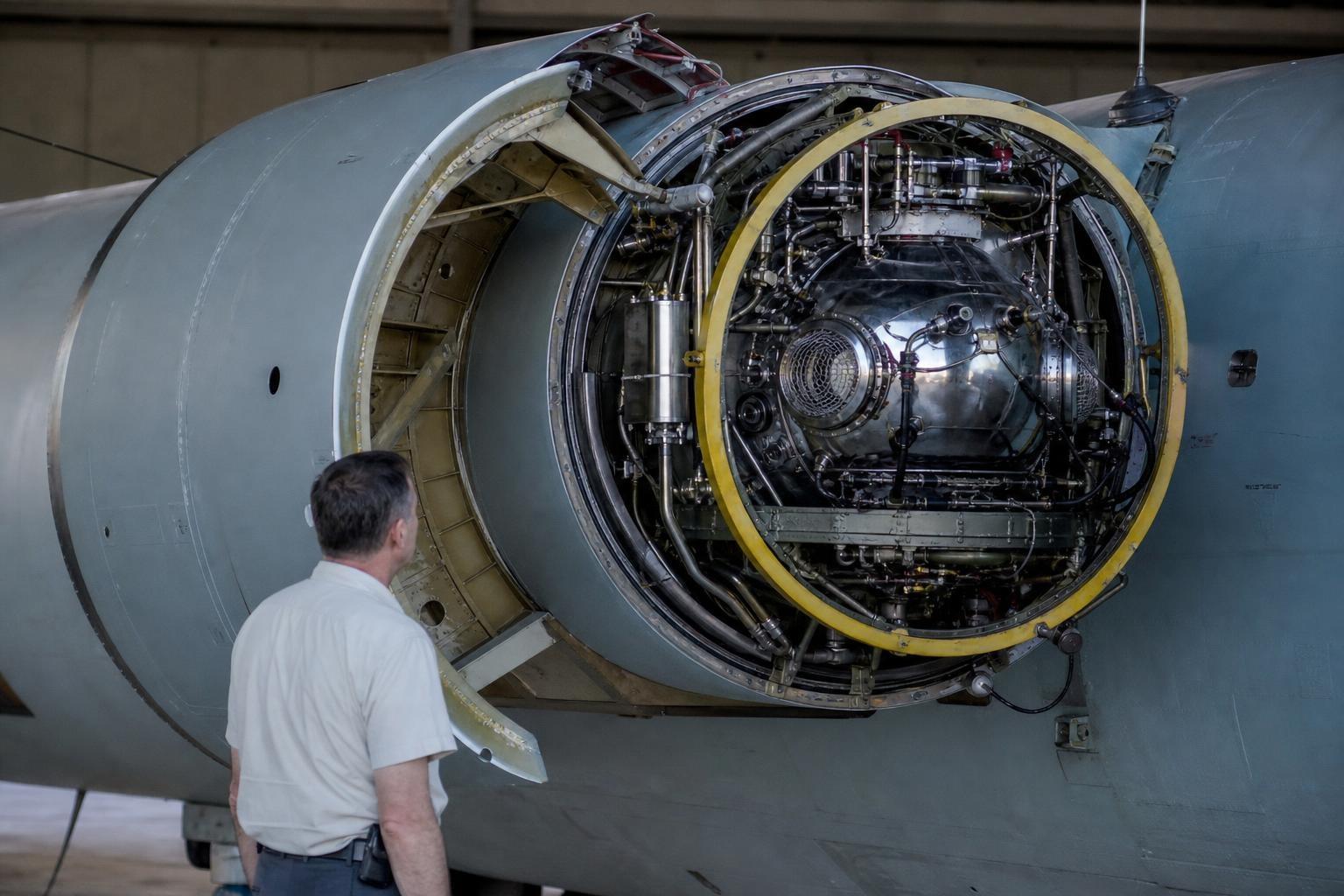
The Cold War briefly flirted with an idea so audacious it bordered on science fiction: a bomber that could stay aloft for days, powered not by kerosene but by a nuclear reactor. In the mid‑1950s, American engineers turned that dream into a flying laboratory, sealing its crew inside an 11‑ton lead-lined capsule while a compact reactor hummed in the fuselage. “Endurance without refueling,” the mantra went, promising strategic reach that seemed limitless.
A Cold War bet on endless flight
Strategists wanted persistent patrols that no tanker chain could match, and reactors promised staggering range. The U.S. program—known as Aircraft Nuclear Propulsion, or ANP—pursued two paths: using reactor heat directly in jet engines, and an indirect cycle with a heat exchanger. But before any of that could be trusted, the Air Force needed to answer a hard question: could people and instruments survive airborne radiation?
The flying reactor lab
Convair modified a giant B‑36 into the NB‑36H, a one‑off testbed often nicknamed the Crusader. Engineers carved out space for a working reactor module and wrapped the forward section in extraordinary shielding. The powerplant onboard was not connected to the propellers; it existed to prove that radiation could be contained. Beginning in 1955, the aircraft executed a series of sorties—forty‑plus in total (often cited as 47)—with the reactor started, monitored, and shut down in carefully scripted cycles.
Life inside a lead-lined cockpit
The cockpit became a bunker in the sky: roughly eleven metric tons of lead, steel, and rubber stood between the crew and neutron‑gamma flux. Windows were slabs of leaded glass, thick enough to distort the world outside. “Shield the people, not the plane,” became the practical philosophy. Every dial that entered the capsule did so through shielded feedthroughs; every radio call threaded past layers of barrier. The space was cramped, hot, and eerily quiet, with the ever‑present knowledge that an invisible hazard pressed just beyond the walls.
Safety rituals in the sky
Operators baked caution into every procedure. Flights took place along pre‑cleared corridors, and chase aircraft sampled the air behind the bomber for any sign of release. Onboard teams rehearsed fast shutdowns—reactor “scrams”—and the NB‑36H carried redundant interlocks. Crew health was tracked obsessively, with dosimeters serving as personal guardrails. The ethos was simple: “Radiation doesn’t negotiate—only physics does.”
- Layers of defense included heavy cockpit shielding, strict reactor startup/shutdown sequences, airborne radiation sampling, ground‑based environmental monitoring, and conservative flight profiles designed to minimize population exposure in the event of an incident.
What the data actually showed
In flight, the reactor’s neutron and gamma outputs interacted with metal, fuel, and air in complex ways. Measurements suggested that with enough mass and smart geometry, crew doses could be kept within stringent limits. But mass remained the immovable obstacle: to tame radiation, you needed weight—lots of it—and every ton of shielding stole payload and performance. The NB‑36H proved a crucial point: “a nuclear aircraft” was technically possible in the narrow sense of radiological feasibility, but it collided with the practical mathematics of aviation.
The propulsion problem that never left the ground
Meanwhile, engineers on the ground wrestled with the far tougher challenge: building engines that could sip reactor heat and still be reliable. Direct‑cycle concepts pushed reactor‑heated air through turbines, raising brutal questions about material embrittlement, contamination, and maintenance. Indirect‑cycle schemes shifted heat through exotic exchangers, adding mass, complexity, and failure modes. In both cases, the trade space bent under temperature limits, shielding, and the unforgiving economics of weight.
Why the dream faded
By the early 1960s, the strategic chessboard had changed. Aerial refueling matured, cutting the legs from the “infinite endurance” promise. Intercontinental ballistic missiles took center stage, making long‑loiter bombers less singular as a deterrent. Public and political tolerance for airborne reactors eroded as safety culture hardened. In 1961, the program’s funding was withdrawn; the NB‑36H went quiet, and the industry pivoted to more tractable wins.
A legacy hidden in plain sight
It didn’t die for lack of ingenuity—it died of tradeoffs. The lessons flowed into materials science, shielding design, sensor development, and systems safety that echo in modern aerospace. You can trace a line from those flights to today’s analytical methods for radiation transport, to space‑reactor concepts, and to the sober risk frameworks that guide complex, high‑energy projects. “We proved we could,” the era seems to say, “and then proved we shouldn’t.”
History often remembers grand experiments by their failures, but this one’s value lies in its clarity. It showed that physics grants possibilities while engineering imposes prices—and strategy decides whether to pay. For a few charged years, a bomber carried a compact sun in its belly, and a crew sat behind tonnes of lead, trusting the math. The sky did not change, but our understanding of what belonged in it certainly did.
