
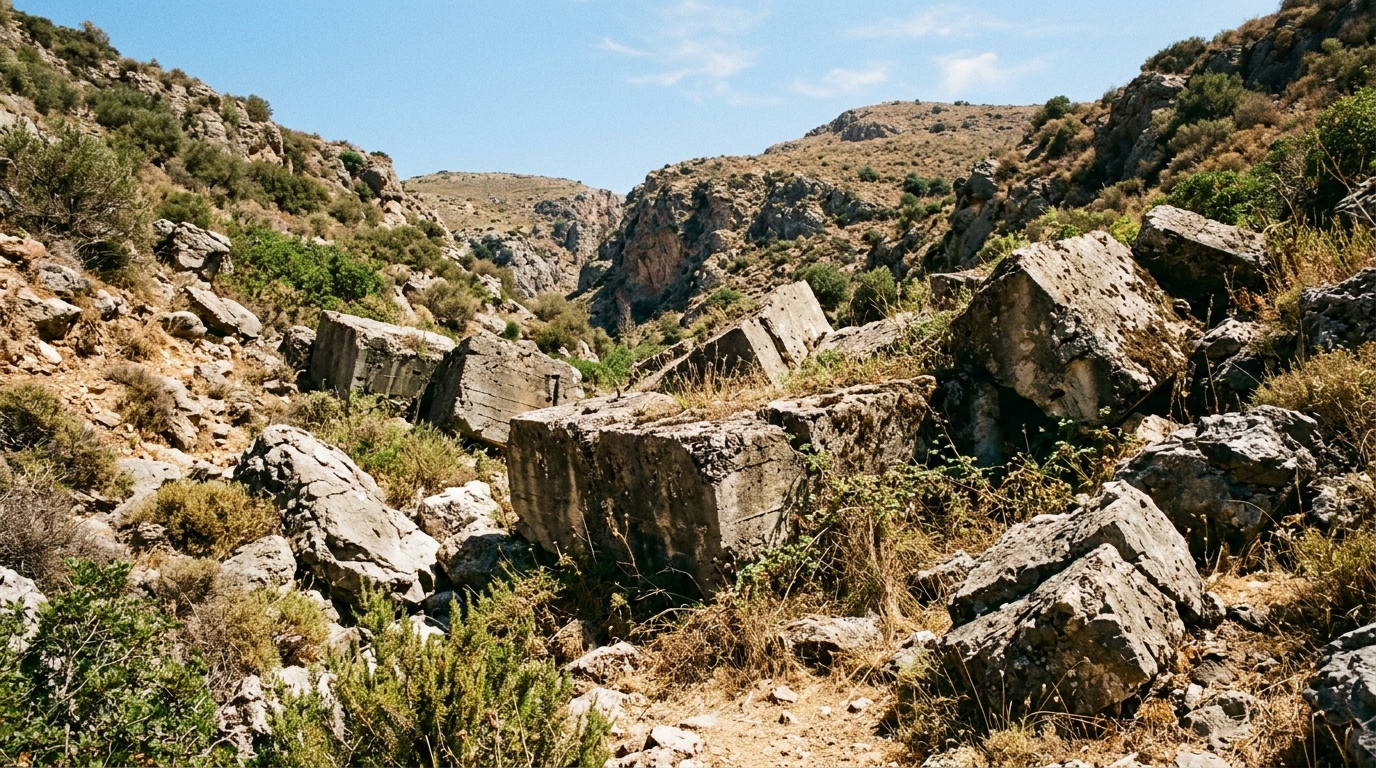
At the heart of the Esterel, under the blazing sun that crushes the garrigue in midsummer, a gray concrete block, cracked, covered in lichen, rises from the bed of a dried-up stream. It weighs several hundred tons. No one has ever moved it. Around it, in the Reyran gorges, dozens of other fragments of this size litter the ground for more than six decades, like the relics of a giant that collapsed in on itself. This almost unreal scenery, today a simple curiosity for hikers, was once the setting of one of the worst civilian catastrophes France has known since the war. A look back at the Malpasset dam’s story, and at the reasons why its ruins have never been erased from the landscape.
An invisible fracture that toppled an entire dam
Completed in 1954, the Malpasset dam was a technical tour de force signed by the engineer André Coyne, one of the leading figures in France’s arch-dam construction. The work stood out for a vertiginous finesse: barely 1.50 meters thick at the crest, for a structure meant to hold millions of cubic meters of water. This architectural lightness, celebrated at the time as a major advance, rested on a blind spot: the nature of the ground on which the structure was built.
Geological studies carried out before construction had not detected the existence of a hidden tectonic fault within the rock that was supposedly impermeable. This fault, insufficiently analyzed, would become the weak link of the entire edifice. After torrential rains that drenched the region during the second half of November 1959, the level of the reservoir rose by 4 meters in just 24 hours. The pressure exerted on the foundation became unbearable, brutally revealing the terrain’s fragility.
When 50 million cubic meters of water erase a city from the map
On 2 December 1959, at 21:13, the vault gave way. In only a few minutes, about 50 million cubic meters of water poured into the Reyran valley, forming a wave over 40 meters high that plummeted down the slope at an estimated speed of 70 km/h. Twelve kilometers separate the dam from Fréjus. The wall of water crossed that distance in barely twenty minutes, leaving the population with almost no time to react.
The toll was horrific: 423 dead and missing, including 135 children under 15. One hundred fifty-five buildings were wiped off the map, more than a thousand hectares of farmland were devastated. Entire neighborhoods of Fréjus disappeared in a single evening, swallowed by a liquid mass that nothing had warned about a few hours earlier. To this day, it remains France’s largest civilian disaster since World War II.
Why these ruins have never left their stone tomb
Investigations in the months following the tragedy quickly ruled out two hypotheses that circulated at the time: that it was caused by an earthquake, and that explosives connected to the nearby Esterel–Côte d’Azur highway project, whose bridge lay about a kilometer downstream. A chilling detail was later revealed: the dam’s spillway valve had not been opened in time, precisely to protect that highway project. A decision that, with hindsight, probably aggravated the catastrophe.
Once the geological cause was established, the question of rebuilding never really arose. The site, marked by a fault in its very foundation, had become unfit to host a new structure. The shattered concrete blocks, some weighing hundreds of tons, proved too heavy, too numerous, and too deeply rooted in the landscape to be moved on an industrial scale. They stayed where the flood had thrown them, turning the Reyran valley into a time-frozen, open-air monument.
What the Reyran’s silence still tells today
Today, in the heat of summer, a few hikers still follow the trails winding among these remnants. The vault’s fragments, broken into monumental chunks, remain visible deep in the gorges, silent witnesses to a night that changed an entire region. The site, accessible to the public, receives no spectacular promotion: no grand museum, no special crowds. A form of anonymity that is almost unsettling for one of France’s most significant modern tragedies.
Yet the disaster left a lasting imprint in the technical realm: the Malpasset catastrophe led to much stricter rules governing the geological study of foundations before any dam is built in France. A painful lesson learned, but one that has helped prevent other unseen faults from causing similar tragedies.
The Reyran Gorges thus bear, in their rugged relief and frozen blocks, the memory of a December night when the rock betrayed humans. And as one strolls there today, almost nonchalantly, under the shade of pines and oaks, it is hard not to wonder how many other works, elsewhere, still rest on foundations that have never truly been probed.
