
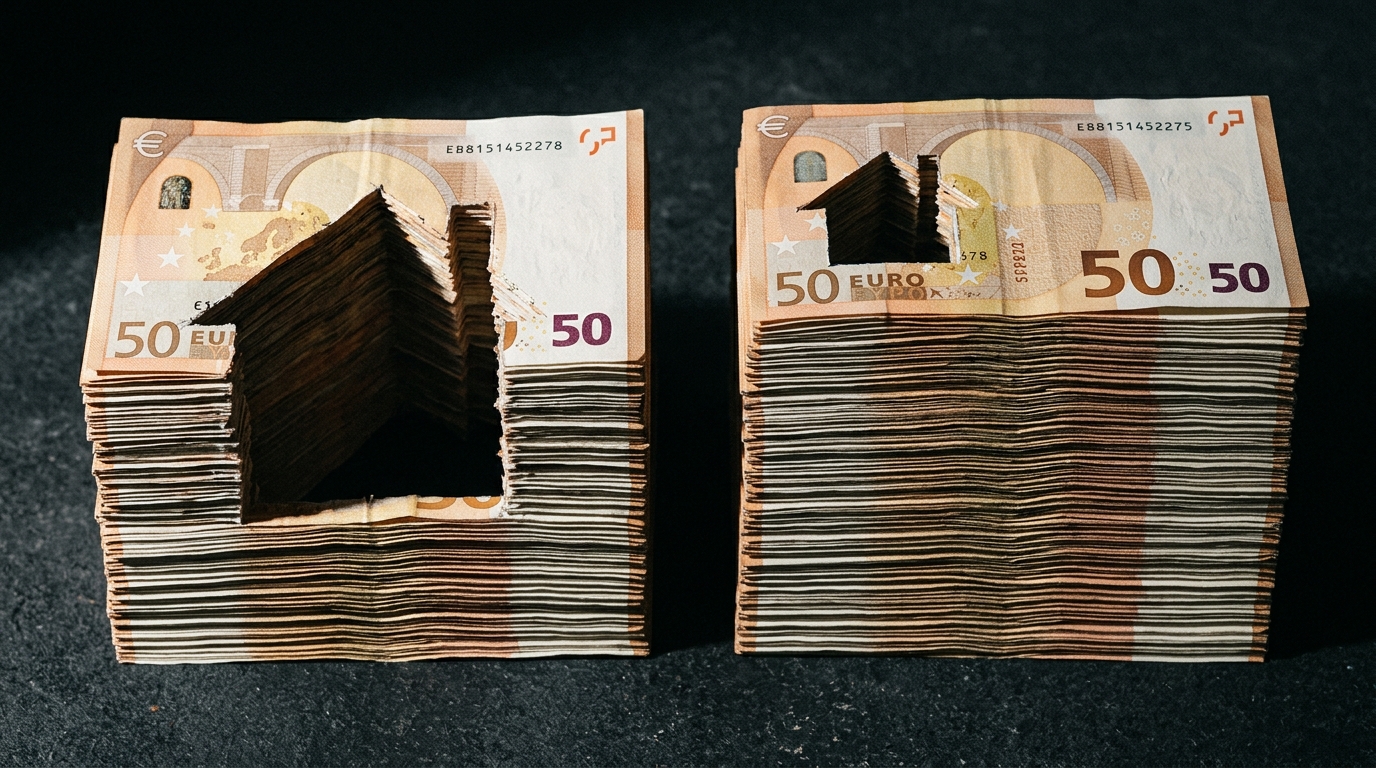
A couple earning the minimum wage and a couple of well-paid executives can live in the same type of apartment, in the same city, with rent per square meter almost identical. Yet one spends nearly half of their budget on housing, while the other spends barely a tenth. This wide gap, far from being a statistical quirk, quietly structures the lives of millions of French people. As the new school year begins and fixed costs weigh heavier than ever on budgets, it’s time to understand what really lies behind these dizzying figures.
- The poorest 20% of households allocate on average close to 40% of their income to housing, versus just 8% for the wealthiest 20%.
- The determining factor is the tenure status: among modest households, owners devote 18.7% of their income to housing, compared with 40.7% for private-sector renters.
- Since 1959, the share of disposable income spent on housing has more than doubled, rising from 10.5% to 22.8%.
- Forty percent against eight: the gap revealed by INSEE
- Neither rent nor square meters: the real explanation is surprisingly different
- Fixed charges, this silent trap that drains small budgets
- A widening gap: what these figures portend for tomorrow
Forty percent against eight: the gap revealed by INSEE
The most recent data deliver a stark finding: the poorest 20% of households allocate on average nearly 40% of their income to housing, compared with barely 8% for the wealthiest 20%. A ratio of one to five, almost from simple to quintuple, which places the roof over one’s head as the first invisible inequality of daily life. One might think it is a marginal gap, confined to a few isolated cases, but it concerns millions of households spread across the country.
Other statistical breakdowns confirm the same trend, albeit with variations in method: the 25% most modest allocate around 32–34% of their income, compared with 14–16% for the 25% of the wealthiest. Among the 10% poorest, the effort rate climbs to 42%, i.e., four times higher than among the 10% richest. And the story does not end there, since after housing aid is taken into account, some modest private-sector renters show a net average effort rate of 44.7%, versus only 7.1% for affluent owner-occupiers not in the market for a new property.
Neither rent nor square meters: the real explanation is surprisingly different
The most common intuition would be that the gap is driven by the price per square meter, or that wealthy households live in smaller, hence cheaper, accommodations. In reality, that hypothesis is largely insufficient. The true explanatory factor lies elsewhere—in the tenure status of the dwelling. Among modest households, being a homeowner or being a private-sector renter drastically changes the picture: homeowners in this quarter spend 18.7% of their income on housing, compared with 40.7% when they are private renters.
In other words, it is less the size of the apartment or even the absolute rent that damages the budget, and more the fact of not owning one’s home. A modest homeowner has largely finished paying off their property or carries only a light remaining mortgage, while a renter pays indefinitely an amount that does not build any wealth. Social housing partially corrects this dynamic: it brings the housing share of the budget down to 27.3% on average for modest households, a figure well below that of the private sector, without erasing the gap with owners entirely.
Fixed charges, this silent trap that drains small budgets
To grasp this mechanism clearly, imagine two sponges submerged in the same bucket of water. The first, small and dry, soaks up almost all the liquid immediately. The second, already saturated, takes only a tiny additional portion. Housing operates in exactly the same way in a modest budget: rent, charges, home insurance, and energy bills form a block of inelastic expenditures that press in before even considering food or leisure. For a well-off household, this same block represents a marginal share of a much larger income, leaving substantial room to maneuver.
This logic explains why one in five private-sector renters spends more than 40% of their income on housing. It isn’t necessarily because their rent is exorbitant, but because their overall income is too low to absorb a fixed cost that remains the same regardless of living standards. The phenomenon is not new, but it is worsening. Over the long term, the housing share of the budget for the bottom 10% rose from 31.4% to 42.1%, while it moved only from 9.8% to 10.8% among the top 10%. More broadly, since 1959, the share of consumption tied to housing in households’ disposable income has more than doubled, from 10.5% to 22.8%, a fundamental shift that has turned housing into the number-one spending item for a majority of households.
A widening gap: what these figures portend for tomorrow
This substantial gap between 40% and 8% is not fixed in stone; it continues to widen year after year. As long as access to ownership remains out of reach for a large portion of modest households, trapped in perpetual renting, the mechanism described above will keep producing the same effects. Support measures, whether housing allowances or social housing, ease the pressure without ever removing it completely, somewhat like a bandage placed on a fracture that would require much deeper treatment.
This dynamic directly raises questions about future housing policies. If tenure status weighs more than the price per square meter or the size of the dwelling, then the most effective levers may lie not only in rent regulation but also, above all, in facilitating ownership for the most vulnerable households and expanding the social housing stock where demand is surging. Without this, the gap between the two ends of the income scale is likely to continue widening, year after year, budget after budget.
In the end, these figures tell a story far more complex than a simple problem of rents being too high. They reveal a structural fracture between those who own their roof and those who rent it indefinitely, a divide that neither the size of the dwelling nor its price per square meter can fully explain. A collective question remains: how far can this gap widen before it becomes socially untenable?
