
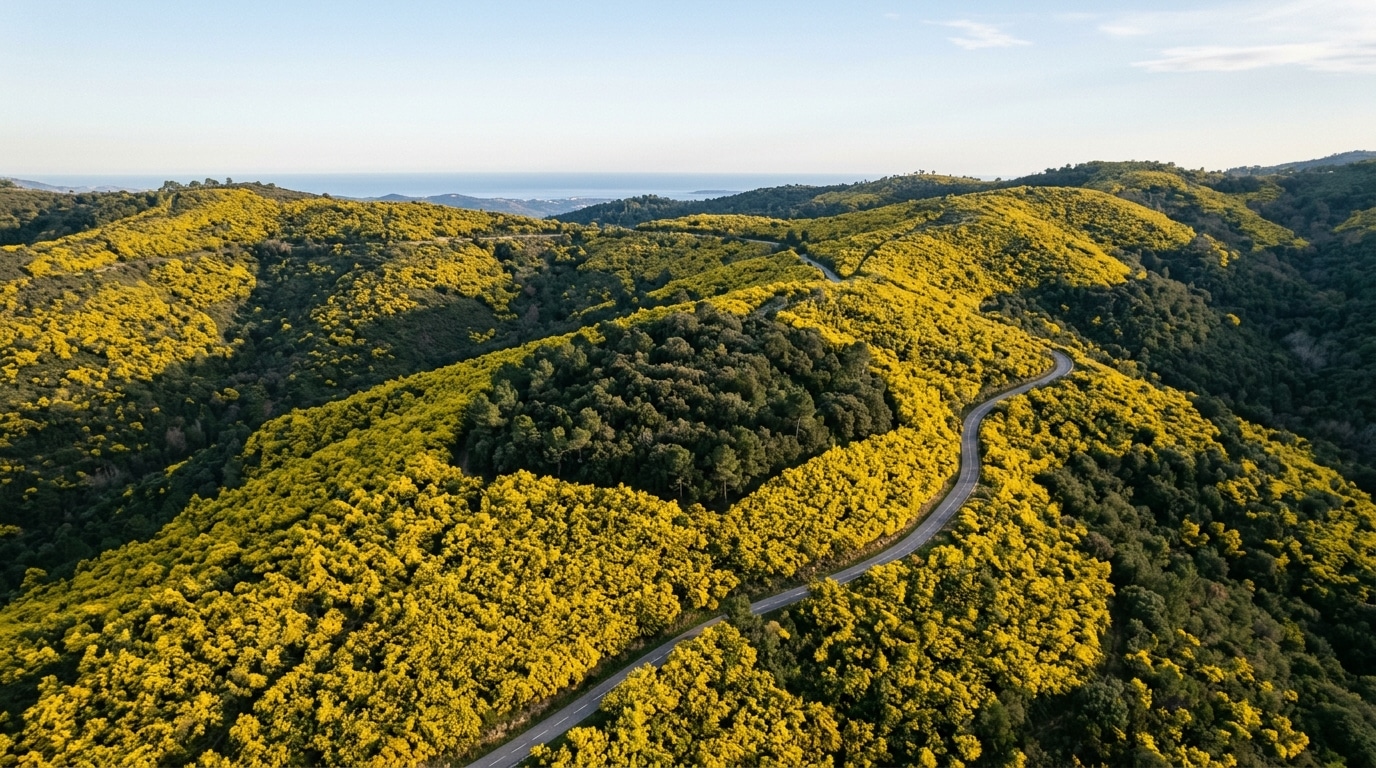
The winter mimosa (Acacia dealbata), emblem of the French Riviera, originates from Australia. Introduced to Cannes in the 19th century as an ornamental plant, it has naturalized in the Tanneron and Esterel massifs. Managers classify it among invasive exotic species: it multiplies by seeds and by stump sprouts, competes with the local flora, and burns easily. Its expansion is difficult to control.
An Australian tree introduced for ornamental purposes
The winter mimosa is native to Australia. It arrived in England in 1792 for its ornamental qualities. On the French Riviera, it appeared in Cannes in the 19th century, in the gardens of British winter residents. The details are disputed: several sources mention Lord Brougham and the year 1864, others mention his protegé, the rosarian Gilbert Nabonnand, and others still a introduction around 1880 by one of the city’s prominent guests.
The tree then left the gardens. The first observations in the wild date back to 1864, and the species spread into the Esterel between 1870 and 1875. Tanneron, today the largest area in France planted with mimosa and grown in a wild state, covers about 200 hectares.
This situation is nuanced: the mimosa is at once a crop that sustains producers and a species that escapes from plots. The Mediterranean Botanical Conservatory of Porquerolles has placed it on its blacklist of invasive species, and the regional strategy regards it as invasive. Yet it is not banned from sale, and it can still be found in garden centers.
Seeds, stump sprouts, and chemical compounds
Several mechanisms explain its progression. The mimosa has a short life, but it produces a huge number of seeds as soon as it matures. These seeds can remain in the soil and germinate in large numbers after a fire. The tree also multiplies through stump sprouts and suckers, which allows it to regrow after cutting.
It directly competes with native flora: where it is dense, the number of local species declines. Compounds released by the species inhibit the germination and growth of neighboring plants, a phenomenon known as allelopathy. Laboratory tests conducted at the University of Vigo on other plants have shown this, and these same compounds seem to even stimulate the germination of its own seeds. In the Esterel, the Conservatoire d’espaces naturels (CEN) notes that the mimosa is highly allergenic, making the limitation of its expansion a public health issue.
These effects explain the rapid colonization described by managers. In the Esterel, there are wadis with oleanders, cork-oak woodlands, and maquis shrubland among the affected habitats.
A highly inflammable tree, difficult to control
The mimosa is also described as highly inflammable. The CEN sums it up as: “highly inflammable and very allergenic.” Since its seeds germinate en masse after a fire’s passage, the species profits from a fire it may have helped to promote: a vicious circle that managers are trying to break.
The Esterel and Tanneron massifs are regularly exposed to the risk. Each summer, the Alpes-Maritimes prefecture classifies certain days as “very severe” risk: access, traffic, and works are then prohibited for the day, as on July 22, 2025. The heightened vigilance period runs from June 1 to September 30.
Controlling the species is challenging. The CEN, the Estérel Côte d’Azur Agglomeration, and the Syndicat mixte du Grand Site de l’Estérel launched in 2022 a pilot site in Fréjus, with clearing, to limit the mimosa’s expansion. The stated objective is to reduce it, not to eradicate it.
Sources :
- Control of the invasive winter mimosa species – Estérel Côte d’Azur Agglomeration, December 9, 2022
- The mimosa, this garden star that causes destruction – Reporterre (AFP)
- Acacia dealbata at Cap Lardier: management of an invasive exotic species – Port-Cros National Park
- Differential responses to allelopathic compounds released by the invasive Acacia dealbata – CSIRO Publishing
- Mimosa is pretty… but ‘posing threat to biodiversity’ – Connexion France
- Mimosa Route 2026 – press pack
- The Bloom of Mimosa in Tanneron – Provence-Alpes-Côte d’Azur Tourism
- Fire risk: closure of the Esterel-Tanneron massif on Tuesday July 22 – RCF
- Prefectural decree on forest fire, May 2025 – Alpes-Maritimes Prefecture (via Vence)
Article prepared with the help of AI · Our method
