
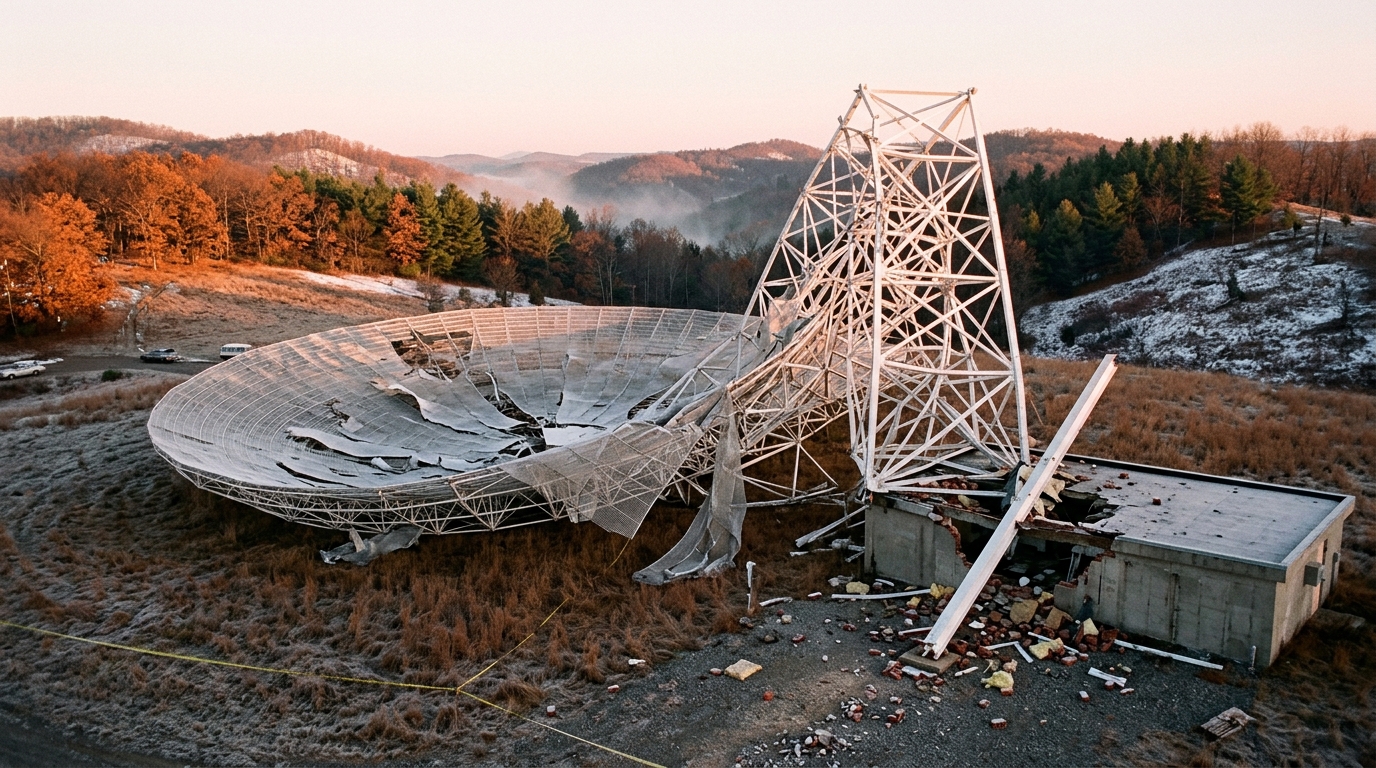
How can a single steel plate topple a 91‑meter telescope in just a few seconds? For twenty‑six years, the Green Bank antenna watched the sky without faltering. Then, on a quiet November night in 1988, its framework collapsed all at once, without storm or warning, revealing a flaw hidden since its construction.
- The 300‑foot antenna collapsed on November 15, 1988 due to the failure of a gusset plate that had been defective since its construction in 1961
- Regular visual inspections had failed to detect this hidden structural fatigue at the heart of the metal assembly
- The Green Bank Telescope, built in 2000 with enhanced monitoring, will participate in tracking the Orion spacecraft during NASA’s Artemis II mission
- A poorly engineered gusset plate, twenty-six years of service, and a silence that precedes the collapse
- 10:30 p.m., no witnesses, no alarms: how 91 meters of steel collapsed silently
- From the iron crater to an engineering lesson: what Green Bank changed forever
A poorly engineered gusset plate, twenty-six years of service, and a silence that precedes the collapse
Erected in 1962 amid the green hills of West Virginia, the Green Bank 300‑foot antenna stood as a paraboloid with a diameter of 90.44 meters. For its era, it was a triumph of engineering, capable of catching radio signals from the far reaches of our galaxy. For more than two decades, the instrument served astronomers around the world with distinction.
Yet beneath this technical prowess lay a detail that had slipped past notice. The structure rested on a closed‑box assembly connected by four large gusset plates—metal components tasked with distributing stresses between the beams. But these plates had never been designed to sustain twenty‑six years of continuous operation. That is what the engineers from Modjeski and Masters, later tasked with investigating the tragedy, would conclude.
Even before the catastrophe, warning signs existed. Observatory teams had noted a pointing drift, a slight misalignment in the direction the dish was aimed. At the time, the diagnosis pointed to an electronic instrumentation issue. No one imagined then that the true culprit lay in the steel itself, fatigued by years of repeated loads.
10:30 p.m., no witnesses, no alarms: how 91 meters of steel collapsed silently
The NRAO 300‑foot radio telescope in West Virginia toppled during the night of November 15, 1988 after the failure of a gusset plate in its supporting structure. According to Modjeski and Masters, the collapse occurred precisely at 9:43 p.m., while a separate report from the National Science Foundation places the event at 9:43 p.m. This minor discrepancy does not change the core fact: the night was clear, there was no strong wind, and nothing in the conditions suggested such a disaster.
The dish was in the middle of an observation session. Visual inspections had been carried out that same day, yet no technician detected the fatal flaw. The implicated gusset plate finally gave way abruptly, hauling the entire metal framework down with it. In mere seconds, 91 meters of steel sagged into themselves, with no direct witness to witness the moment of failure.
The ensuing investigation recovered the infamous sheared gusset plate among the rubble. More troubling still, photographs taken during the antenna’s 1961 construction already showed this piece, then intact but unmistakably identifiable. The record was complete: the defect originated at the source, not from sudden wear or an accident somewhere along the line.
From the iron crater to an engineering lesson: what Green Bank changed forever
The investigators’ conclusion was unequivocal: the telescope was lost due to the rupture of a gusset plate. No matter how regular the visual checks, they were not suited to detect structural fatigue lodged at the very heart of the assembly. The episode left a lasting mark on the scientific community, a reminder that an instrument of such mass remains subject to the same physical laws as a bridge or a building.
The observatory did not surrender. From the ruins of the old dish rose a new instrument, the Green Bank Telescope, completed in 2000. Taller and more precise, it incorporated, from its inception, the lessons drawn from the collapse, with a level of structural surveillance far more rigorous than that applied to its predecessor.
That vigilance continues to pay off. In 2021, a full inspection conducted by Modjeski and Masters—already involved in the historical case—identified a different but equally serious problem: the protective coating on the current telescope was nearing the end of its life, triggering corrosion on key structural elements. The Ohio‑based company Liberty Maintenance was contracted to address the issue, initially dedicating $4.5 million to refurbishing the instrument’s feed arm and related systems.
A NRAO press release announced that this repainting campaign would reach a major milestone during the summer. It also noted that the Green Bank Telescope would participate in tracking NASA’s Orion spacecraft during Artemis II, guiding its journey around the Moon. From the collapse of a single antenna to the ongoing monitoring of a crewed spacecraft, Green Bank’s trajectory illustrates how disciplined engineering—rebuilt after a failure—can yield outcomes that exceed the original ambitions of the project.
