
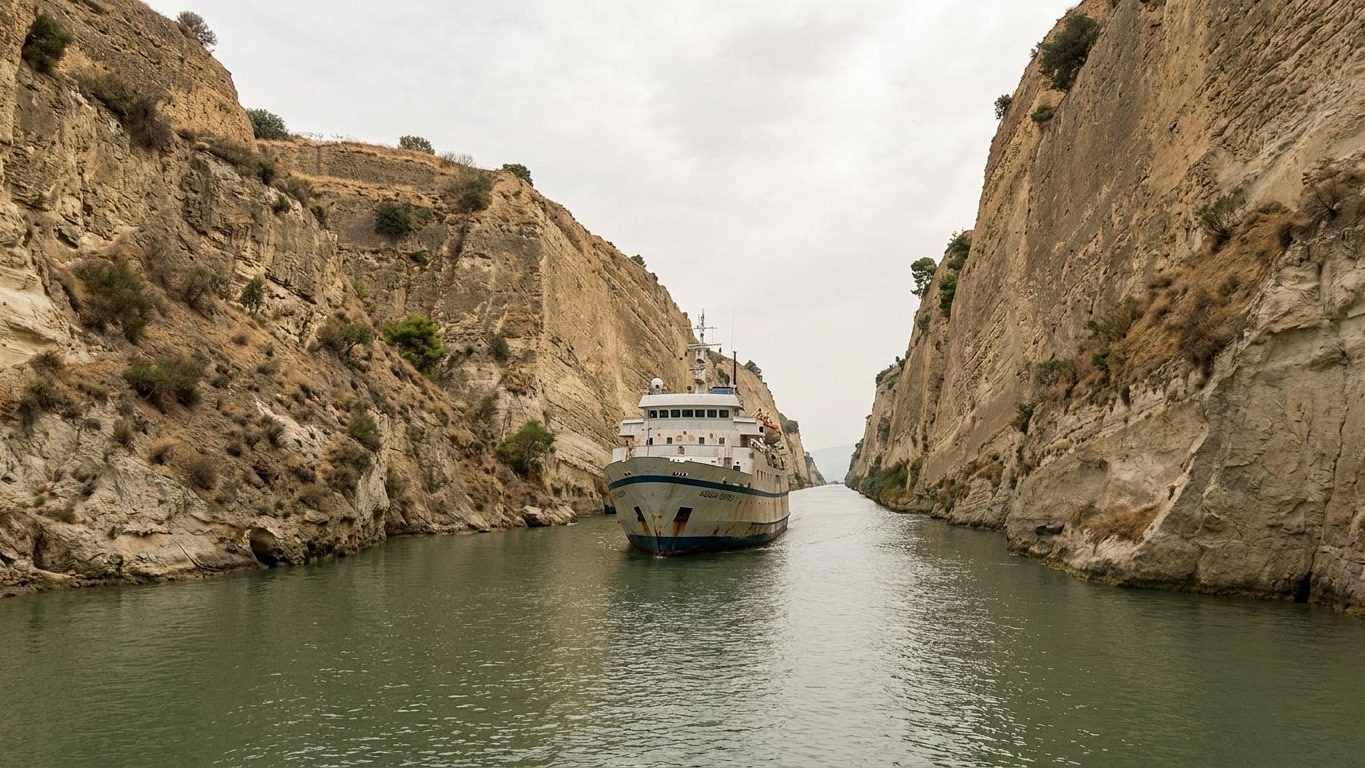
Six kilometers and three hundred forty‑three meters of limestone rock cut vertically, walls that rise up to about 90 meters above the water, and a surface width not exceeding 25 meters, narrowing to 21 meters at water level: the canal features steep limestone faces ascending to 90 meters in height and a depth of 8 meters, with a surface width of 25 meters narrowing to 21 meters at sea level, over a distance of 6.4 kilometers. This canal connects the Gulf of Corinth to the Saronic Gulf and severs continental Greece from the Peloponnese, turning this historic peninsula into an island overnight, the canal’s excavation having transformed the Peloponnese into an island. The shortcut saves around 325 nautical miles of navigation by avoiding the Peloponnese’s detour for ships that, without it, would have to skirt the entire peninsula along the south.
The problem: it has almost never accommodated the ships for which it was imagined.
The idea of such a passage goes back to the 7th century BCE, when the tyrant Periander of Corinth already considered piercing the isthmus, before abandoning the project in the face of its scale and turning to the Diolkos, a towpath for moving ships. Disheartened by the magnitude of the undertaking, he ultimately chose to have this chaussée built on which boats were literally wheeled from one gulf to the other on carts, a solution that sufficed for centuries. Seven centuries later, the Roman emperor Nero revived canal construction in the year 67, mobilizing Jewish prisoners captured during the First Jewish–Roman War. The work ground to a halt at his death, and the project was canceled after Nero’s death in 68 CE, the effort being abandoned for 1,800 years.
- The Corinth Canal is 6.4 kilometers long with a maximum width of 24.6 meters and a depth of 7.3 meters
- Modern ships, including container ships and tankers, far exceed these dimensions and cannot pass
- Built between 1881 and 1893, the canal was once perfectly suited to ships of its era but aged quickly
A gauge designed for another century
At the time of its inauguration, the canal perfectly matched the ships plying the Mediterranean: its width and depth more than sufficed for the hulls of the era, because the canal, completed in 1893, runs 6.4 km long but is only 21.4 meters wide at its base. Time, however, turned against it, since the canal opened in 1893 precisely as steel-hulled ships were replacing the older iron ships. Today, the maximum width allowed for a ship remains set at 24.6 meters, with a maximum draft of 7.3 meters, a vintage constraint compared with the standards of modern maritime transport.
Container ships and modern tankers far exceed these dimensions.
In 2019, the cruise ship MS Braemar became the largest vessel to squeeze through the channel, with only two or three feet of clearance on either side. When the canal closes for maintenance, the small boats that typically use it must bypass the entire Peloponnese, a detour of 185 nautical miles to travel between the Gulf of Corinth and the Saronic Gulf. The traffic, for its part, can only operate in one direction at a time, regulated by signals at both ends. Despite these constraints, the canal is mainly used by tourist ships, pleasure boats, and small cruise liners, with roughly 11,000 vessels passing through each year.
Walls that have never ceased collapsing
The fractured limestone of the isthmus, located in an active seismic zone, proves unstable from the earliest months of operation, because the heavily faulted nature of the sedimentary rock in a seismically active area poses a persistent problem. Between 1893 and 1940 alone, the structure accumulated a total of four years of closure for maintenance work aimed at stabilizing the walls.
In 1923 alone,
Sources: quebecnouvelles.com | shango.media
