
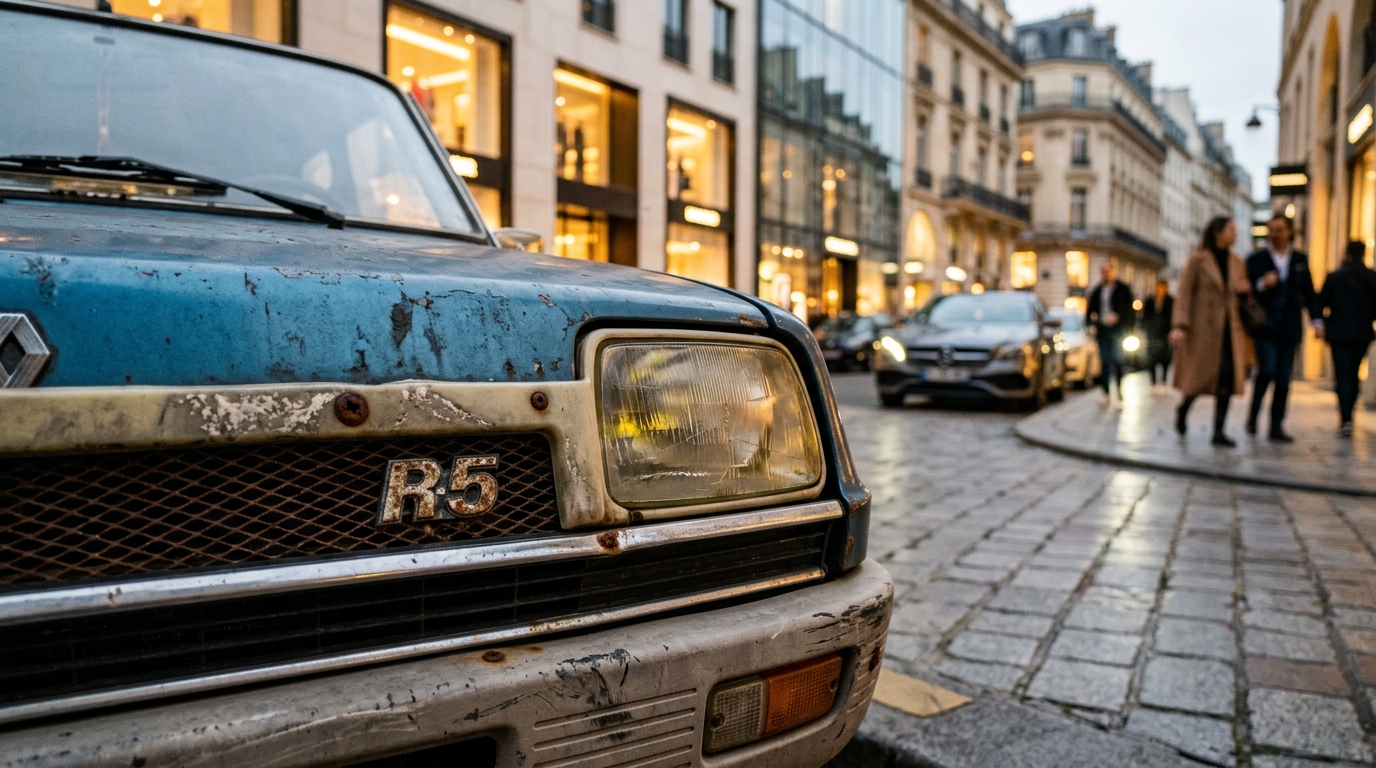
How much does the simple act of going to work cost when you live thirty kilometers from a city center? This question, seemingly trivial at first glance, has become an existential puzzle for millions of French people since the rollout of mobility low-emission zones. Designed to improve air quality in large urban areas, this system has gradually turned into a source of anxiety for those who cannot afford to switch vehicles, nor the luck to live near a reliable train station or bus line. A paradox that few political leaders anticipated, but one that a senatorial report highlighted with almost unsettling clarity.
- In Marseille’s 3rd arrondissement, the poorest in France, 52% of vehicles are classified as Crit’Air 5, 4 or 3 and are therefore subject to the bans.
- Despite aids such as the ecological bonus (up to €7,000) or the conversion premium (up to €6,000), the rate of non-take-up reaches about 50% according to France Urbaine.
- In spring 2026, Parliament voted to repeal the legal framework of the ZFE, but the Constitutional Council struck down that decision.
- The paradox of ZFE: protecting the air, excluding the poor
- Who are really the losers of low-emission zones
- When changing cars becomes an inaccessible luxury
- Metropolises under pressure: between proclaimed ecology and social fracture
- ZFE, Year III: what to take from this controversial scheme
The Paradox of ZFE: Protecting the Air, Excluding the Poor
The original aim was indeed laudable. By gradually banning the most polluting vehicles in 43 French metropolitan areas, the 2021 Climate and Resilience Law sought to cut fine-particle emissions responsible for thousands of premature deaths each year. On paper, the equation seemed simple: fewer old cars, less pollution, better health for all. Yet in practice, this linear reasoning overlooked a major detail: not everyone has the same capacity to adapt to such a sudden regulatory constraint.
That is precisely what a senatorial report published in 2023 highlighted, warning about a timetable deemed unsustainable for the poorest households. The text bluntly noted that the rapid rollout of these zones, without adequate support, was likely to place the burden primarily on those with the least financial leeway. In other words, the measure intended to protect the health of the most vulnerable populations risked, in practice, penalizing them even more.
Who Are Really the Losers of Low-Emission Zones
A mapping study of Greater Paris yielded an unambiguous finding: owners of polluting vehicles largely live outside the ZFE zones, and these are overwhelmingly low-income households. This data challenges the glossy image of the affluent urban resident driving diesel for comfort or habit. The reality is different, as it is often the financially constrained households that retain older vehicles because they cannot afford to replace them.
The example of Marseille’s 3rd arrondissement, considered the poorest district in France, perfectly illustrates this fracture. There, 52% of vehicles are classified as Crit’Air 5, 4 or 3, and thus directly affected by the progressive bans on circulation. For these residents, the car is not a luxury but often the only means to access employment, healthcare, or administrative tasks located in the city center.
When Changing Cars Becomes an Inaccessible Luxury
The ongoing rise in real estate prices in major cities has gradually pushed the most modest households toward peri-urban or rural areas, often poorly served by public transport. As a result, these families find themselves doubly penalized: by geographical distance and by the obligation to own a reliable vehicle to keep moving. Replacing an old car with a newer model, electric or hybrid, represents a substantial investment that many simply cannot afford.
Admittedly, aids exist. Since January 2023, the ecological bonus can reach up to €7,000 for households whose reference income per share is below €14,089, while the conversion premium can rise to €6,000 for the most modest households. The amounts may seem substantial, but they are often insufficient compared to the real price of a clean vehicle, and especially difficult to mobilize. France Urbaine, which represents France’s major cities, indeed estimates that the uptake rate of these aids reaches about 50%, due to a lack of clarity in the schemes. In other words, one in two households that could benefit simply gives up, discouraged by administrative complexity.
Metropolises Under Strain: Between Displayed Ecology and Social Fracture
Facing this finding, the senatorial report recommended preserving and strengthening a zero-interest loan dedicated to light clean vehicles, aimed at households and businesses located in or near the affected zones. The idea was simple: provide a real financial safety net to those who have no choice but to drive to live and work, rather than leaving them alone in the face of a regulatory constraint they cannot meet.
This tension between ecological ambition and social justice sparked intense debates in Parliament. An amendment to simply erase the low-emission mobility zones was filed and rejected by the National Assembly in early 2023. But the challenge did not stop there, and the issue remained a major point of contention in the French political landscape, revealing a widening gap between large metropolises and their outskirts.
ZFE, Year III: What Assessment Can be Drawn from this Controversial Scheme
In the 2026 return to work, the debate took a major turn. After years of controversy and alarming reports, Parliament finally voted, last spring, to repeal the legal framework of ZFE within a simplification law, but the Constitutional Council subsequently struck it down. A reversal that confirms, if there was any doubt, that the scheme had ended up crystallizing far more fractures than it had solved environmental problems.
What was meant to be a major health advancement has thus transformed, in the eyes of many local elected officials and lawmakers, into what the senators themselves feared as early as 2023: a true zone of strong exclusion, rather than a low-emission zone. The lesson from this episode goes well beyond the car question alone; it questions how environmental public policies are conceived, often conceived from urban centers without always measuring their tangible consequences on the lives of those who live on the margins.
One lingering question remains in debates on the ecological transition: how to reconcile climate urgency with social justice without sacrificing one for the other. For if the air in city centers must be cleaned up, it cannot be achieved at the price of excluding those who have no choice but to live far away, to drive old, and to hope that national solidarity will finally catch up with the eco-friendly intentions proclaimed.
