
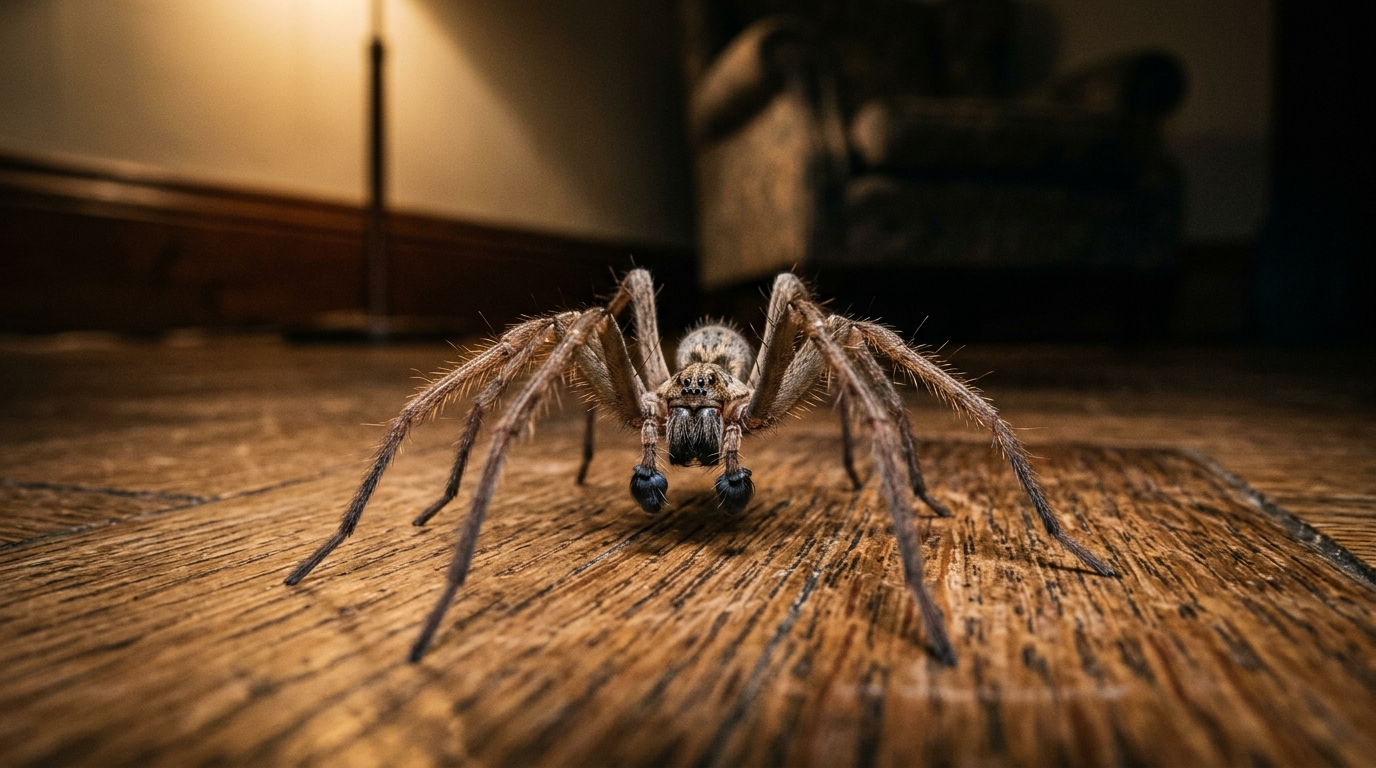
Every year the same scene repeats in thousands of French homes: a big spider appears in the dead of night, dashes across the living room at full speed, and sparks panic before vanishing under the sofa. The reflex is often the same: we imagine a creature driven by the cold, fleeing the garden to seek shelter in warmth. Yet that explanation, as appealing as it may be, does not reflect reality. What observing the behavior of these arachnids reveals is far more fascinating and noticeably less anxiety-inducing than one might think. For these spiders have not recently crossed your threshold: they have been living in your home for a long time, discreet and silent, and what changes in this season is only their behavior. Let us delve into the backstage of this autumn phenomenon that has stirred social media and hallway conversations for years.
- The Tegenaria spiders seen in autumn have already been living in the house for a long time; they don’t arrive from the outside cold.
- It is the adult males who wander in search of a mate, recognizable by their slender abdomen and swollen pedipalps.
- After mating, the male dies quickly, either from exhaustion or because the female devours him, while she can live for several years.
- The autumn invasion myth finally debunked
- These discreet residents who already share your home
- Why males suddenly come out of their hideouts in October
- A race against time that always ends in death
The Autumn Invasion Myth Finally Debunked
The idea of a massive migration of spiders fleeing dropping temperatures is tenacious, but it rests on a fairly simple misunderstanding of these animals’ biology. The large spiders we encounter in living rooms at this time largely belong to the Tegenaria group, and more precisely to the species known as the large domestic house spider. Yet these arachnids are by no means outdoor creatures seeking shelter from the cold. They do not come from the garden; they have never known lawns or flower beds: they have already lived among your walls, probably for months, or even since their birth.
What actually changes in autumn, therefore, is not their presence, but their visibility. In other words, they do not arrive at your home in October; they simply become apparent. And this nuance completely changes how we read the phenomenon. It is not an external invasion, but an internal behavior within a population that has been cohabiting with us for much longer than we imagine.
These Discreet Residents Who Already Share Your Home
If Tegenaria spiders stay invisible for so long, it is because they lead a particularly furtive lifestyle. The females, in particular, spend most of their lives tucked away in a funnel-shaped retreat, often woven in a dark corner, behind furniture, in a basement, or at the back of a closet. This characteristic architecture lets them monitor their surroundings without exposing themselves, waiting for prey to wander too close to their web.
This discretion explains why we rarely encounter the females, even though they are present in large numbers inside homes. Their sedentary nature is total: they hardly move at all, except when absolutely necessary. And it is precisely this stability that allows them to live two years or more, a remarkable longevity for a spider of this size. During this time, they eventually lay their eggs in a cocoon carefully hidden away, far from prying eyes, thereby ensuring the species’ continuity without ever leaving their territory.
Why Males Suddenly Leave Their Hideouts in October
The real trigger of this autumnal ballet is the adult male. Unlike the sedentary female, he abandons his shelter to embark on a frenzied quest: to find a mate. This purely seasonal behavior drives him to roam the house, mainly at night, covering distances that may seem trivial to us but represent a substantial effort for him. It is precisely during these nocturnal forays that he traverses the open spaces, such as the living room or the hallway, where we have the best chances of seeing him streak by at full speed.
Identifying a male is not hard once you know the right cues. His abdomen is noticeably slimmer than the female’s, and his legs appear proportionally longer, giving him that slender, fast silhouette that leaves a strong impression. But the most revealing detail is at the front of his body: two swollen pedipalps that look like miniature boxing gloves. These appendages are not for combat but for transferring sperm during mating, a crucial function in this reproductive cycle.
An arachnologist at the National Museum of Natural History, Christine Rollard, perfectly sums up this dynamic with an image as poetic as it is effective: she speaks of a Romeo in search of his Juliet. A phrase that aptly captures the urgency and determination that drive these males during this pivotal period of their lives.
A Race Against Time That Always Ends in Death
This autumn wander is far from trivial: it marks literally the last stage of the male’s life. This active-search behavior typically lasts four to six weeks, a relatively short window during which everything unfolds. Once mating is accomplished, the male’s fate is sealed. In the weeks that follow, he dies, sometimes simply from exhaustion after this exhausting quest, sometimes because the female herself ends his life by devouring him.
This sacrifice is not tragic biologically: it is part of a reproductive strategy where the essential has already been achieved. The male has transmitted his genetic material, and the rest of the cycle now rests entirely on the female, who will be able to live many more months, protected in her refuge, before giving birth to the next generation. Thus, among the Eratigena spiders of the Tegenaria group, it is indeed the adult males who roam in autumn to mate. Most of them had already been living in the house long before this period, and they die soon after fulfilling their sole reproductive mission.
So next time you see a spider dashing across your living room, remember that it is probably not an invader from the cold, but a discreet tenant who has been there for a long time, engaged in the final race of its life. A behavior that, once explained, loses much of its frightening edge to become what it truly is: a simple, brief yet fascinating episode in the grand cycle of animal reproduction.
