
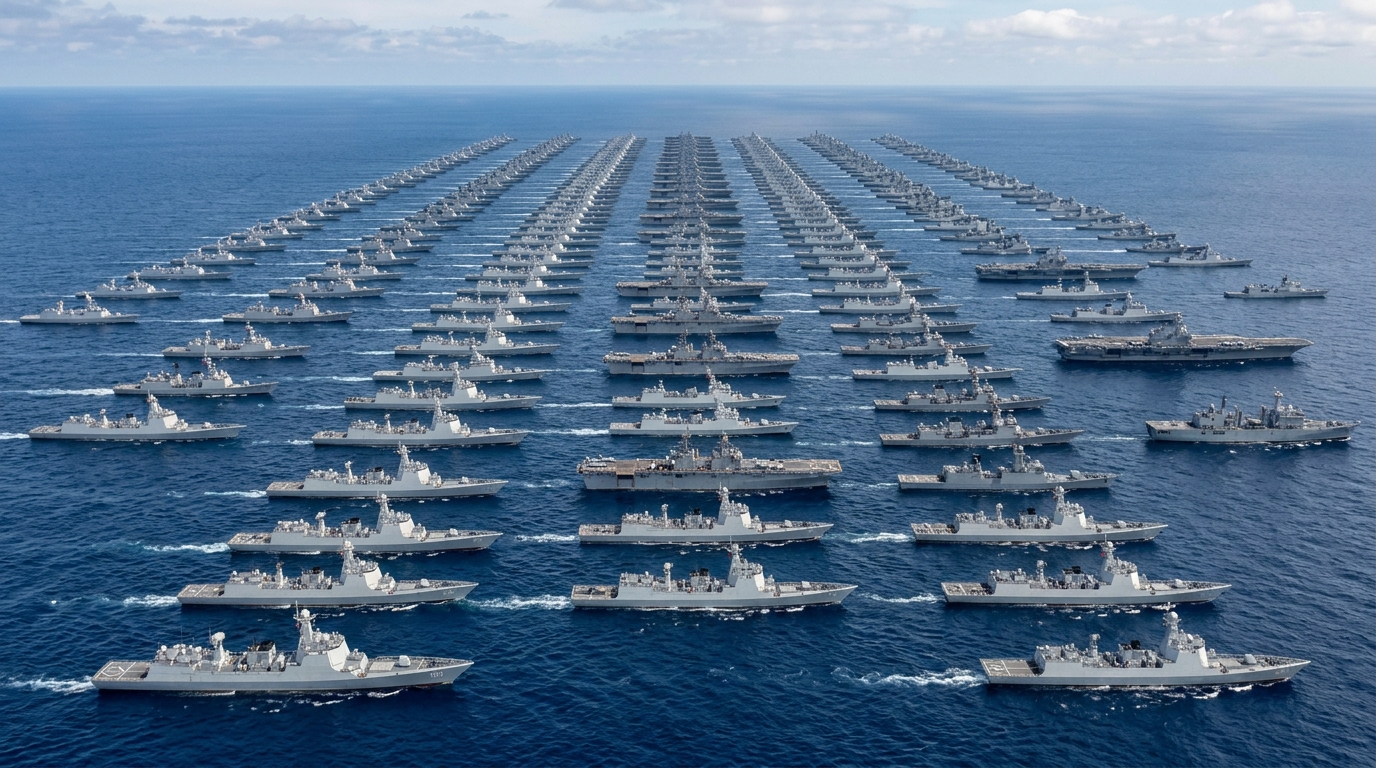
Useful clarification before we dive into the heart of the matter: the figures presented here rest on counts of ships in active service, not on the overall tonnage of fleets, two indicators that must not be confused. With that said, the information deserves careful attention. The Chinese navy now fields more than 370 warships, a total that officially puts it ahead of the American fleet in terms of the number of units. This shift, long anticipated by naval geopolitics specialists, has materialized before our eyes, almost quietly, far from the usual headlines about the Sino-American rivalry. For decades, the US Navy embodied global maritime power without contest. That is no longer entirely the case, at least if we count hulls rather than tons. Washington still holds a clear technological edge, but digital supremacy has, indeed, shifted allegiance. A major strategic drift is taking place in the silent waters of the Pacific, and it deserves to be explained clearly and at length.
- The Chinese navy counts roughly 370 warships against 295-296 for the US Navy, a gap that could reach 500 Chinese ships by 2030 according to a French parliamentary document
- The United States retains the advantage in tonnage, technological sophistication and operational experience, with China still lagging in long-range mission mastery
- China is expanding its international deployments, even to the Baltic Sea, and actively constructing new aircraft carriers, prompting France to bolster its national Navy
- The number that changes everything: how China doubled its fleet in two decades
- Quantity versus quality: why more ships does not mean more power
- The zones of tension where this fleet is already redrawing the balance of power
- The American response: budget, alliances and technologies against the numbers
The number that changes everything: how China doubled its fleet in two decades
Twenty years ago, no one would have bet on a scenario like this. The Chinese navy, once confined to a defensive and coastal role, has transformed into an ocean-going force capable of rivaling the planet’s largest naval powers. With roughly 370 ships and submarines in active service, it now outnumbers the US Navy, which counts between 295 and 296 by the most recent analyses. The gap, already substantial, could widen further, as a report mentions a Chinese fleet surpassing 400 vessels by year-end, i.e., about a hundred more ships than the American fleet.
What stands out most is the production pace. A former chief of staff of the French Navy recalled that in 2016 alone, China was launching the equivalent of the entire French fleet every four years. An industrial rhythm that is dizzying, and explained largely by the strength of Chinese shipyards, able to mass-produce frigates, destroyers and submarines with formidable efficiency. A French parliamentary document goes even further, mentioning a fleet that could reach 500 warships by 2030. If this trajectory is confirmed, the gap with Western navies will only widen in the years to come.
Quantity versus quality: why more ships does not necessarily mean more power
Before shouting about a total shift in global military power, we must keep things in perspective. The raw number of ships tells only part of the story. The US Navy maintains a clear advantage in overall tonnage, meaning its vessels are heavier, more capable, and often better equipped than their Chinese counterparts. It’s a bit like comparing a garage full of small hatchbacks to another with fewer vehicles, but each outfitted with far more powerful engines.
Operational experience also plays a decisive role. A French officer bluntly notes that China has not yet demonstrated the same mastery as the United States or France when it comes to conducting complex, long-range missions, far from its shores and logistics network. Deploying a naval force to the other side of the world, coordinating joint operations, ensuring replenishment at sea—these skills are learned over the long term and cannot be decreed overnight, even with an impressive fleet on paper. Quantity is impressive, but operational quality remains, for now, the prerogative of the most battle-hardened navies.
The zones of tension where this fleet is already redrawing the balance of power
If Beijing’s operational superiority remains debatable, its ability to project globally is no longer in question. The Chinese navy has significantly multiplied its deployments internationally, extending beyond the Pacific to reach the Atlantic. One episode particularly seized Western observers: an unprecedented passage of Chinese ships into the Baltic Sea, a region traditionally kept under close watch by NATO members. Such incursions, unimaginable just a few years ago, illustrate how Beijing now intends to affirm its presence on all of the world’s seas.
At the same time, the rise in carrier capabilities continues to advance, symbolizing the ultimate projection of power. The construction of a third Chinese aircraft carrier is well underway, and a fourth would already have been launched. This is a strong signal to the international community, because possessing a carrier fleet requires not only colossal financial resources but also an openly stated strategic ambition to operate far from home. The Indo-Pacific, in particular, concentrates the concerns, and several French parliamentarians are already urging a strengthening of the French Navy’s capabilities, deemed insufficient in the face of this buildup.
The American response: budget, alliances and technologies against the numbers
In the face of this numerical shift, the United States clearly has no intention of staying passive. Washington relies on several levers to compensate for its unit shortfall. The first remains technological: American ships remain generally more sophisticated, better armed, and equipped with more advanced detection and communication systems than their Chinese counterparts. The second lever is alliances. Unlike China, which often operates in naval isolation, the United States can count on a dense network of partners, from Japan to Australia and including European nations, to pool surveillance and deterrence capabilities in the Indo-Pacific region.
Then comes the budget question, which will likely be decisive in the years ahead. Building warships is costly, very costly indeed, and the ability to sustain a naval construction effort over time will depend directly on political choices made in Washington. China, by contrast, benefits from an industrial system capable of mass-producing at relatively lower costs, a structural advantage that could weigh heavily if the current trend persists. The battles of tomorrow’s seas will therefore not be fought solely on hull numbers, but on the ability of each side to combine quantity, quality and solid alliances.
This numerical shift, however spectacular on paper, does not imply an immediate reversal of the global military order. It does mark a deep evolution in maritime power dynamics, in which China asserts itself as a major actor capable of rivaling the great historical naval powers. For France and its European partners, the message is clear: there is an urgent need to rethink naval capabilities in light of this new reality, or risk seeing the Indo-Pacific permanently slip away from any balanced Western influence. The maritime history of the twenty-first century is being written before our very eyes, and the sequel promises to be just as gripping to follow.
