
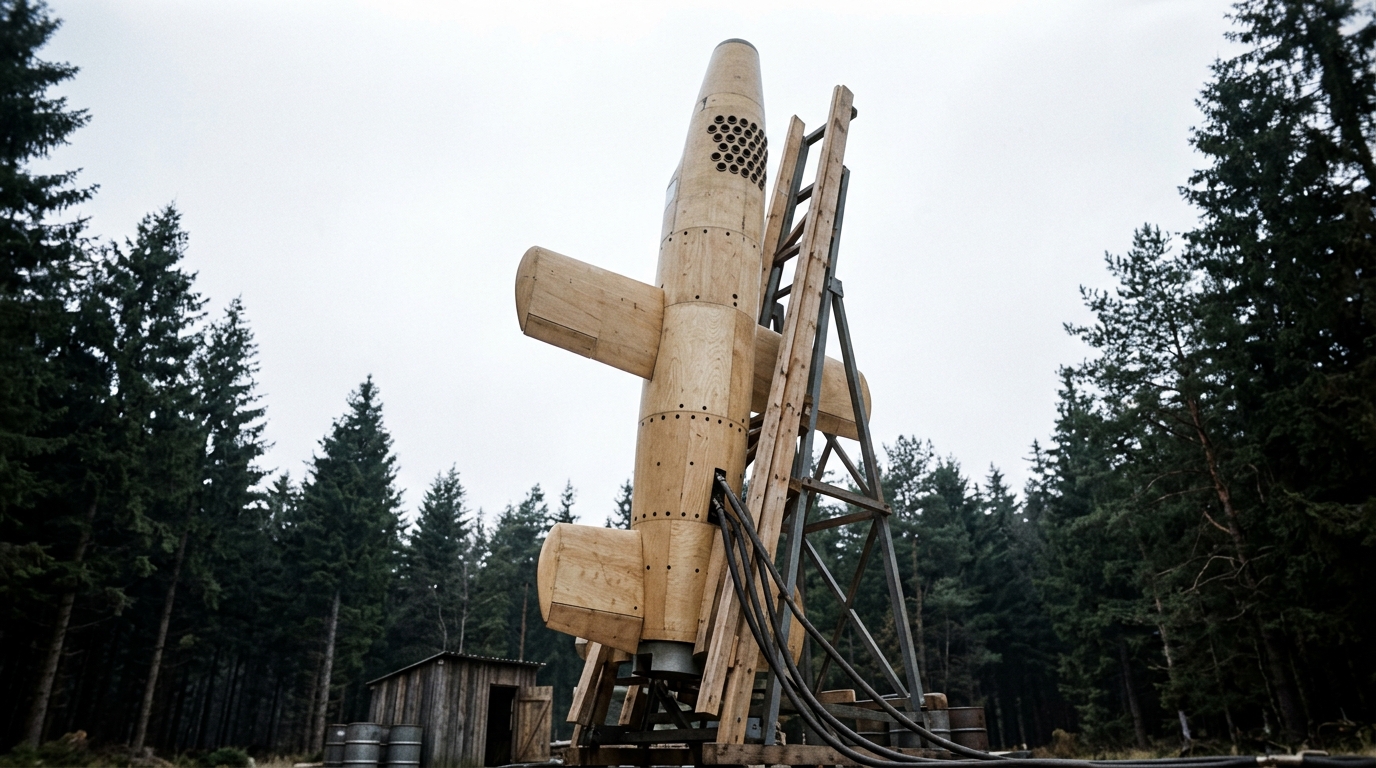
Important note: this account is based on documented historical facts and contains no invented data. In a time when space news regularly reminds us of the feats and risks of aerial adventure, it is useful to examine an obscure episode of World War II in which military urgency pushed German engineering to its limits. Imagine an aircraft that does not take off like a conventional plane, but springs from the ground vertically, powered by rocket engines, with a man aboard reduced to the role of mere spectator of his own trajectory. This is exactly what German test pilot Lothar Sieber experienced during a flight that remains tragically famous in the annals of military aviation. A look back at the Bachem Ba 349 Natter, a wooden interceptor born from the despair of a regime cornered by events.
- The Bachem Ba 349 Natter, designed by Erich Bachem in 1944, was a wooden interceptor that took off vertically using rocket engines, without the possibility of active piloting.
- On March 1, 1945, during the program’s sole manned flight, pilot Lothar Sieber died after the cockpit canopy ripped off in flight, causing the aircraft to crash.
- Of the 200 units initially ordered, only 36 were produced and none ever carried out an operational mission before the remaining aircraft were destroyed by the Germans.
- An aircraft you don’t pilot, you endure
- When wood and rocket replace aluminum and propeller
- Three minutes of flight, one pilot dead
- Why Berlin chose to bury its project rather than fix it
An aircraft you don’t pilot, you become its passenger
The very principle of the Natter upends everything known about traditional aviation. Unlike a classic fighter where the pilot maintains control from takeoff to landing, this interceptor literally transformed its occupant into a passenger aboard a rocket. The craft lifted off vertically, propelled by brutally powerful rocket engines, with no runway, no taxiing, and no margin for maneuver to correct a risky trajectory. The pilot thus found himself subjected to extreme accelerations, pressed against his seat, in a tiny cockpit where the slightest mechanical failure could prove fatal.
This radical design was not the product of a technical whim, but of an absolute strategic necessity. Faced with waves of Allied bombers pounding German territory with little effective opposition, Reich engineers sought a quick, cheap, and easy-to-produce solution on a mass scale. The Natter was thus intended to enable relatively inexperienced pilots to intercept enemy bombers, fire a volley of rockets, and then eject, the aircraft being designed for extensive sacrifice after each mission.
When wood and rocket replace aluminum and propeller
Designed in August 1944 by engineer Erich Bachem under the designation BP-20, this project addressed a major industrial constraint: Nazi Germany was severely short of strategic materials like aluminum, monopolized by the production of more conventional aircraft. The solution chosen was as radical as it was economical: construct the interceptor from wood, a plentiful, inexpensive material that was easy to work with, even by unskilled labor. This choice, far from being merely anecdotal, illustrates how exhausted the German industry was at this stage of the conflict.
The first tests began in mid-December 1944, with in-flight towing by a glider, before an initial unmanned takeoff was attempted a few days later. It was only in February 1945 that a full powered flight occurred, with a mannequin in the cockpit to validate the craft’s behavior under real propulsion. These successive tests, conducted under urgency and time pressure, already revealed the numerous technical uncertainties surrounding this ambitious yet rushed project.
Three minutes of flight, one pilot dead
On March 1, 1945, at the Lager Heuberg military camp in southern Germany, test pilot Lothar Sieber took his place aboard the Ba 349A M23 prototype for what would be the program’s only manned flight. The aircraft initially rose correctly, propelled by its rocket engines, reaching an altitude of about 500 meters. It was then that the cockpit canopy tore off violently in flight, probably due to intense vibrations or aerodynamic pressure that the structure could not withstand.
The craft then rolled onto its back, continuing its chaotic ascent to around 1,300 meters before diving toward the ground in a steep descent. Later analyses also suggested that one of the auxiliary boosters failed to detach properly, further destabilizing the already precarious behavior of the device. The flight, lasting roughly a minute by some estimates, covered nearly 14 kilometers in total, with an average speed calculated to be around 800 kilometers per hour. Lothar Sieber likely lost consciousness within the first moments of ascent due to the extreme accelerations, before the aircraft crashed, leaving no chance of survival for the pilot.
Why Berlin chose to bury its project rather than fix it
Remarkably, this fatal accident did not immediately halt the program. A further order for twenty Ba 349A units was placed in its wake, with delivery planned before May 10, 1945, evidence that the German high command, in the waning days of the conflict, still counted on this desperate weapon to try to slow Allied raids. Of the 200 units initially ordered, only 36 were ultimately produced, and about a dozen of them were assembled in the final days of the war.
Yet none of these aircraft ever carried out an operational mission. Facing the rapid collapse of the front and imminent capitulation, the Germans destroyed the remaining units to prevent them from falling into Allied hands. Nevertheless, one Natter was recovered and shipped to the United States after the war, to be evaluated by American engineers curious to understand the principles behind a design as bold as it was reckless. The project, rather than being refined, was simply abandoned, a casualty of its technical immaturity as well as the chaotic context of the war’s end.
This episode remains today a striking testament to what urgency and scarcity can push people to design, even at the expense of pilots’ most fundamental safety. The Natter embodies, in its own way, that frenzied technological race that characterized the final months of the conflict, where each side desperately sought an innovation capable of turning the tide of events. One question continues to captivate military history enthusiasts: how many other extreme projects were conceived, tested, and then abandoned in the shadows of those troubled years?
