
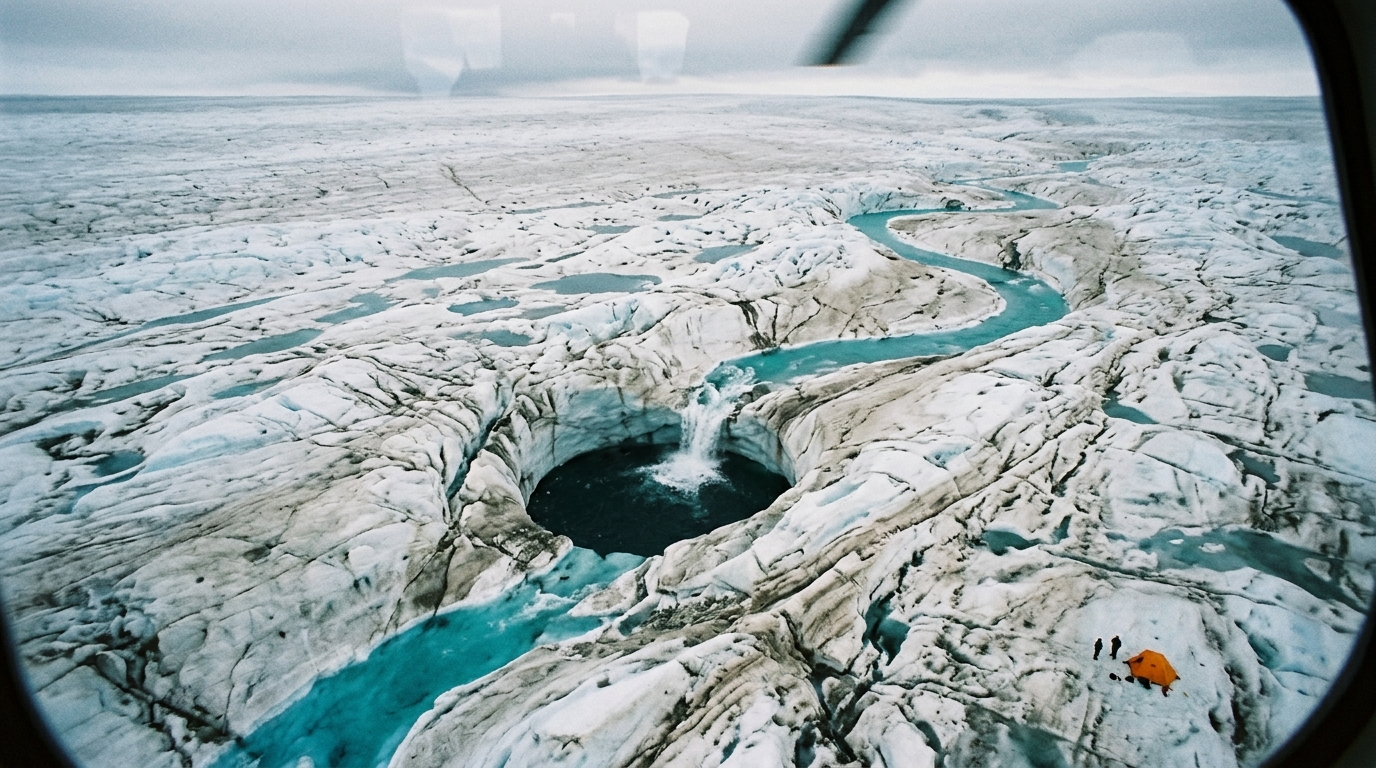
Imagine a giant bathtub perched atop the world, its stopper slowly starting to loosen a few decades ago. Today, it’s no longer a mere trickle but a veritable torrent: each year the Greenland ice sheet loses about 270 billion tonnes of ice. The cause has long been known—the warming of the planet gnawing at polar ice—but the scale of the phenomenon continues to surprise scientists. To make this vertigo-inducing figure a bit more tangible, NASA and several research teams decided to translate it into an image that many French people know well: a lake nestled between Switzerland and Haute-Savoie.
- The Greenland ice cap loses about 270 billion tonnes of ice per year, roughly three times the volume of Lake Léman erased from the map each year
- This melt has accelerated sharply since the 1980s, rising from around 60 to more than 260 billion tonnes annually, with five-sixths of it coming from warm ocean waters rather than the air
- The meltwater enters the Arctic Ocean and contributes to sea level rise, with effects already visible on low-lying coasts such as Florida, the Netherlands, or certain Pacific archipelagos
- 270 billion tonnes disappear from Greenland every year
- Three Lake Léman volumes erased from the map each year
- Why Greenlandic ice is melting faster than models had predicted
- The water already rising on coasts, from Geneva to New York
- What the Greenland ice sheet tells us about the decades to come
270 billion tonnes disappear from Greenland Every Year
The world’s largest island hosts an ice sheet that, fifty years ago, remained almost stable. In the 1980s, annual losses hovered around 60 billion tonnes. This figure exploded to 264 billion tonnes in the 2010s, a shift confirmed by cross-checked data from the European Space Agency’s CryoSat missions and NASA’s ICESat-2. Another estimate, published a little earlier, even spoke of an acceleration sevenfold in forty years, rising from 40 to more than 280 billion tonnes per year between the 1970s and 2010.
On the ground, this melt translates into an average thinning of 1.2 meters between 2010 and 2023, a figure that climbs locally to 6.4 meters in the zones most exposed to summer melt. Jakobshavn Glacier, one of the fastest on the planet, illustrates this drift by retreating now at nearly 50 meters per day. In human terms, we are almost witnessing the disappearance of a glacier that has stood for millennia in real time.
Three Lake Léman Volumes Erased from the Map Each Year
It is hard to picture concretely what 270 billion tonnes of water means. That is precisely where the comparison becomes meaningful for a French audience, especially for those living in the Léman region. Lake Léman, with its clear waters shared between Switzerland and the Haute-Savoie region, contains about 89 billion cubic meters of water. Since a tonne of water roughly equals a cubic meter, Greenland’s annual loss is equivalent to almost three times the volume of Léman, simply and repeatedly erased from the map each year.
This image helps grasp the magnitude of a phenomenon that, on paper, reduces to a string of zeros. It also helps explain why scientists are so worried: this is not a one-off loss, but a recurring pace that, according to several studies, even tends to accelerate. In other words, in a decade Greenland has already lost the equivalent of several dozen Lake Léman volumes, without showing any real sign of slowing.
Why Greenland’s Ice Is Melting Faster Than Models Predicted
For a long time, it was believed that polar ice melt stemmed mainly from warmer air arriving at the surface. The reality is more insidious. An analysis based on data collected since 1972 for Greenland and 1979 for Antarctica found that about 11,300 billion tonnes of ice have melted on these two ice sheets since the late 1970s, enough water to cover the entire continental United States with a layer of 1.5 meters thickness. Yet five-sixths of this melt would come not from the air but from warmer ocean waters, which gnaw at the ice sheets from below and at the sides, in a way reminiscent of ice melting from the inside before its surface softens.
Studies published in late 2023 reinforced this view: the melting speed of Greenland’s glaciers would have simply doubled in the past twenty years. This partly explains why climate models from previous decades were sometimes overly optimistic, underestimating this subterranean erosion driven by ocean depths rather than the sky above.
Water Rising Already on the Coasts, from Geneva to New York
This meltwater obviously does not vanish into nothing. It reaches the Arctic Ocean, where it produces a double-edged effect. On one hand, it carries nutrients rising from the depths and stimulates the growth of phytoplankton, the microscopic life that forms the base of the entire marine food chain. One could see a somewhat positive aspect, but this disruption of balance has far more problematic consequences: the disruption of traditional fishing zones, the reduction of sea-ice habitats where polar bears rest and hunt, and above all a direct contribution to sea level rise.
If this sea level rise remains, for now, invisible from the shores of Lake Geneva or the quays of Geneva, it is already felt much farther away on the low coasts of Florida, the Netherlands, or certain Pacific archipelagos. Greenland is not a local problem at the ends of the earth; it is a reservoir of freshwater that, as it drains, gradually redraws the coastline of the entire planet.
What the Greenland Ice Sheet Tells Us About the Coming Decades
Examining the evolution since the 1970s reveals a clear trend: what began as a small imbalance has become a continual hemorrhage, with acceleration sevenfold over a few decades. If this pace persists, or even intensifies as suggested by the latest observations of the melt rate doubling, the volumes of water released each year would continue to grow, with consequences for Arctic marine ecosystems as well as the most vulnerable coastal zones.
Greenland thus acts as a forward indicator, a giant thermometer that delivers, year after year, a health bulletin of the planet. Scientists continue to monitor these variations with increasingly precise instruments capable of measuring the ice surface altitude with centimeter-level accuracy from space.
Three Lake Léman volumes evaporating symbolically each year, a glacier retreating 50 meters per day, a sevenfold acceleration over decades: these figures, impressive as they are, represent only the visible portion of a far larger mechanism, in which the ocean itself becomes an accomplice to ice melt. The question remains how long nature will be able to absorb this imbalance before its consequences become, too, impossible to ignore from our own shores.
