
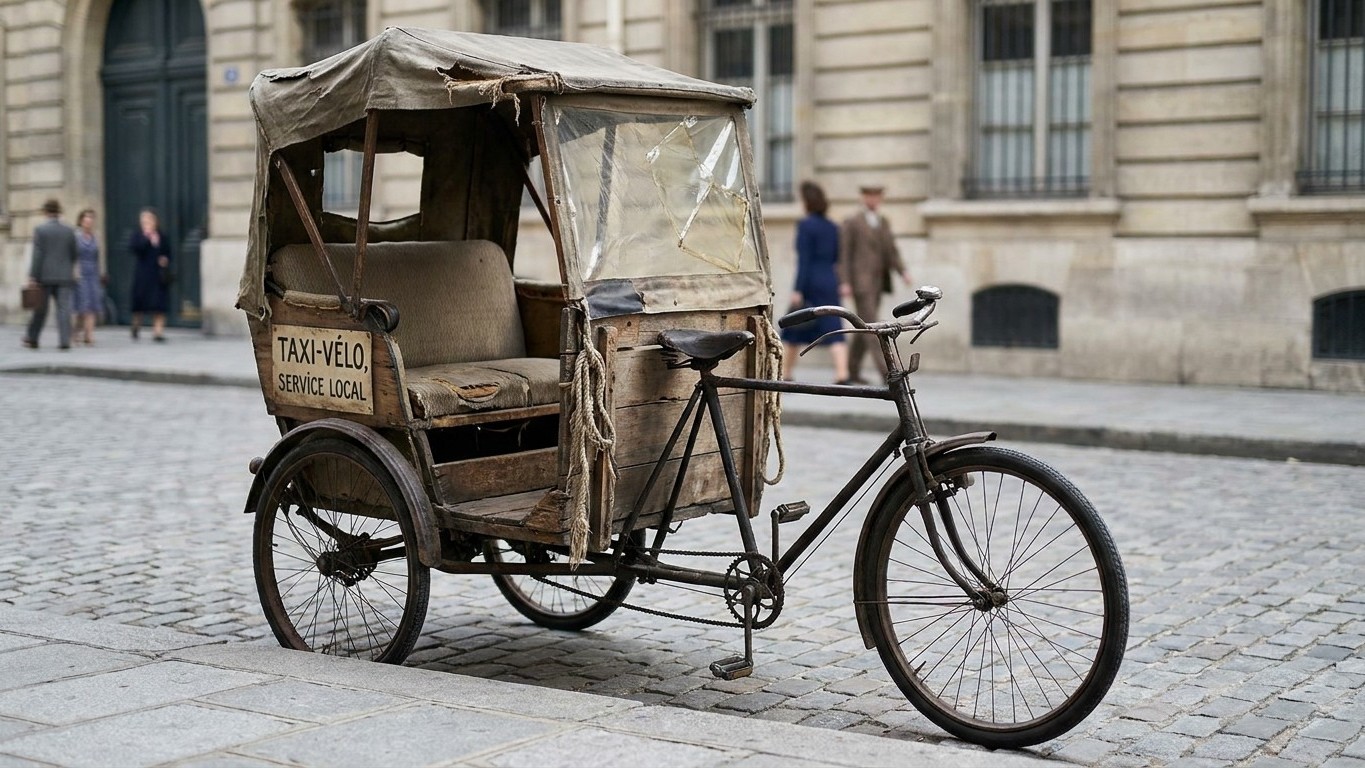
In 1941, a simple bicycle, a wooden trailer, two salvageable wheels, and sometimes a windscreen made of cellophane were all that a Parisian taxi looked like. When the German occupation commandeered gasoline and vehicles, Paris’s craftsmen did not wait long to devise a workaround. They hitched a two-seater trailer behind their bicycles, and the bicycle taxi was born.
Key takeaways
- How a simple bicycle transformed into a mass urban transport within a few weeks
- Why the Police Prefecture had to establish a regulatory frame to govern these new vehicles
- What surprising heritage today’s tourist bike-taxis actually inherit
A DIY hack becomes a profession in a few weeks
In June 1940, Fidèle Outterick becomes the first in France to convert a plain bicycle into a bike-taxi, by pairing a bicycle with a motorcycle to assemble an initial prototype that would be refined later. The idea quickly spreads. With automobiles nearly vanishing, everyone starts tinkering with their own contraptions, using whatever is at hand: a plank, a few cushions for a makeshift bench, and the job is done.
Some models remain rudimentary, while others evolve into real little cabs. The Imperial War Museum’s records describe a typical late-war bicycle taxi, built on two old bicycle wheels and equipped with a wooden box wrapped in an improvised canopy, with a cellophane windshield to shield riders from Parisian rain. It’s a homemade bicycle taxi, with a cellophane windshield, a makeshift canopy, two old bicycle wheels, and a wooden crate, though factory-made versions circulated as well during the same period. The phenomenon grew to such an extent that by October 1940 the first bike-taxi race on the slopes of Montmartre was organized, proof that the object had entered Paris’s folklore.
The Police Prefecture regulates the new trade
A bike-taxi did not spring up haphazardly in occupied Paris. Automobile traffic was tightly controlled: a March 13, 1941 decree required cars to have authorization from the Prefecture to circulate, with a maximum speed of 40 km/h for cars and 20 km/h for trucks. Even bicycles were swept into the bureaucracy: bikes had to bear a license plate and were subjected to a speed limit, with a yellow plate bearing black digits fixed to the rear fender under the reflector. A bike-taxi operating without authorization risked a guaranteed fine.
Prices, however, were set by a flat-rate, not by a meter, precisely because there was no meter to begin with. In 1943, bike-taxi drivers were paid a 5-franc pickup fee and 9 francs per kilometer, a sum to be weighed against the era’s average monthly salary of around 2,500 francs. Two years later, prices surged with wartime inflation: a bike-taxi ride cost roughly 400 francs per mile, a rate comparable to that of a motor taxi, as noted by British archives at the Imperial War Museum. Both pedal and motor drivers justified their charges the same way: fuel costs or black-market provisions for food were the practical needs they faced.
A few motor taxis, many gasogène vehicles
Of the 20,000 taxis that roamed Paris before the war, almost none ran on pure gasoline by 1941. A handful of motor taxis remained in operation, extremely rare; the rest were replaced by bicycle taxis, either solo or in tandem, driven by strong men who avoided unemployment and earned solid daily returns. The few motorized taxis that persisted ran on gasogen, a system that converts wood or coal into combustible gas and could power both private cars and certain taxis. With the energy crisis triggered by the war, taxis nearly disappeared, and the surviving ones used gasogen, while bicycle taxis and even carriages reappeared with fixed fares.
The bicycle then literally flooded the city. The number of bicycles in circulation was estimated at 10.7 million in 1942, a dizzying figure that illustrates the scale of the shift. Paris’s Halles, once crowded with trucks and cars, found themselves surrounded by more handcarts and bicycles than gasoline-powered vehicles parked in the square. The bicycle—long associated with the working class—began to become a badge of distinction for Parisian elites, who faced few alternatives.
The slow renaissance of the automobile taxi
It would take until the Liberation to see motor taxis return in meaningful numbers. In 1945, taxis gradually resurfaced: about 1,000 in the capital, a small figure compared with the prewar 20,000, but marking the beginning of a return to normalcy. The bike-taxi, meanwhile, did not vanish overnight: organized rides on Montmartre continued to attract crowds for several years after the fighting ended, and it would be 1950 before these hybrid vehicles finally disappeared from Paris’ streets.
One lingering, amusing question for those pedaling today through Paris in a cargo bike or a tourist bike-taxi near the great monuments: this mode of transport, touted as a green innovation of the 21st century, is ultimately only the resurrection of a system conceived in emergency, under constraint, by Parisian artisans who had run out of gasoline.
Sources: gpmetropole-infos.fr | iwm.org.uk
