
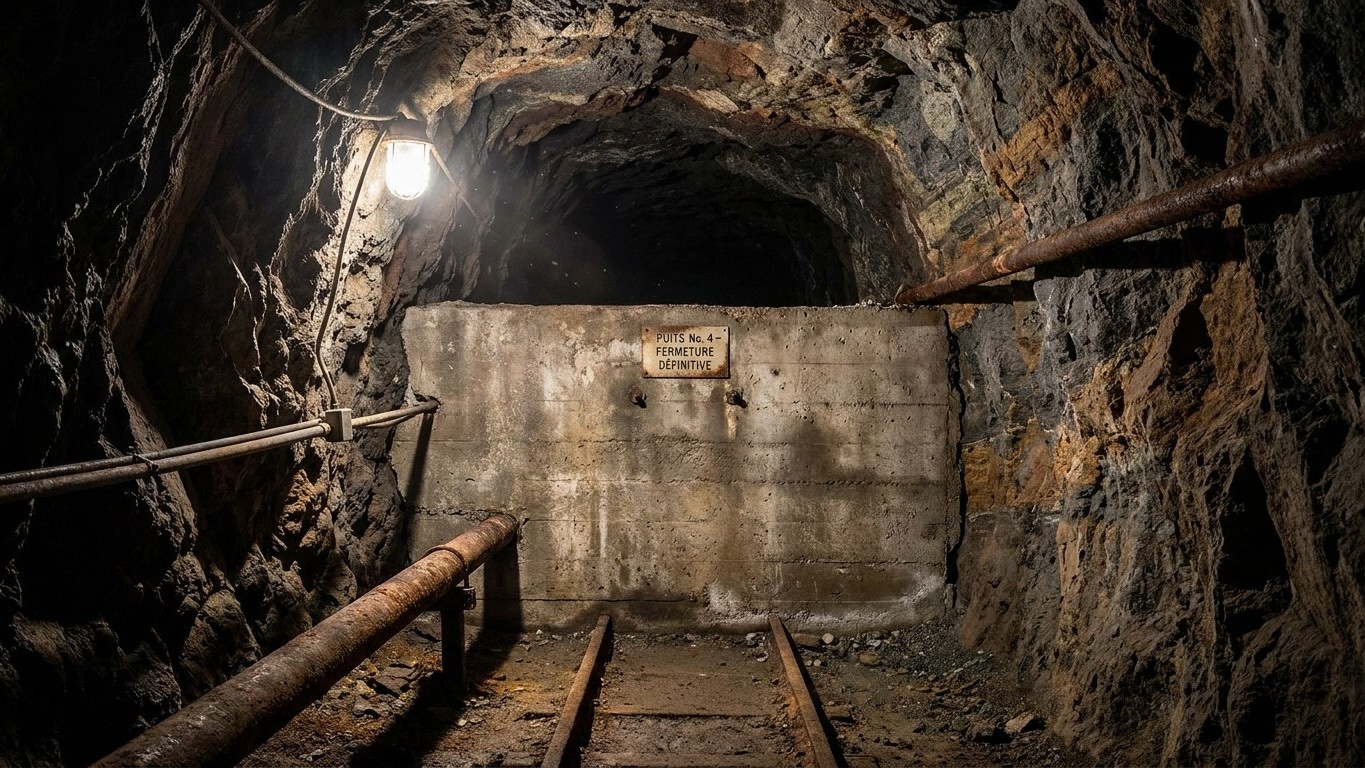
Forty-four thousand tonnes of extremely toxic industrial waste, buried more than 500 metres underground in the Alsace soil: that is the record of the StocaMine site, at Wittelsheim, which the State had sold as reversible storage. After two decades of proceedings, the justice system has ruled in favor of permanent confinement. The waste will not rise to the surface. It will remain sealed behind concrete barriers, beneath one of the continent’s largest groundwater reserves.
The State’s initial commitment, established in the prefectural order of February 3, 1997, authorized Stocamine, a subsidiary of the public company Mines de potasse d’Alsace, to store ultimate industrial waste in Wittelsheim, north of Mulhouse, in a reversible manner. The principle looked attractive on paper: to use the abandoned galleries of a former potash mine, dug in rock salt, to store what industry in France could no longer treat. It is the only site in France that was authorized to host waste of “class 0,” i.e., materials deemed “particularly dangerous.” Arsenic, cyanide, mercury, asbestos, pesticide residues: between 1999 and 2002, 44,000 tonnes of waste contaminated with mercury, cyanide, asbestos, or chromium were placed in mine galleries dug 550 metres deep.
Key takeaways
- A fire in 2002 froze what was supposed to be temporary
- The Alsatian groundwater aquifer, a major drinking-water reserve in Europe, remains at the heart of the stakes
- Twenty-three years after the storage began, the courts confirm: extraction is impossible, permanent confinement
A fire that froze it all
September 10, 2002 changed the situation. A fire ended Stocamine’s activity. The disaster broke out in the famous Block 15 and, according to contemporary accounts, it would take several weeks to bring it completely under control. The operation stopped abruptly, with tens of thousands of tonnes already buried, trapped in galleries that were not expected to have to be closed so quickly. Since then, the site has never reopened normally: since then, the waste already stored has largely remained within the site.
A withdrawal attempt did take place between 2014 and 2017, but it remained symbolic in the face of the scale of the problem. About 2,000 tonnes of waste containing mercury, thus particularly dangerous for soils, were extracted. A drop in the ocean compared with the tens of thousands of tonnes still sleeping in the mine’s bowels. And as time passed, the option of complete destocking became riskier: the galleries, left without maintenance, deteriorated year after year.
The haunting of the groundwater aquifer
What makes this local file an European issue is its location. This industrial dump lies beneath Alsace’s groundwater aquifer, one of Europe’s most important sources of drinking water. An aquifer that knows no borders: it feeds the Rhine basin into Germany and Switzerland. A contamination at Wittelsheim would not stay a French-only problem.
The opponents of the project, associations and local authorities at the forefront, have never hidden their worry on this precise point. They respond to the call from opponents to the Stocamine project, supported by the State, which envisages burying, for eternity, under the aquifer, 42,000 tonnes of waste contaminated by arsenic, cyanide, or asbestos. Even the operators charged with reassuring the population never promised zero risk. Supported by studies and mathematical models, the MDPA asserted that the impact on the aquifer would be negligible, even if pollutants would reach the drinking-water reserve sooner or later. A nuance that, for residents, reads like an admission.
Two decades of judicial wrangling
After years of contradictory expert opinions, the decision came on January 18, 2021: the Minister of Ecological Transition Barbara Pompili decided to bury permanently the dangerous industrial wastes in the depths of Stocamine, provoking the anger of those who argued for extracting as much as possible before closing the site. A decision that does not close the dossier: it opens a new wave of appeals. In October 2021, the Administrative Court of Appeal of Nancy annulled the prefectural order authorizing storage for an unlimited duration, deeming the financial guarantees insufficient. The government responded a few weeks later by inserting a state financial guarantee in favor of the MDPA in the 2022 finance law, allowing the confinement works to be relaunched.
The work resumed in May 2022 with the casting of the first barriers, but each step was challenged in court. Following a challenge by the Alsace Nature association, which calls for the extraction of these wastes, the Administrative Court of Strasbourg suspended on November 7, 2023, in interim proceedings, the prefectural authorization to proceed with the permanent burial. This decision was welcomed by environmentalists because it mobilized, for the first time in this dossier, the idea of the rights of future generations. The Conseil d’État eventually lifted this blockage in early 2024, authorizing the resumption of operations.
The judicial resolution arrived on June 17, 2025. The Administrative Court of Strasbourg rejected the requests by associations and local authorities seeking the destocking of the 42,000 tonnes of toxic waste at the Wittelsheim site. The judges aligned with the opinion of a public rapporteur who, a month earlier, had already ruled in this sense after weighing the environmental risks of the two options. Cyanide, arsenic, these “ultimate” elements, which can no longer be treated or depolluted, will therefore remain in the gallery of the former potash mine. The court also found that destocking is no longer an option “under acceptable safety conditions for personnel and environmental risk.” This judgment may be appealed within two months to the Administrative Court of Appeal of Nancy.
What confinement concretely entails
The scheme chosen is nothing like a simple symbolic plug. It is essentially about backfilling the empty galleries, then isolating the storage from its surroundings by installing twelve concrete barriers, each 12 metres long, to close all galleries leading to the storage zone, backfilling the wells, creating two sealing plugs intended to limit water infiltration into the wells, and covering each well with a reinforced concrete protection slab. Each barrier combines several segments of concrete and salt, filling the entire width of the gallery to be closed.
The financial argument weighed in the debates, even if the authorities had always denied making it a decisive criterion. The cost of complete destocking was estimated at between 309 and 384 million euros, versus 181 million for confinement, a gap that the opposing associations deem secondary in light of health concerns. There remains one rarely emphasized fact: a criminal investigation has been open since July 2021 with the Office central de lutte contre les atteintes à l’environnement et à la santé publique, proof that the StocaMine case is not merely about concrete and administrative procedure, but also a question of accountability that may resurface in court long after the last plugs have been poured.
Sources: strasbourg.tribunal-administratif.fr | francebleu.fr | nancy.cour-administrative-appel.fr
