
The Tronçais State Forest in the Allier owes its existence to a minister more accustomed to arsenals than to groves. Developed by Colbert, Louis XIV’s minister, it is renowned for sheltering one of Europe’s finest stands of oaks, with some trees several centuries old. Colbert initiated the renovation and reforestation of the forest, creating a timber reserve for naval construction. This massif, one of the most beautiful in France, now covers 10,583 hectares.
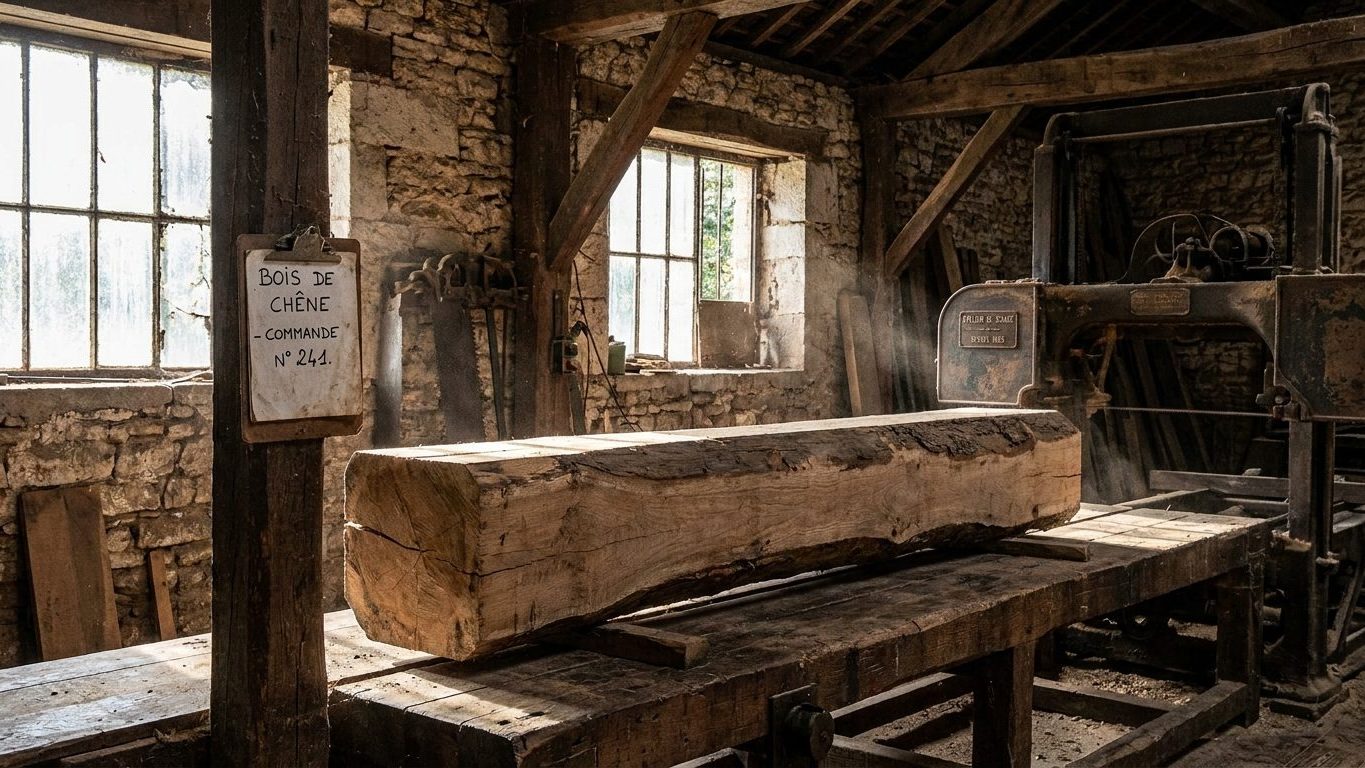
Every October, Tronçais wood hosts its grand autumn sale, one of the most renowned for merrain oak used in cooperage, attracting sawyers, merandiers (wood traders), and coopers. This oak, prized since the 17th century for outfitting the king’s ships, ends today in the barrels of the greatest wines, from Bordeaux to Cognac.
Part of the harvest, however, will never be sawn in France.
- 400 oak sawmills have closed in France since 2005, taking with them generations of know-how
- Foreign traders bid up at public auctions thanks to margins wider than those of French sawyers
- French oak ships out in containers to Asia, returns transformed into parquet or furniture, depriving France of 6 billion euros of added value
Auctions, where price rules
The mechanism is simple in a few lines, yet it weighs heavily on sawmills. In France, the sale of the logs from state forests is conducted by auction; the material goes to the highest bidder. Today, foreign traders participate in these auctions with financial resources far exceeding those of French buyers. A purchaser who factors in maritime freight and a cheaper sawing workforce than in France can afford to bid higher than a local mill, bound by tight margins and a just-in-time operation. The log then heads to a port, and then into a container.
When the mill closes, an entire savoir-faire fades away with it.
According to parliamentary questions citing sector figures, about 400 oak sawmills have disappeared in France since 2005, and the wood sector has shed around 50,000 jobs in ten years. It’s not just about cubic meters. Oak does not yield the same wood depending on whether it grew in the Tronçais forest or in the Morvan, which affects characteristics and, often, prices—expertise that only generations of locally established sawyers truly know how to read.
Countermoves, but holes in the racket
Facing the pressure, the state and the ONF (National Office of Forestry) eventually took action. A decree of September 12, 2015 reserved certain oak lots sold by the ONF to companies holding the “Transformation European Union” label, but lots from private forests are not covered by this measure. It is precisely in private forests that a large portion of the battle is fought. The sector has also leaned on multi-year supply contracts, which guarantee a defined wood supply in advance and provide French companies with visibility in the face of fluctuating markets.
The pressure, however, never truly ceased.
The contract signed between the State and the ONF for the 2021-2025 period sets an objective of 75% of mobilized volumes in state forests being sold by contract, versus 35% in municipal forests. Still, these commitments cover only a portion of the oak placed on the market each year. The labeled lots and reserved contracts remain bulwarks, not full barriers.
What the end customer ultimately pays
The oak shipped in containers does not vanish from the French economy; it simply returns transformed elsewhere. Part goes back out, once sawn, sanded, and assembled thousands of kilometers away, in the form of parquet or furniture that ends up on French shelves. A portion of the wood sector’s value added thus escapes the country, contributing, according to lawmakers, up to 6 billion euros to the exterior trade deficit. The buyer of a solid oak parquet often does not realize that the tree grew a few kilometers from home before making a round trip across the globe.
The autumn timber sales on standing trees are currently taking place in French forests.
The paradox ends at the doors of the cooperage. The year 2024 marked the end of a favorable cycle for barrel sales, with France remaining the world’s leading producer and exporter of barrels, using its regular oak. In this specific segment, the value added remains French, from merrain to barrel. The oak planted under Colbert continues to age peacefully at Tronçais, awaiting the next autumn auctions.
Sources: senat.fr | couleuvre-troncais.fr | assemblee-nationale.fr
