
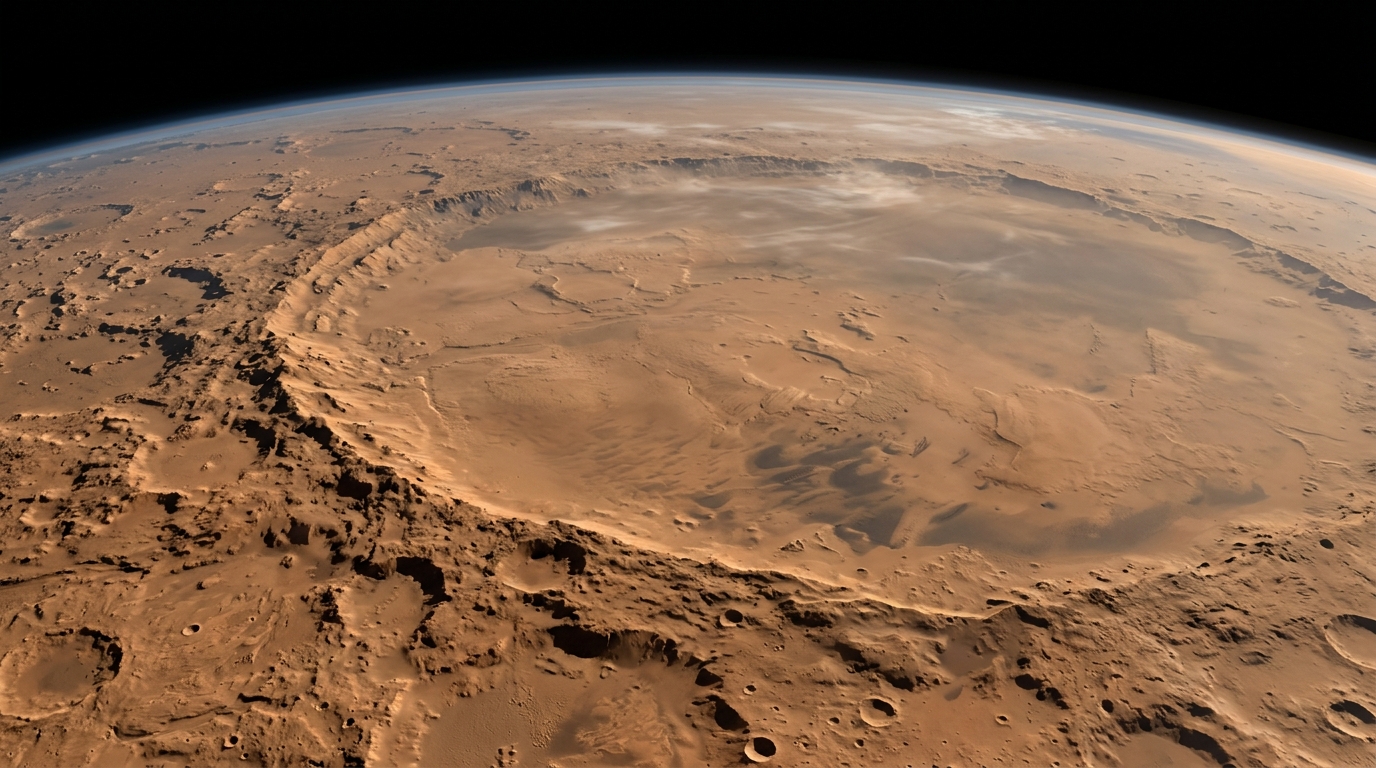
Before you get carried away and imagine rivers flowing across the surface of the Red Planet, a clarification is in order: this isn’t a rediscovered ocean, but an extremely narrow physical window where the laws of thermodynamics permit, for the first time, the existence of liquid water on Mars. A detail that nonetheless changes a great deal about how we perceive this planet, which we believed to be stuck in a frozen desert state beyond repair.
- At the bottom of Hellas Planitia, atmospheric pressure reaches 1,155 pascals, surpassing water’s triple point (611 pascals), which allows ice to melt rather than sublimate.
- This liquid water could exist only as a highly saline brine, appearing in brief, localized episodes tied to seasonal variations.
- This discovery makes Hellas Planitia a top priority target for future missions seeking traces of Martian life.
- Hellas Planitia, the crater that defies the laws of Mars
- The water triple point, this physical boundary finally crossed
- Liquid water on Mars, a furtive but real window
- What this discovery changes for the search for Martian life
Beneath the dusty plains of Hellas Planitia, at a depth of 7,000 meters, lies an impact basin so vast it spans nearly 2,300 kilometers. A giant chasm, a relic of a cosmic collision that occurred billions of years ago, which could well hold the key to a mystery long left unsolved: how could water survive in a liquid state on a planet where the atmospheric pressure is, on average, one hundred times lower than on Earth?
Hellas Planitia, the crater that defies the laws of Mars
It is impossible to discuss Mars without acknowledging its immense geological scars, testimony to a tumultuous past. Among them, Hellas Planitia holds a special place. This impact crater, one of the largest in the entire solar system, sinks so deeply into the Martian crust that it locally creates atmospheric conditions that differ radically from the rest of the planet.
On the high Martian plateaus, the air is so thin that any water, if it were liquid, would evaporate almost instantaneously. Yet at the bottom of this gigantic natural funnel, the situation changes dramatically. The basin’s exceptional depth, combined with gravity, allows the atmosphere to compress and reach pressures well above what is measured elsewhere on the planet.
The water triple point, this physical boundary finally crossed
To grasp why this detail matters so much, one must consider a key concept in physics: the water triple point. It is the precise threshold of pressure and temperature at which water can coexist in its solid, liquid, and gaseous states. Below this threshold, fixed at 611 pascals, ice never melts: it sublimates directly into vapor without passing through the liquid phase.
But at the bottom of Hellas Planitia, the atmospheric pressure climbs to 1,155 pascals, almost double this critical limit. In concrete terms, this means that the Martian ice in this region now has the physical margin to melt instead of instantly sublimating. A difference that may seem minor, but it represents a fundamental shift in our understanding of the Martian water cycle.
Liquid water on Mars, a fleeting but real window
However, do not imagine pristine, tranquil puddles. To survive even a few moments at freezing temperatures, this water would have to be extremely saline, forming what scientists call brine. This salty concoction lowers the freezing point of water, much like the salt used on winter roads to prevent ice formation.
If it exists at all, this liquid water would not be abundant or permanent. It would appear as brief, localized episodes, probably tied to seasonal variations or the partial melting of buried ice deposits. A fleeting window, in short, but enough to upend the image of a completely dried-out Mars that has long been painted.
What this discovery changes for the search for Martian life
Where this finding gains its full significance is in the field of exobiology. Across Earth, liquid water is known to be the essential ingredient for the emergence and sustenance of life. Finding a spot on Mars where this condition can be met, even transiently, instantly elevates Hellas Planitia to a top priority for upcoming exploration missions.
This giant impact basin becomes one of the most scrutinized sites on the Red Planet, in the hope of detecting traces, even tiny ones, of past or present biological activity. A brine capable of persisting for a few hours or days could shelter extremely hardy microorganisms, akin to those found in Earth’s most hostile environments.
In this season of spaceflight news that continues to surprise us, Hellas Planitia reminds us how much Mars still holds in reserve as a mystery, despite decades of robotic exploration. This deep crater, once considered merely a geological curiosity, now stands as one of the few places where the boundary between a sterile world and a potentially habitable one becomes unexpectedly blurred. An invitation to keep exploring, patiently, the secrets buried beneath the red dust of our planetary neighbor.
Source: Wikipedia
