
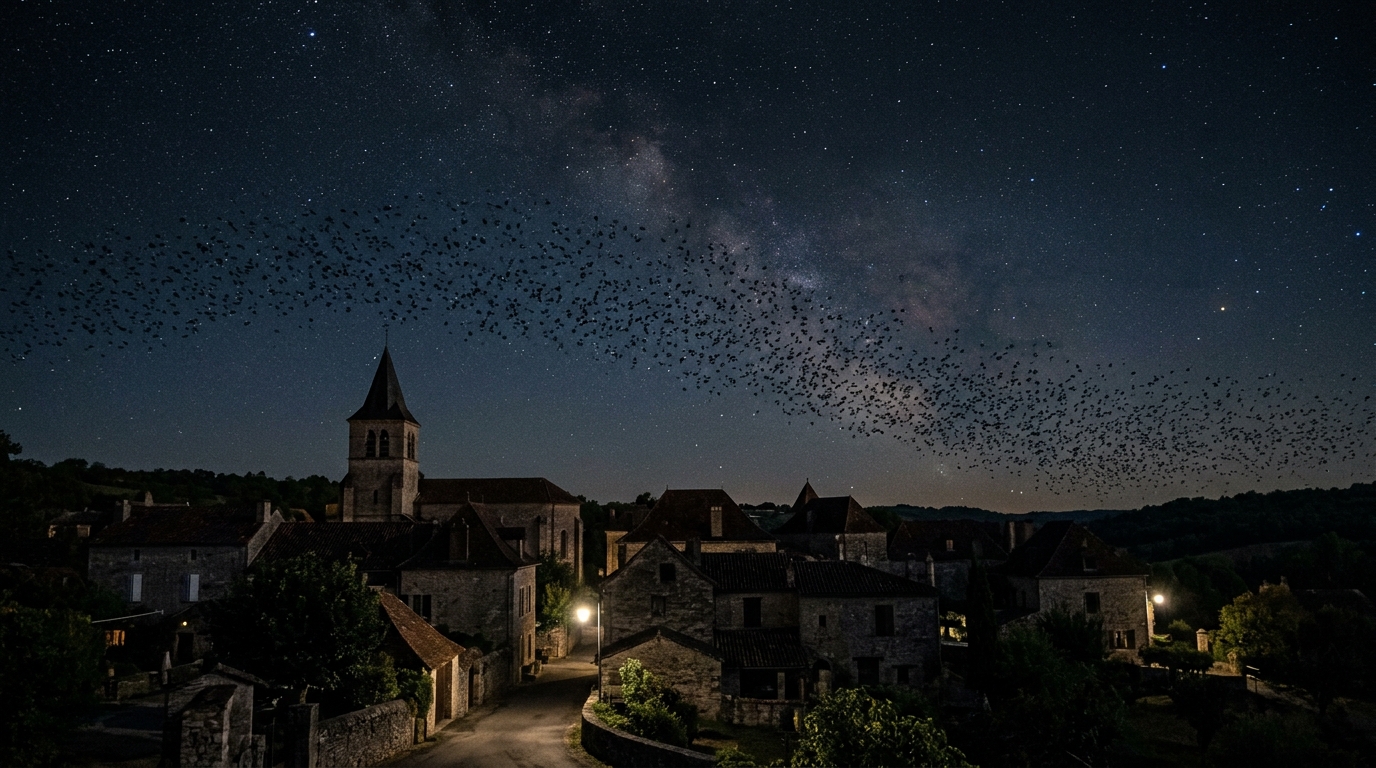
Each year at the start of September, as France settles into the gentle charm of the first cool evenings, a phenomenon of vertiginous scale unfolds right above our heads, between sunset and sunrise. Millions of birds cross the country in total darkness, using air corridors that no eye has ever been able to observe. This nocturnal ballet, invisible from the ground, leaves a very real trace: that of weather radars, the very devices meant to monitor rain and storms, which every night pick up a strange, dense, moving signal that has nothing to do with atmospheric disturbance. Here is the story of clandestine air traffic that has played out under our windows for millions of years, and which technology is only now beginning to pierce.
A weather radar that spies wings rather than clouds
Meteorological radars were designed with a single, clear mission: to detect precipitation, measure storm intensity, and forecast storms. Their principle rests on sending waves that bounce off water droplets in the atmosphere, enabling real-time mapping of clouds. But these devices, installed across Europe, also record something else: biological echoes. In plain terms, radar waves don’t merely distinguish between a cloud and clear sky; they also respond to thousands of small solid bodies in motion, namely migratory birds.
Every September night, these radars thus display signatures that could be mistaken for a storm disturbance, with dense masses moving across the screen, following coherent trajectories and progressing at a steady speed. The essential difference lies in the shape of the signal and its evolution: whereas a cloud disperses or intensifies according to well-known physical laws, these mysterious swathes behave like living organisms, changing course, speeding up or slowing down according to rules tied to animal flight. Meteorologists, who for a long time regarded these interferences as mere parasites, now know that they are observing, in fact, the largest movement of animals in Europe, without even having looked for it.
Midnight, the peak hour of a sky we never watch
If one were to chart the densest air traffic above France, it would look nothing like the map of commercial flights. The peak activity does not occur in the late afternoon, as with passenger aviation, but well after nightfall, typically between midnight and the first light of dawn. It is at this hour, when almost the entire population is sound asleep, that millions of individuals take off simultaneously toward the south, taking advantage of the coolness of the night and the absence of thermal turbulence to conserve their energy.
This invisible rush hour involves species as diverse as warblers, robins, thrushes, and even certain raptors, which follow migration routes sometimes thousands of years old. France, located at a strategic geographic crossroads between Northern Europe and Africa, plays the role of a true bird highway. Radar data show that the intensity of this traffic can literally double from one night to the next depending on weather conditions, a favorable wind, or a sky clear enough to trigger massive, synchronized departures, as if a silent directive were given to millions of birds at once.
Flying in the dark: a strategy millions of years old
Why opt for darkness rather than daylight to cover hundreds, even thousands, of kilometers? The answer lies in several combined advantages. Night offers relative protection from predators, most diurnal raptors being at rest. The nocturnal air is also more stable and cooler, which reduces water loss through evaporation for these animals whose metabolism surges during flight. Finally, the absence of rising thermal currents, typical of the hotter hours of the day, allows for a straighter flight and thus greater energy efficiency.
To navigate in this near-total darkness, migratory birds rely on an impressive sensory toolkit, refined by natural selection spanning millions of years. Some orient themselves by the stars, memorizing their positions relative to the North Star; others directly perceive the Earth’s magnetic field thanks to sensitive particles in their beaks or eyes. This biological compass, whose exact workings are still not fully understood, lets them maintain a precise course over considerable distances, despite darkness and clouds that can sometimes completely obscure the starry sky.
What these invisible swarms tell us about the state of Europe’s skies
Beyond mere scientific curiosity, observing these nocturnal migratory flows through weather radar networks opens a valuable window into the health of bird populations in Europe. By comparing the intensity of detected signals from year to year, it becomes possible to sketch trends in the overall number of migrants crossing the continent, an indirect but telling indicator of the state of the ecosystems they traverse, from nesting areas to African wintering grounds.
This approach, still in its infancy a few years ago, proves especially useful at a time when many species see their numbers quietly dwindle, far from the public gaze. The radars, initially dedicated to weather forecasting, thus become tools for large-scale ecological monitoring, capable of detecting variations that ordinary observation—necessarily limited to a few spots on the map and to daytime—could never capture with the same thoroughness. A technological pivot as unexpected as it is useful, for a phenomenon that unfolds each night of September just above our rooftops.
Thus, behind the apparent stillness of the night sky lies a movement of unimaginable scale, orchestrated by millions of silent wings that cross France unseen. Thanks to weather radars, this invisible spectacle is finally beginning to reveal its secrets, night after night. The next time you lift your eyes to a September sky that looks empty, perhaps you will think of this discreet crowd that, just above you, continues its millennial southward journey.
