
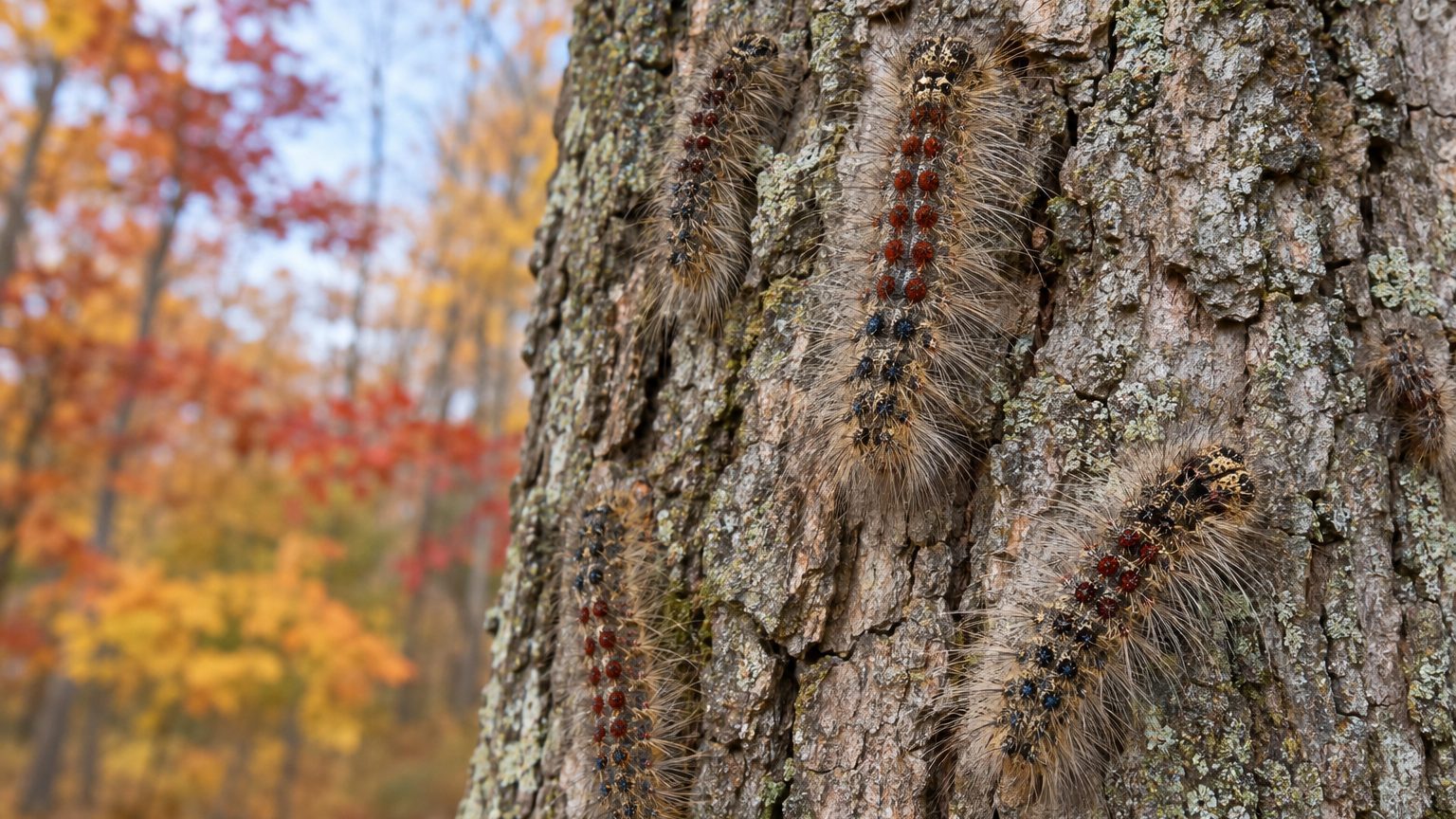
In the mid-1860s, by importing masses of European spongy moth eggs, a French astronomer living in Medford, Massachusetts, set in motion a chain of events that would lay bare the forests of the northeastern United States. Étienne Léopold Trouvelot was seeking silk. More than a century later, in 1981, the descendants of these insects were stripping the foliage from 12.9 million acres of forest.
- Étienne Léopold Trouvelot, an astronomer and amateur entomologist, brought mass egg shipments of the European spongy moth to the United States around 1860.
- Caterpillars escaped from his Medford home around 1869 and thrived without predators.
- In 1981, the spongy moth defoliated 12.9 million acres of forests from Maine to Maryland.
An astronomer dreaming of American silk
Born in the Aisne in 1827 and died in Meudon in 1895, Trouvelot was at once an artist, an astronomer, and an amateur entomologist. In the realm of the sky, he is credited with the discovery of facular “sunspots“ on the Sun in 1875, but today his name is more commonly found in ecology texts for his caterpillars.
Traditional silkworms were being decimated by a variety of diseases, and Trouvelot took a keen interest in the larvae of Lepidoptera, including North American moths that he believed could be exploited for silk. In the 1860s, several entrepreneurs dreamed of a U.S. silk industry, while the Civil War disrupted cotton supply. According to Wikipedia, the precise reasons he imported masses of spongy moth eggs (Lymantria dispar) remain unclear. Several official sources suggest the aim was to create a hybrid more resistant to diseases than the domestic silkworm.
According to the Smithsonian, more than a million larvae lived behind his house.
That house stood at 27 Myrtle Street in Medford. Around 1869, some of the moths escaped, according to accounts, either when a jar fell from a window or a protective net carried by the wind gave way. Trouvelot issued alerts to entomologists, but no one saw the insect as a menace, and the caterpillars proliferated on a vacant lot nearby.
A decade of silence, then the invasion
A little over ten years later, the caterpillars appeared in swarms, and by the late 1880s they were already defoliating the region quite severely. In 1889, the fruit trees and shade trees in an area of 360 square miles around Medford—more than 900 square kilometers—were stripped.
On its native continent, from Europe to North Africa and across Asia, parasites and diseases keep the species in check. In America, it found a climate well-suited to its needs and very few natural enemies. Its caterpillars feed on hundreds of species of trees and shrubs, with a marked preference for oaks. Each female lays a single mass containing 600 to 1,000 eggs in her lifetime, wrapped in a light brown silk cocoon.
A researcher from the Cary Institute describes the mechanics in numbers: one egg mass in the first year, 125 in the second, more than 15,000 in the third. When more than 2,000 masses per acre are present, complete defoliation becomes increasingly likely. The record observed before the outbreak subsided reached 6,000 masses per acre.
1981: a record at 12.9 million acres
In 1981, 12.9 million acres lost their leaves, stretching from Maine to Maryland.
That figure represents 52,200 square kilometers, larger than the area of Slovakia and greater than the combined size of Rhode Island, Massachusetts, and Connecticut. That year, nearly 1.5 million acres were affected in Connecticut alone, close to 80% of its forests.
The aftereffects endured. When the Cary Institute team sampled forests in 1984, nearly all the understory spruces had died, a consequence researchers attributed to the defoliation of 1980, 1981, and perhaps 1982. Most trees regrow their leaves in the same season, but repeated attacks weaken their defenses against drought, other insects, and diseases. Connecticut officials note that, despite the forest losses, their forests recovered.
Forty years later, still there
Since 1980, more than a million forested acres have been defoliated each year.
Wikipedia places the annual toll at about 868 million dollars in damages, a rough estimate of the order of magnitude. Starting in Massachusetts, the species has crossed into more than 20 states. In Pennsylvania, the first spongy moths were detected in 1932 in the Luzerne and Lackawanna counties, and by the 1980s the infestation had spread to Centre, Blair, Huntingdon, and Clearfield counties.
The primary ally of foresters has been a fungus, Entomophaga maimaiga, deliberately introduced to North America, whose effectiveness became apparent only after a delay. Wet springs activate it, while dry weather slows its spread. After a succession of dry springs, the eastern Connecticut region experienced widespread tree mortality before rain returned and halted the outbreak. Aerial surveys recorded 156,000 acres defoliated in 2020, followed by 45,548 in 2021.
Recent American sources speak of the “spongy moth,” a term that supersedes the old “gypsy moth.” The egg masses, however, can cling to almost any surface—trunks, fence posts, mailboxes, and vehicles—making a quick glance under eaves and over car bodies before leaving a region a useful habit.
Sources: dem.ri.gov | entomology.mgcafe.uky.edu | business.ct.gov
