
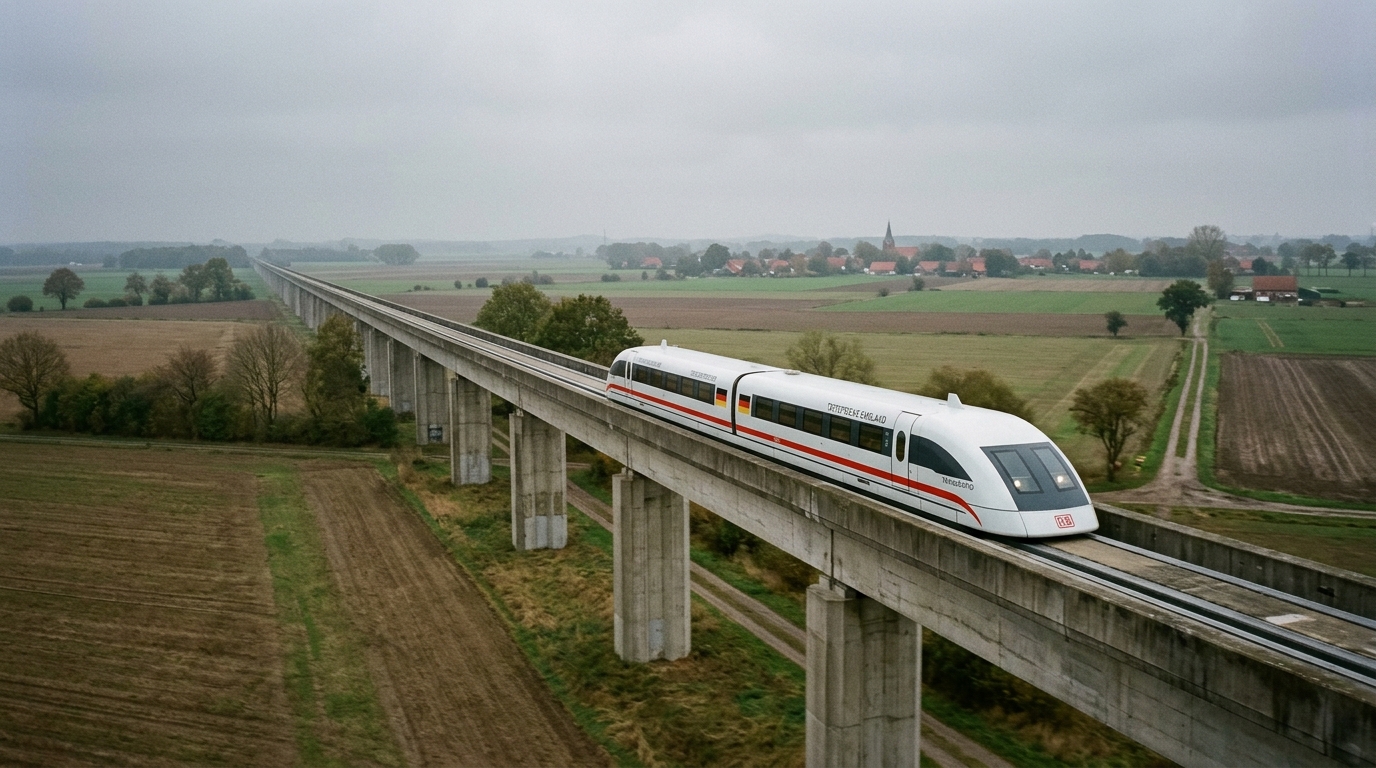
162 kilometers per hour. That is the speed at which a wheel-free train, gliding on a magnetic cushion, struck a maintenance vehicle left on the track. Not a storm, not an electronic failure, not a derailment on the rails since there were none. Just an oversight. This accident, in Germany exactly twenty years ago, sealed the fate of a technology many people regarded as the train of the future. Yet, thousands of kilometers away in Shanghai, identical trains continue today to carry passengers every day, without the slightest hitch. The story of this tragedy speaks volumes about how a human management error can be enough to bury decades of research, even when the technology itself is not at fault.
- On September 22, 2006, the Transrapid 08, launched at 162 km/h, collided with a 60-ton maintenance vehicle left on the Emsland track, killing 23 people and injuring 11.
- The investigation established that the accident resulted from a human communication error, not a failure of magnetic levitation or propulsion.
- Despite this conclusion, the German track was closed in 2011 and demolished in 2012, while the Shanghai Maglev Train, using the same technology, has operated without incident since 2002.
- A one-of-a-kind test track in the Emsland
- On September 22, 2006, a phantom train on the track
- Why human error was enough to bury an entire program
- Shanghai still runs: what the accident did not kill
A one-of-a-kind test track in the Emsland
In the region of Lower Saxony, in the northwest of Germany, there stretched an unusual infrastructure: a 31.8-kilometer track linking the towns of Lathen and Dörpen, solely dedicated to the development of the Transrapid, a magnetic levitation train designed to literally soar above the ground without ever touching it. Built to test this disruptive technology, the elevated track rested on concrete pillars, lifting the convoy about five meters above the ground. The objective was ambitious: prove that a train could cruise at more than 400 kilometers per hour without mechanical friction, relying solely on magnetic fields.
This site was not simply a closed laboratory. The Transrapid 08, the program’s most advanced version, regularly carried out tests there, sometimes with actual passengers on board, to demonstrate to the world that this technical feat was ready for commercial operation. For years, the Emsland site became the showcase of German know-how in wheel-free railway transport.
September 22, 2006, a ghost train on the track
That day, Transrapid 08 ran as planned on its test track. Nothing hinted at the tragedy that would follow. The problem was that a maintenance vehicle, weighing nearly 60 tons, was left immobilized on the track. A communication oversight meant that no one warned the train about this obstacle. In the space of half a second and just 25 meters, the train, moving at 162 kilometers per hour, plowed into the vehicle that had no business there.
The very design of the Transrapid, optimized for aerodynamics and speed, turned against it at impact. The train’s pointed nose plunged beneath the maintenance vehicle, tearing off the roof of the car in the process. The toll was devastating: 23 people lost their lives and 11 were injured. Rescue teams, already confronting a chaotic scene, faced an additional challenge: the five-meter height of the track complicated access to victims trapped in the debris.
Why the human error was enough to bury an entire program
Very quickly, investigators ruled out any technical failure. The prosecutor’s office confirmed that the collision resulted from a human error, not a problem with the magnetic levitation or the train’s propulsion. Rudolf Schwarz, spokesperson for the IABG, which oversaw the track at the time, publicly affirmed this version as well: it wasn’t the technology that failed, but an inadequate safety protocol regarding the presence of a vehicle on the track.
Yet this distinction between human error and technical failure did not save the project in the eyes of public opinion and political decision-makers. The image of the Transrapid, already weakened by years of indecision over its German commercial deployment, collapsed for good. Lost confidence is not easily rebuilt: even if technically flawless, a technology associated with a human tragedy becomes difficult to market. Five years later, at the end of 2011, the operating license for the track expired and was not renewed. In early 2012, authorities approved the complete demolition of the site, including the track and the plant, sealing the end of a once-promising industrial venture on paper.
Shanghai still runs: what the accident did not kill
Here is the detail that changes the entire perspective: while Germany was burying its program, the same technology continued to operate on the other side of the world. As early as 2002, the German engineers who originated the Transrapid had completed the first commercial implementation of their maglev in Shanghai. This train links Shanghai’s rapid transit system to Pudong International Airport over about 30.5 kilometers, a distance very close to that of the former German test track.
The Shanghai Maglev Train has carried passengers daily for more than twenty years, and neither magnetic levitation nor speed has ever been singled out as a source of danger. In essence, the technology has never been the problem. What doomed the German dream was not the magnetic field or the speed, but a banal organizational oversight, the kind that can occur in any mode of transport, from conventional trains to air travel.
This distinction deserves to be kept in mind whenever a high-tech accident makes headlines. Public panic often links innovation to danger, whereas the real fault more often lies with the organizational framework surrounding it. The German Transrapid stands as almost a perfect illustration: a track closed, demolished, forgotten, while in Shanghai the same technical principle continues to glide silently above the rails, proving that magnetic levitation never needed rehabilitation; it had simply never been at fault.
