
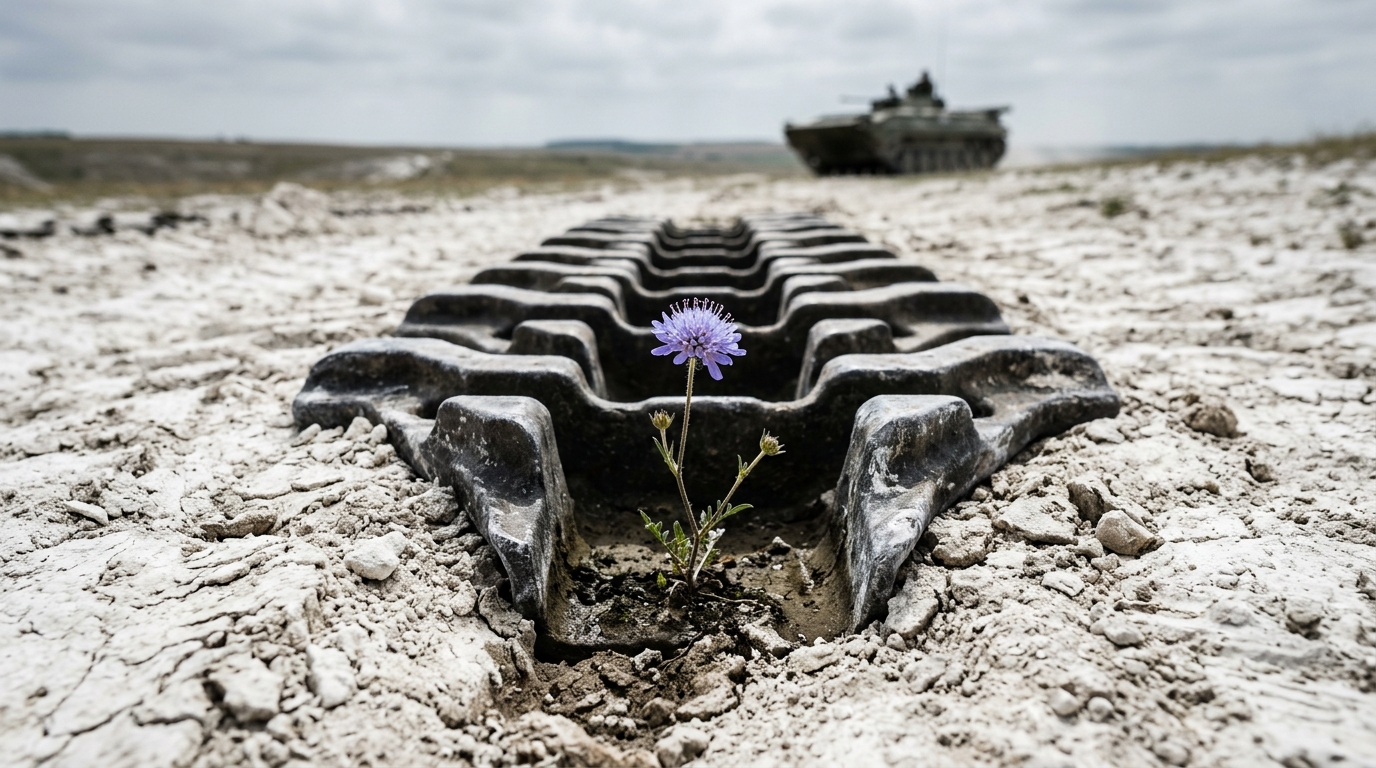
There exists in France a territory larger than Paris’s inner city where no one ever strolls, where no tractor tills the soil, and where no developer has ever laid the first stone of a housing estate. It is not a protected nature reserve marked by dozens of explanatory boards, nor a national park advertised in tourist brochures. It is a military zone, closed to the public for more than a century, where the sound of artillery shells resonates regularly. And yet, it is precisely thanks to this closure that nature has asserted its rights there in a way that almost nowhere else in Western Europe can match.
- The Mailly-le-Camp military camp, closed to the public since 1902, covers roughly 12,600 to 13,000 hectares and constitutes the largest military camp in Western Europe.
- This site hosts the savart, a dry steppe turf almost vanished elsewhere in the Champagne crayeuse, with rare species such as the Sysimbre couché, the Lin de Léon, and others.
- Since 2016, the Conservatoire d’espaces naturels de Champagne-Ardenne has been collaborating with the army to preserve these ecosystems, military activities paradoxically recreating the disturbances necessary to sustain this biodiversity.
- A no-man’s land as vast as Paris intra-muros
- The grassland that refuses to disappear elsewhere
- When artillery fire protects better than a nature park
- Mailly, or the paradox of a nature saved by the army
A no-man’s land as vast as Paris intra-muros
The Mailly-le-Camp military camp, located in the Aube department, covers roughly 12,600 to 13,000 hectares, making it the largest military camp in Western Europe. To give a concrete sense of this vastness, this area far surpasses the expanse of Paris’s city limits. Since 1902, this zone has been closed to any civilian activity: no walkers, no farmers, no urban planners have set foot there for more than a century.
This prolonged closure has produced a fairly rare phenomenon: a territory freed from standard human pressures, with the exception of the military maneuvers themselves. Within this expansive area, a 536-hectare portion has been designated a Natura 2000 zone, distributed between the municipalities of Dampierre and Lhuitre in the northern part of the department. This Special Conservation Area, named “Savart of the Mailly-le-Camp military camp”, sits at the heart of the Champagne crayeuse, somewhere between Vitry-le-François and Troyes.
The grassland that refuses to disappear elsewhere
What this corner of Champagne preserves goes by a nearly poetic name: the savart. It is a dry steppe lawn, typical of poor calcareous soils, punctuated by scattered shrubs and bushes. This kind of landscape, once widespread across the Champagne crayeuse, has almost vanished elsewhere, eroded away by intensive agriculture and the rapid spread of urbanization in recent decades.
Isolated amid a sea of broad cereal crops, the Mailly camp today stands as one of the last remnants of these savarts. It is a bit like having frozen, unintentionally, a postcard of Champagne from more than a century ago. The site thus shelters plant species that have become exceptionally rare, such as the Sysimbre couché, the Lin de Léon, and the Gaillet de Fleurot, plants that are hardly found anywhere else except in this type of preserved habitat.
When artillery fire protects better than a nature park
Here is the paradox that makes this story so striking: it is not the absence of activity that has preserved this habitat, but the persistent presence of the army. Military exercises, the passage of heavy vehicles, and the impacts continually create areas of bare soil, free from dense vegetation. And it is precisely these exposed patches that allure pioneer flora, those fragile and rare species that cannot compete with sturdier plants and require regularly disturbed ground to establish themselves.
In a conventional nature park, vegetation would tend to close in over time, shrubs encroaching until the more discreet plants are smothered. Here, military activity unintentionally plays the role that would normally be filled by extensively grazed pastures or controlled fires, practices largely abandoned today. The result is this open, steppe-like landscape that cannot maintain itself without ecological management interventions to keep it in this open state.
Mailly, or the paradox of a nature saved by the army
Since 2016, an unprecedented partnership has linked the Conservatoire d’espaces naturels de Champagne-Ardenne with the military authorities. Together, they work to preserve biodiversity across all the region’s camps, amounting to nearly 10,384 hectares classified as Natura 2000. This collaboration, unusual in a realm often imagined as starkly opposed, enables reconciling the army’s operational imperatives, deemed essential, with the protection of these last savarts.
The Champagne camps thus host the largest ensemble of calcareous grasslands with orchids in the entire Champagne-Ardenne region, an unexpected refuge for numerous plant and animal species struggling to find suitable conditions elsewhere. This situation is not unique at a national scale: the Ministry of the Armed Forces manages a vast landholdings where 329 Natura 2000 sites overlap with military areas, representing nearly 45,000 hectares. Among them, 11 sites lie entirely on military terrain, illustrating how national defense can, perhaps unintentionally, become one of the strongest allies of French biodiversity.
This Mailly-le-Camp story ultimately recalls a simple but rarely highlighted idea: nature protection does not always pass through sealing off a territory from use. Sometimes, it is precisely stable and repetitive human activity—provided it does not destroy—that allows fragile ecosystems to endure. In this sense, this vast Champenois training ground invites us to rethink our relationship with natural spaces, and perhaps to question other unsuspected places where conservation unfolds far from the beaten paths of conventional ecology.
