
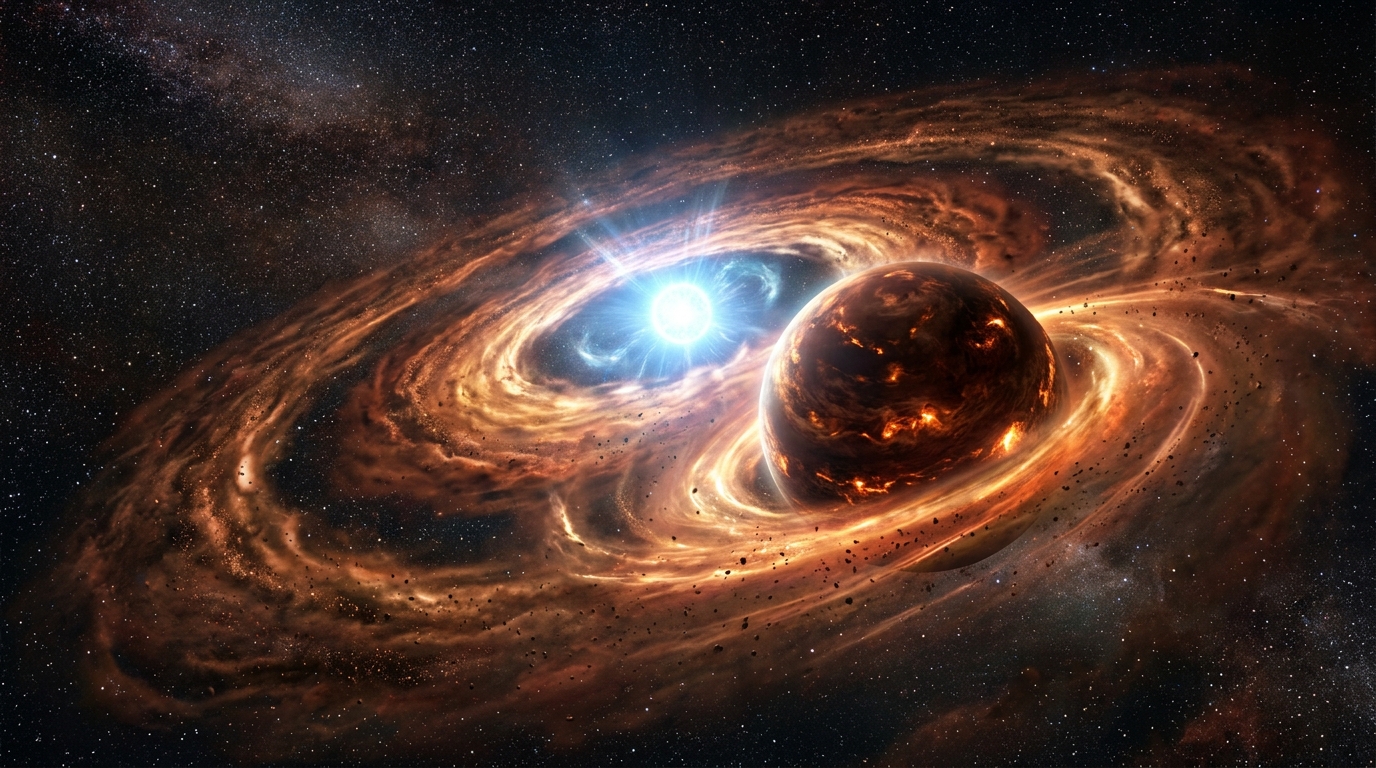
A simple cliché, almost austere at first glance: a disk of dust and gas wrapped around a young star, like a fragile crown whirling in the darkness. Nothing at first sight that would hint at a scientific revolution. And yet, tucked in the folds of this cosmic ring, a planet far too large and too premature to exist revealed itself to astronomers. Elias 2-24 b simply should not have been there, at least not according to the rules we thought we knew about the birth of worlds. This discovery, though seemingly modest in appearance, shakes decades of certainties about how planets form around stars.
- Elias 2-24 b is a gas giant several times more massive than Jupiter, detected in the protoplanetary disk of a star barely one million years old.
- Its mass and rapid formation do not perfectly fit either the core accretion model or the gravitational instability model, challenging classical theories of planetary formation.
- This discovery suggests that gas giants could form much faster than previously thought, upending the accepted chronology and reminding us that our solar system may be only one scenario among many.
- A dust ring that hid a monstrous planet
- When a planet’s mass defies its own age
- Planetary formation models put to the test
- What Elias 2-24 b reveals about the birth of worlds
A Ring of Dust That Hid a Monstrous Planet
Credit: © WM Keck Observatory/Adam Makarenko
Protoplanetary disks are among the most closely watched objects in astronomy, because they essentially constitute the nurseries where future planets are born. These structures, made up of gas and residual dust from the birth of a star, can stretch across hundreds of astronomical units. Observing these rings typically reveals grooves, cavities, or asymmetries that betray the presence of a planet in formation, much like ripples reveal the passage of a fish beneath the surface of a pond.
It is precisely this kind of clue that piqued researchers studying the disk around a very young star. But what they ultimately identified goes far beyond the simple groove expected. It was a massive planet, directly detected right inside this very stellar dust, at a stage where, in theory, no body of such scale should be able to form so quickly. This planet has since been given a name: Elias 2-24 b.
When a Planet’s Mass Defies Its Own Age
What makes this discovery so troubling is primarily a problem of cosmic arithmetic. The star around which Elias 2-24 b orbits is extremely young by astronomical standards, barely a million years old, a blink compared with the 4.6 billion years of our own Sun. Yet the discovered planet has a mass several times that of Jupiter, which is a major issue, literally.
According to classical models, forming a gas giant of this magnitude requires time, a lot of time. In the standard model, a solid core grows through the gradual accretion of dust and pebbles, before this core becomes massive enough to attract and retain a substantial gas envelope. This process typically unfolds over several million years, a delay far too long given the age of the host star. Elias 2-24 b seems to have skipped steps, as if a child could lift weights meant for an adult long before the right time.
Planetary Formation Models Put to the Test
In the face of this anomaly, two major competing theories are usually invoked to explain the birth of giant planets. The first, known as core accretion, relies on slow and steady growth, brick by brick, until a critical mass is reached. The second, called gravitational instability, posits that a portion of the protoplanetary disk collapses abruptly onto itself, somewhat like a dough that suddenly buckles under its weight, giving rise to a planet in record time.
The problem is that neither scenario fits perfectly with what has been observed. Elias 2-24 b’s mass appears compatible with core accretion, but its rapid emergence makes slow accretion unlikely. It is precisely this contradiction that drives many researchers today to revisit their equations. One could summarize the situation as follows: Elias 2-24 b calls into question even our best planetary formation models, and so far, no one has a fully satisfactory explanation.
What Elias 2-24 b Reveals About the Birth of Worlds
Beyond a mere statistical anomaly, this discovery invites a reevaluation of the entire timeline for the formation of planetary systems. If gas giants can truly form so quickly, it would mean that some protoplanetary disks carry within them planetary seeds far more advanced than previously imagined. A hypothesis that would overturn the conventional chronology in which rocky planets form first, followed long after by gas giants.
This planet could also imply that the diversity of planetary systems observed across our galaxy can be explained by multiple, faster formation pathways than expected. Our own solar system, with its gradual maturation, would then be just one example among a range of possible scenarios, not a universal blueprint. A notion that places our corner of the galaxy in a more modest, almost anecdotal perspective in the face of the variety of worlds that populate the universe.
Ultimately, this overly massive planet for its age exemplifies how modern astronomy advances through successive surprises. Each new observation, even one as modest at first as a simple ring of dust, can be enough to shake theories we believed to be solid. As observational instruments grow more precise, it is likely that more Elias 2-24 b–like discoveries await us, lurking in the shadows of protoplanetary disks, ready to once again unsettle our certainties about how worlds are born.
