
One might assume that a rarity like the Pyrenean desman would inevitably leave obvious traces whenever it still dips into a river. Yet, the opposite is precisely what is unfolding in the Vicdessos torrents in Ariège. On one side, the image of a small semi-aquatic mammal that you’d expect to spot with the naked eye, skimming between stones along the clear water. On the other, the land reality: hardly anyone sees it anymore, yet its presence has never been more thoroughly documented. The key to this contradiction does not lie in binoculars or camera traps, but in a simple water sample taken at the torrent’s edge. Here is how science has learned to uncover the invisible.
- Faced with dwindling direct sightings of the desman in the Vicdessos, naturalists now rely on environmental DNA extracted from torrent water to prove its presence.
- This method is part of the LIFE+ Desman European program, with a budget exceeding 2.6 million euros, aiming to safeguard the species across eleven Natura 2000 sites in the Pyrenees.
- The desman’s geographic range has fallen by more than 50% in thirty years, and the detection—or absence—of its DNA in water serves as an indicator of the ecological health of mountain torrents.
- A phantom mammal that no longer lets itself be seen
- The torrent water keeps the memory of its passage
- The LIFE Desman program tracks the invisible
- What these genetic traces reveal about its future
A Phantom Mammal That No Longer Lets Itself Be Seen
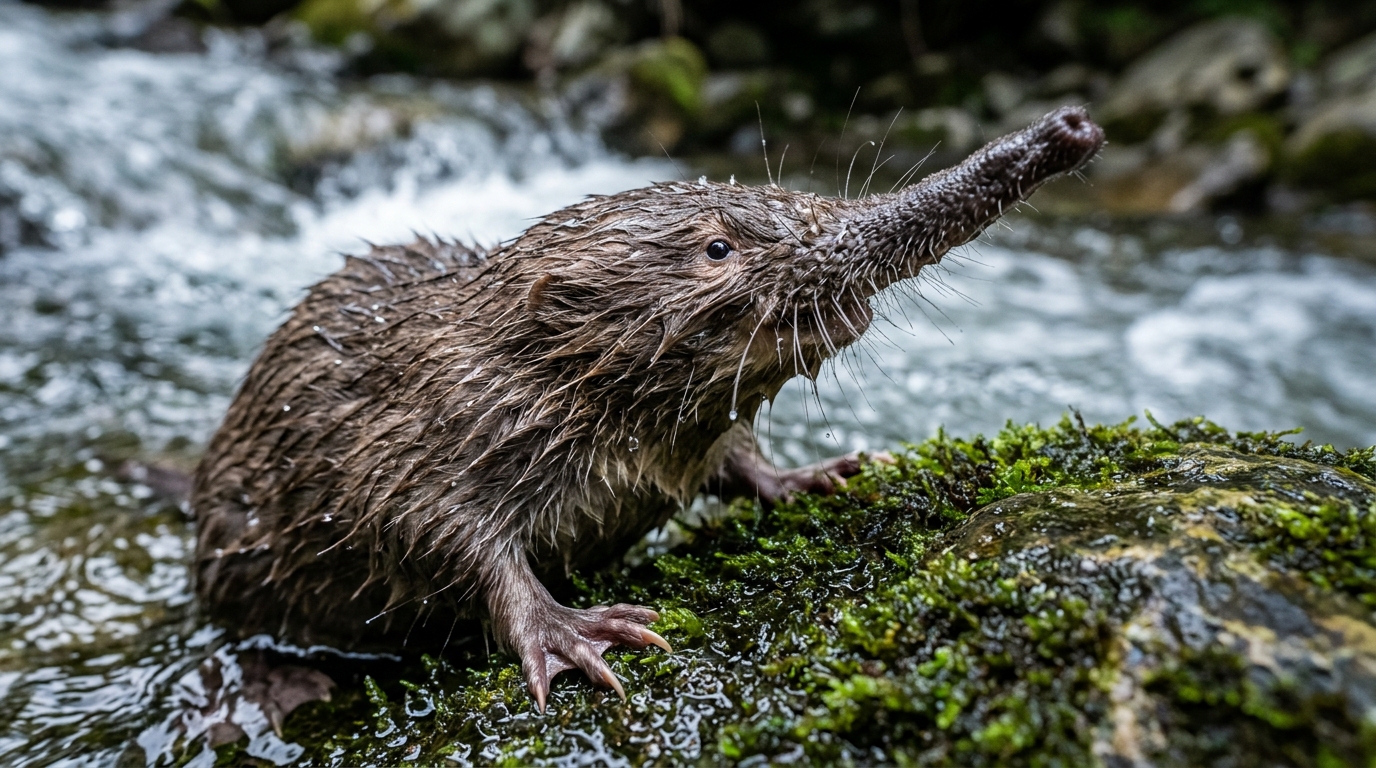
The Pyrenean desman (Galemys pyrenaicus) belongs to the mole family, yet it has swapped subterranean life for the drama of mountain torrents. This small endemic insectivore, found nowhere else in the world except in the Pyrenees and the northwest Iberian Peninsula, lives in streams, torrents, and high-altitude lakes, from 200 to 2,700 meters above sea level. Its long snout, trunk-like in shape, and its webbed feet once made it a discreet yet unmistakable denizen of the Pyrenean waterways.
But that era seems to be over. In the Vicdessos basin, an Ariège region celebrated for its suitable habitats, direct observations have grown so scarce as to be practically nonexistent. The desman is listed as vulnerable on the global red list of threatened species, and its range has shrunk by over 50% in just thirty years, according to the French Biodiversity Office. Pressures such as the artificialization of riverbanks, hydroelectric dams, and diffuse pollution have quietly pushed back this already hard-to-observe creature.
The Torrent Water Keeps the Memory of Its Passage
In response to this scarcity, naturalists had to abandon classic direct observation methods, which had become almost sterile. Several alternative techniques were tested in French fieldwork: footprint rafts designed to capture the desman’s paw prints, scat tunnels to collect clues of its passage, or operations of capture and radiotracking, such as the Vicdessos study conducted in 2018. These methods yielded valuable data, but they remain labor-intensive and depend often on the luck of encountering an individual at the right moment.
That is where a much more discreet approach comes into play: environmental DNA. Every animal moving through a watercourse leaves behind microscopic traces: skin cells, fur, saliva, feces. These genetic fragments disperse in the current and can be detected by simple water sampling. In other words, you no longer need to see the desman to prove it is present: the water has preserved the chemical memory of its passage. It is precisely this technique that is being tested on the Ariège rivers, with encouraging results for confirming the species’ presence in places where human eyes can no longer capture anything.
The LIFE Desman Program Tracks the Invisible
This methodological revolution is part of a major European project: the LIFE+ Desman program (reference LIFE13NAT/FR/000092), launched to assess and mitigate the impacts of human activity on this animal and its habitat. The objective is clear: to sustainably improve the conservation status of the species across eleven Natura 2000 sites scattered throughout the Pyrenean massifs. The projected budget for this program stood at €2,672,707 over five years, financed half by the European Commission, a proof that safeguarding this little-known mammal is taken very seriously at the continental level.
To carry out this mission, a genuine network of partners formed around the project: the Conservatoire d’espaces naturels Midi-Pyrénées, the Parc naturel régional des Pyrénées Catalanes, the Association des naturalistes ariégeois, and the Parc national des Pyrénées. Together, these players combine their expertise to map the desman’s presence, restore its habitats, and raise awareness among local authorities about the stakes involved in preserving mountain torrent ecosystems. Environmental DNA has become one of the flagship tools of this program, enabling wide coverage of watershed basins without disturbing the animal or its habitat.
What These Genetic Traces Reveal About Its Future
Beyond sheer technical prowess, these water samples tell a broader story about the health of the Pyrenean torrents. Where desman DNA is detected, it typically indicates that the stream maintains ecological quality sufficient to harbor this demanding species, which is particularly sensitive to water quality degradation and habitat alteration. Conversely, the absence of genetic traces in areas that were once favorable serves as an early warning about ongoing degradation of these high-altitude aquatic environments.
These data, accumulated site by site, help LIFE Desman managers steer restoration efforts to where they will be most effective: preserving natural banks, limiting certain hydroelectric developments, and increasing monitoring of sensitive zones. Implicit in this genetic tracing is also a commentary on the fragility of an ecological balance that extends beyond the desman itself: it concerns an entire mountain torrent ecosystem, whose good health underpins the survival of many other stealthy species, equally threatened but far less studied.
Thus, even when invisible, the Pyrenean desman continues to tell its story to those who know how to read the clues that water unconsciously carries. The shift from direct observation to genetic analysis illustrates how conservation tools evolve to adapt to ever more elusive and endangered species. The question remains whether these efforts will reverse a trend that has been underway for decades, or whether the Vicdessos and other Pyrenean basins will one day have to settle for DNA traces as the sole memory of a once-familiar mountain-stream animal.
