
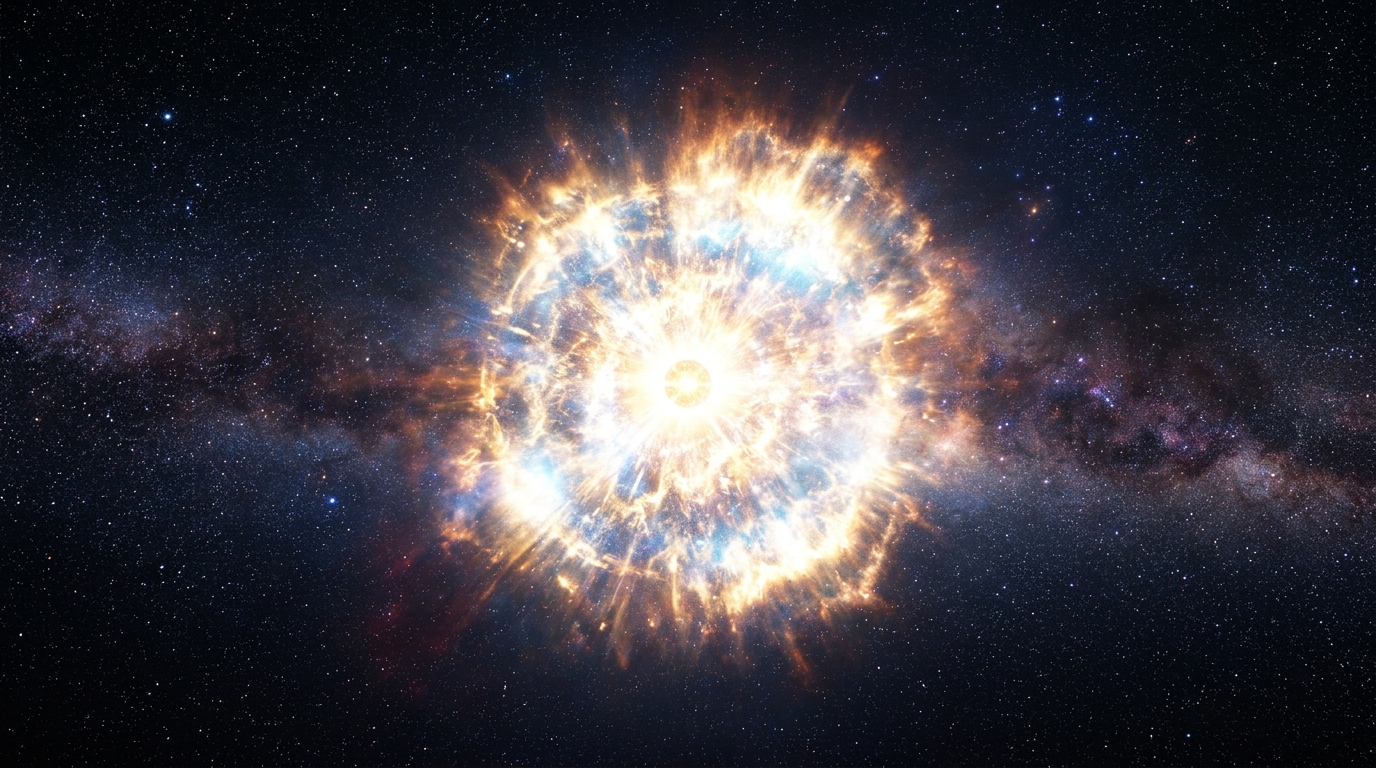
À 50 000 années-lumière de la Terre tourne un astre de 20 km qui a libéré en un dixième de seconde plus d’énergie que le Soleil en 100 000 ans
And what if the galaxy’s most dangerous object measured only 20 kilometers across, barely the size of a major French urban area? This question might seem absurd, as we tend to associate cosmic power with colossal scales—giant stars or supermassive black holes. Yet, at roughly 50,000 light-years from Earth, in the constellation Sagittarius, a tiny body released in a tenth of a second an amount of energy so immense that it defies comprehension. In less than a fraction of a second, this object emitted more energy than the Sun does in 100,000 years. This phenomenon, as brief as it is devastating, upended our understanding of extreme physics and even left a measurable trace on our own atmosphere. A look back at one of the most spectacular events ever observed in our galaxy.
- The magnetar SGR 1806-20, a 20 km-diameter object located in the Sagittarius constellation, has a magnetic field estimated at about 200 billion teslas.
- On December 27, 2004, it released in a tenth of a second an energy estimated up to 5 × 10⁴⁶ ergs, causing the saturation of NASA gamma detectors and a measurable perturbation of the Earth’s ionosphere.
- This giant eruption, caused by a catastrophic reconfiguration of the magnetic field, allowed scientists to study up close an analogue of cosmological gamma-ray bursts usually observed billions of light-years away.
- A Tiny Star, a Monstrous Power
- December 27, 2004, the Second That Saturated Detectors
- When the Magnetosphere Explodes: The Physics Behind the Chaos
- What This Burst Changed in Our View of the Universe
A Tiny Star, a Monstrous Power
The object in question is called SGR 1806-20, a magnetar discovered in the late 1970s. A magnetar is a neutron star—the ultra-dense remnant left after a massive star collapses in a supernova. At its modest 20-kilometer diameter, it is estimated to pack a mass comparable to that of the Sun. To give a sense of this vertiginous density, a single teaspoon of neutron-star matter would weigh several billion tonnes on Earth.
What makes SGR 1806-20 truly unique, however, is its magnetic field, estimated at about 200 billion teslas. By comparison, Earth’s magnetic field—the one that makes compass needles wobble—hovers around 0.00005 tesla. This magnetar thus possesses a magnetic field billions of times stronger than our planet’s, a figure so abstract that it is hard to grasp in concrete terms.
December 27, 2004, the Second That Saturated the Detectors
It was on December 27, 2004 that the improbable occurred. In the space of a tenth of a second, SGR 1806-20 unleashed a total energy estimated at roughly 2 × 10⁴⁶ ergs, with some calculations placing it as high as 5 × 10⁴⁶ ergs. Put simply, this tiny star emitted, in the blink of an eye, more energy than the Sun releases in 100,000, or even 250,000 years of continuous activity. A number that leaves one’s mind reeling when you consider how enormously energetic our own Sun is.
This colossal eruption, the third ever recorded after those of 1979 and 1998, proved one hundred times more intense than the two earlier events put together. The NASA instruments tasked with tracking gamma-ray emissions across the universe simply saturated, incapable of handling such a sudden and violent surge from such a distant source. The shock wave was so powerful that it produced a measurable ionospheric disturbance in Earth’s upper atmosphere, altering the electron density at about 60 kilometers altitude by six orders of magnitude—a global effect detected worldwide despite the vast distance that separates us from the star.
When the Magnetosphere Explodes: The Physics Behind the Chaos
How can a release of energy reach such extremes? Scientists point to a catastrophic reconfiguration of the magnetar’s magnetic field. Picture a neutron star with an extraordinarily rigid crust that is strained by internal magnetic forces so intense that it fractures—somewhat like a seismic quake, but on a cosmic scale and with unimaginable power. This sudden rupture instantly liberates an astronomical amount of magnetic energy that had built up over years, even decades.
This hypothesis aligns with the most careful estimates, which suggest an internal magnetic field of the magnetar exceeding 10¹⁶ Gauss—an order of magnitude far beyond what can be replicated in Earth’s laboratories. About seven days after the initial eruption, astronomers observed the emergence of a resolved, linearly polarized radio nebula propagating at nearly a quarter of the speed of light. This rare phenomenon offered an unparalleled chance to study up close a nearby analogue of the cosmological gamma-ray bursts that are typically observed billions of light-years away and far harder to analyze in detail.
What This Burst Changed in Our View of the Universe
For a long time, this giant flare was regarded as the brightest extrasolar flash recorded in modern times. It enabled researchers to gain a deeper understanding of the extreme physics governing magnetars, among the galaxy’s most enigmatic objects. It also served as a stark reminder of Earth’s vulnerability to the caprices of the cosmos, even when the source of danger lies 50,000 light-years away—a distance that might have suggested total tranquility.
The event opened new avenues of inquiry into the possible links between such giant magnetar bursts and some gamma-ray bursts observed at the edge of the cosmos. By studying this relatively nearby phenomenon, scientists gained a unique natural laboratory to test theories that would otherwise remain purely speculative due to lack of precise data.
Two decades after the event, SGR 1806-20 continues to fascinate the scientific community and reminds us of a troubling reality: our galaxy harbors objects capable of releasing, in a fraction of a second, energies that are nearly unimaginable. As autumn settles in and nights lengthen, inviting skywatching, perhaps it is worth turning our gaze toward Sagittarius and remembering that a star as large as a city may harbor forces that surpass anything humanity has created or even imagined.
