
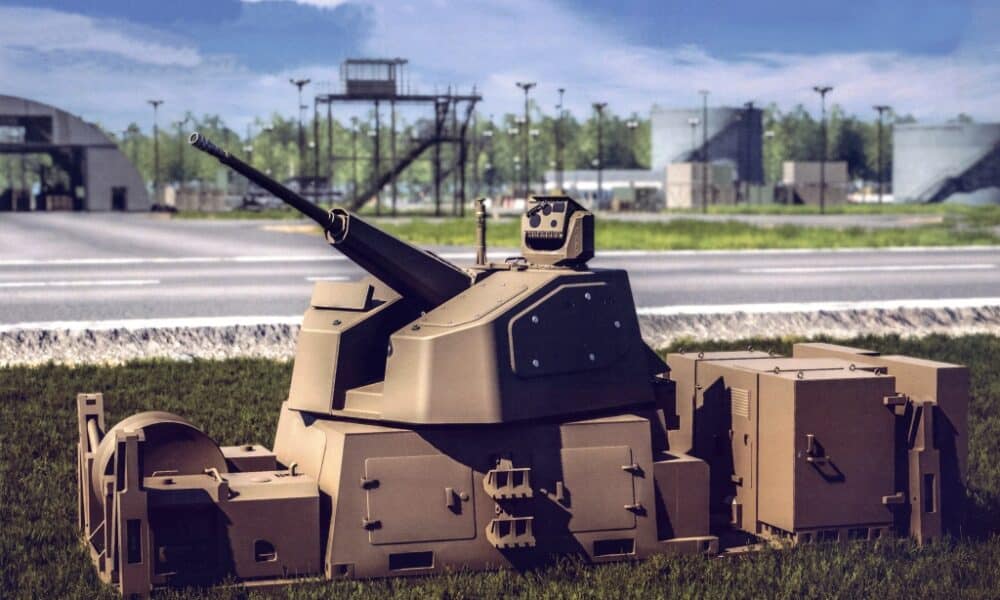
With the proliferation of drones on modern battlefields, armies around the world are seeking effective means to counter this agile, inexpensive… and potentially deadly threat. In France, a new weapon is poised to enter service, promising to sweep the skies: Rapidfire Land, an air-defense system developed by Thales and KNDS France, which targets drone swarms, helicopters, light aircraft — and even rockets and mortars.
A Cannon to Tame the Sky
At the heart of the system sits a 40 mm telescoped ammunition cannon, designed by CTA International, a joint venture between KNDS and BAE Systems. This weapon isn’t entirely new: it already equips the French Army’s Jaguar armored vehicle. But here it shifts role to become an autonomous drone-killer, capable of site defense—whether at a French military base, abroad, or at an outpost on the front line.
The cannon can carry up to 140 ready-to-fire rounds, enabling it to strike multiple targets in quick succession without immediate reloading. A crucial advantage when facing a saturation attack in which dozens of drones attempt to overwhelm defenses.
The Smart Munition That Explodes Before Impact
Yet the real revolution lies in the A3B munition currently in development. Unlike a conventional shell that must directly hit its target, the A3B is an airburst round: it explodes mid-flight, before impact, releasing dozens of tungsten submunitions.
The farther the burst, the wider the coverage. The result: a single shot can neutralize several drones or intercept fast-approaching projectiles. The ability to create a “rain of metal” over a targeted zone changes the game for close-in defenses. France has already ordered 500 A3B shells, with entry into service planned by 2027.
An Almost Autonomous System… But Always Under Control
Rapidfire Land doesn’t just shoot quickly. It thinks, or nearly does. The system houses an advanced fire-control computer that automatically corrects the target’s position after each shot. This enables tracking of fast or moving targets—drones, helicopters, rockets—and adjusting intercepts in real time.
Another benefit: the system requires only two operators, who intervene solely to authorize firing. The rest of the process (acquisition, aiming, tracking) is semi-automatic, reducing human workload while preserving essential human oversight.
Flexible Protection, Deployable Anywhere
Thales and KNDS offer two versions of the system:
-
A semi-mobile version mounted on a 20-foot fixed platform, easy to transport and deploy on the ground.
-
A mobile version integrated into a tactical vehicle, to accompany troops as close to combat zones as possible.
This modularity allows armed forces to choose between durable baseline protection or a system mounted on a vehicle for rapid projection operations. In both cases, the system provides an effective range of about 4 km, creating a close-protection bubble ideal for forward bases or critical infrastructure.
Already Tested… and Validated by the Navy
Before being adapted for land, Rapidfire was tested in a naval version. Two units are already installed aboard the replenishment ship Jacques Chevallier, where they conducted live-fire tests in operational conditions. These trials validated the system’s ability to intercept fast-moving targets at sea, a notoriously challenging environment.
Buoyed by this success, the DGA ordered 14 naval systems for the French Navy, as part of a production contract for 48 units. Still in development, Rapidfire Land can thus lean on this proven naval variant to claim a role as the backbone of France’s close-range air-defense framework.
Why It Matters
The arrival of this system fits a new strategic context: recent conflicts, such as in Ukraine or the Middle East, have shown that cheap drones and smart munitions pose a serious threat—even to technologically advanced armed forces. Swarm drone attacks can saturate traditional defenses, and only ultra-responsive, flexible systems like Rapidfire Land can respond effectively.
This intelligent cannon, capable of sweeping the sky of drones in a matter of seconds, embodies a new generation of air defense: faster, more modular, more economical—and above all ready for tomorrow’s warfare.
Sources: Thales and KNDS France unveil RAPIDFire Land, a land-based variant of the RAPIDFire Naval 40mm system (thalesgroup.com) | Thales, KNDS expand protection system RAPIDFire for bases on land (breakingdefense.com)
Article prepared with the help of AI · Our method
