
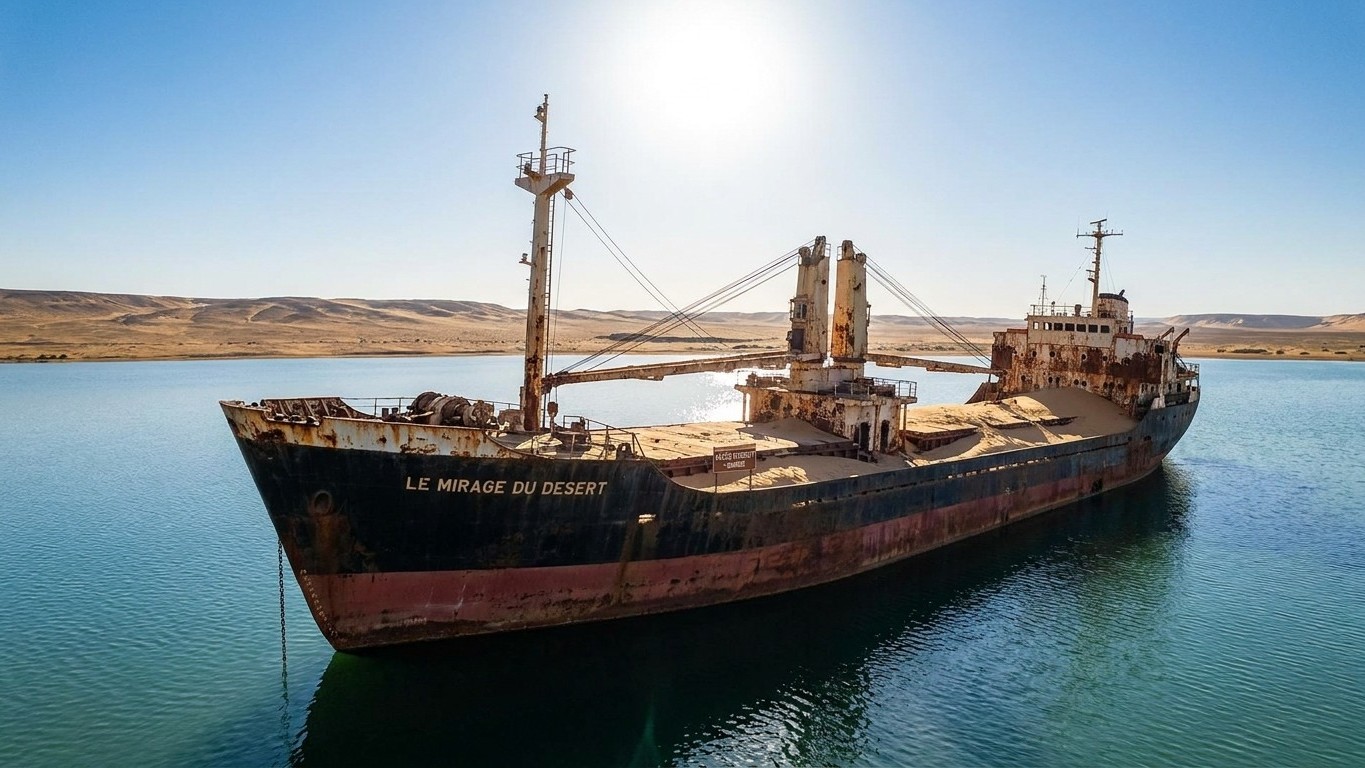
Fourteen cargo ships were stuck for eight years in an Egyptian lake, their sailors transformed into citizens of an improvised nation: this is the true story that preceded, by several decades, the Ever Given fiasco. The Yellow Fleet was a group of fourteen vessels that found themselves blocked in the Suez Canal, in the section of the Great Bitter Lake, from 1967 to 1975, collateral victims of the Six-Day War. Eight years of waiting, sand gradually covering the decks, and crews who refused to sink into boredom. The result goes beyond a maritime anecdote: a genuine floating micro-society, with its own stamps, its sports competitions and its organizational chart.
Key takeaways
- Why did 14 cargo ships from different nations remain stuck in the same spot for eight years?
- How did the three thousand sailors immobilized avoid going mad?
- What unusual institution did these crews establish in the Egyptian desert?
A Convoy Trapped by the Six-Day War
It all begins in June 1967. Fourteen ships pass northward through the Suez Canal as fighting erupts between Israel and Egypt, in what will become known as the Six-Day War. The conflict lasts only a week, but its consequences stretch across nearly a decade. The canal’s two ends are closed by order of the Egyptian government and, after three days, it becomes clear that the canal will remain unusable for a long time due to the deliberate wrecking of ships to block the entrances.
A fifteenth vessel, the Observer, is immobilized a little farther north, in Lake Timsah. The other fourteen drop anchor in the broadest section of the waterway. This flotilla brings together an improbable patchwork of flags: four British ships, two West German, two Swedish, two Polish, one French, one Bulgarian, and one Czechoslovak, if you count the Observer with the rest. Israel holds one shore, Egypt the other. The sailors watch, powerless, as exchanges of fire ripple over their hulls.
Birth of a Floating Nation: The Great Bitter Lake Association
After the first weeks of disbelief, waiting gives way to organization. In October 1967, officers and crews from the fourteen ships meet aboard the Melampus to create the Great Bitter Lake Association, whose purpose is to provide mutual support to the crew members. It is no longer a simple at-sea committee: it becomes a miniature society, with its own hierarchy, rituals and even insignia. Each man receives a specially designed tie and badge, shaped like a crest adorned with an anchor, bearing the letters GBLA at the top and the number 14 at the bottom, in reference to the fourteen ships of the lake.
Each vessel is assigned a specialty. The crews gather on one of the British ships to play football matches, projected films on a Bulgarian vessel, hold religious services on a West German ship, and enjoy the pool aboard a Swedish ship. The Poles, for their part, oversee a makeshift postal service: the association creates its own stamps, highly sought after by collectors today. The social highlight is undoubtedly the Olympic parody staged to coincide with the Mexico City Games. The eight nations represented competed in fourteen events—sailing, diving, sprinting, high jump, archery, shooting, and water polo—with Poland finishing first, Germany second, and the United Kingdom third. Christmas was not forgotten either: a floating Christmas tree was set up and a piano lowered onto a small craft that toured the lake to serenade each vessel.
As crews rotated, more than three thousand sailors would have stayed aboard these immobile hulls. The sole woman on the roster was a Swedish hostess nicknamed the “Lady of the Lake,” who has remained in the Yellow Fleet’s collective memory almost as much as the improvised Olympic Games.
Sand, Wear, and a Two-Speed Exit
The flotilla’s nickname stems from a purely climatic phenomenon. Winds continually blow desert sand onto the ships, and from afar the whole fleet takes on a yellowish tint, hence the nickname “Yellow Fleet.” This sand tells, better than any testimony, about the slow passage of time: year after year the freighters blend into the desert landscape, as if absorbed by the lake itself.
The Yom Kippur War of 1973 reminded the region that its tensions had not vanished. The American vessel African Glen sinks that year during the conflict. The thirteen survivors, meanwhile, continue to wait, kept afloat by a skeletal crew.
The end would come in 1975. At the start of that year, the Suez Canal reopened to international shipping, and on 24 May 1975 the German ships Münsterland and Nordwind finally reach Hamburg, greeted by more than 30,000 spectators. The ending comes in two speeds, since those two ships are the only ones to depart the lake by their own power. For the Münsterland, the voyage to Australia ends after eight years, three months and five days. All the other cargoes had to be towed, in such a deteriorated state that they could not resume normal seafaring. The rest of the ships were towed and left in such a poor condition—especially those carrying perishable cargo—that they were sold and briefly exploited before being scrapped in the following years; by the time they left the canal after eight long years, the container revolution had occurred, and the Yellow Fleet, once at the forefront of technology in 1967, had become obsolete.
The story could have faded into oblivion if not for two books published in the 2010s: Acht Jahre gefangen im Großen Bittersee, published in German by Hans Jürgen Witthöft in 2015, and Stranded in the Six-Day War, by Cath Senker in 2017. This editorial revival is no accident. Whenever a container ship again blocks the Suez Canal, web archivists bring out the handmade stamps and the yellowed photos of the Great Bitter Lake Association, as if to remind that before the era of hourly-timed maritime bottlenecks, there were stranded mariners capable of eight years’ endurance, with a GBLA tie around their neck.
Sources: korii.slate.fr | imarest.org
