
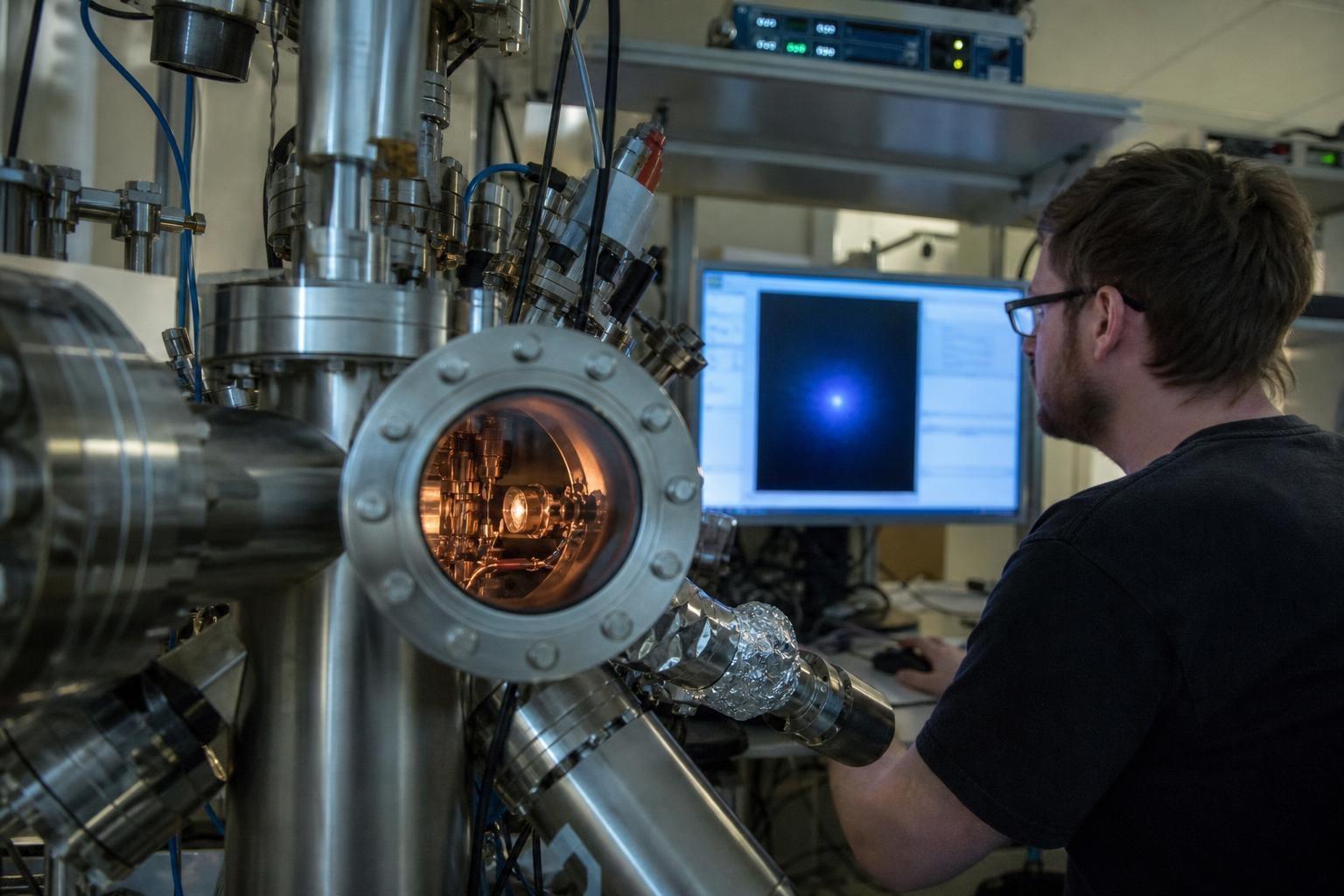
It began as a hunch and a late-night plan: if a single ion glows when struck by the right laser, perhaps a patient camera could catch its light. Hours later, in the soft whirr of a vacuum chamber, a DSLR shutter clicked—and a tiny spark appeared between gleaming electrodes. “You’re looking at a point of light that shouldn’t exist at our scale,” one researcher joked. And for a breathless moment, the quantum world looked shockingly close.
A pinprick of light in a chamber of steel
The celebrated image shows a solitary strontium ion, suspended by electric fields and glowing blue under a violet laser. The dot is faint, but it is undeniably there, hovering between two needle-like electrodes. Taken through a thick window of ultra-high vacuum, the scene feels both industrial and fragile—a cathedral of hardware arranged to hold a single atom steady enough to shine.
“To me, the idea of being able to see a single atom with the naked eye seemed incredible,” the photographer later reflected. The camera didn’t resolve an object so much as it collected a trail of photons, patiently stacking them into one improbable speck.
How do you photograph the nearly unseeable?
Atoms are fantastically small, hundreds of thousands of times tinier than the wavelength of visible light. By ordinary rules of optics, you can’t image their shape with a standard lens. But a trapped ion solves a different problem: it behaves like a microscopic lantern, scattering laser light at a precise color.
In this case, the ion absorbed and re-emitted photons near 422 nm—a blue-violet hue—thousands of times per second. A long exposure let the camera integrate this faint glow against the lab’s dark background, so the atom’s presence emerged as a pinprick of brightness.
The trap that tames a single ion
Holding one charged atom absolutely still is an art of delicate forces. A radio-frequency Paul trap creates a humming cage of oscillating fields that corrals the ion in three dimensions. With cooling lasers, the jittery particle is slowed to mere microkelvins above absolute zero, drastically reducing its random motion.
Everything happens in extreme vacuum, so stray gas molecules don’t jostle the ion out of the trap. Minute tweaks cancel stray charges, stabilize the frequency of lasers, and hush mechanical vibrations. It’s the kind of meticulous craft that makes one bright pixel scientifically profound.
Why scientists gasped
Yes, physicists have imaged individual atoms before with electron microscopes and scanning probes, but this was different in spirit and in feeling. It was visible-light photography—a familiar tool—catching an atom in the act of shining. “It’s a visceral bridge between the minuscule quantum world and our everyday reality,” as one description put it.
Beyond the poetry, it’s a proof of control. The same techniques that let you see that dot are the ones that build trapped-ion qubits, stabilize optical clocks, and test fundamental physics with record-breaking precision. Awe, in this case, runs parallel to engineering.
What this image is—and isn’t
You’re not seeing the ion’s surface, nor its orbital structure. The camera isn’t mapping an outline; it’s catching photons the ion scatters while cycling between quantum states. It’s a point source, not a tiny planet.
Other methods can resolve atomic positions or even visualize electron clouds, but they require different beams, vacuum geometries, and specialized detectors. The wonder here is the simplicity: a lens, a window, a long exposure, and a speck that says, “I’m here.”
A quiet revolution in plain sight
Trapped-ion laboratories have spent decades turning fragile phenomena into robust platforms. Each stable ion is a pristine qubit, each photon a messenger of quantum information. The photo crystallized that progress into a single, shareable moment—a kind of public handshake with the invisible.
“It’s humbling to think a single atom can light up an entire conversation,” a physicist remarked after showing the image to a high-school class. The picture doesn’t just teach; it invites curiosity.
What it took to capture the speck
- Ultra-high vacuum and a radio-frequency trap to hold one ion in stable suspension
- Precisely tuned lasers for Doppler cooling and resonant fluorescence
- Careful optical alignment and low-noise detection to isolate the faint signal
- Long exposure photography with patient, iterative tweaks to settings and focus
The lingering afterglow
Once you’ve seen that single spark, it’s hard to forget how thin the line is between the abstract and the tangible. The atom was always there, but it took craft, patience, and a willingness to look long enough for the world to answer back.
In the end, the photograph isn’t just a triumph of technique; it’s a small act of translation. A quantum system speaks in discrete photons, the camera listens, and we’re left—quietly, unmistakably—speechless before a lone point of light.
