
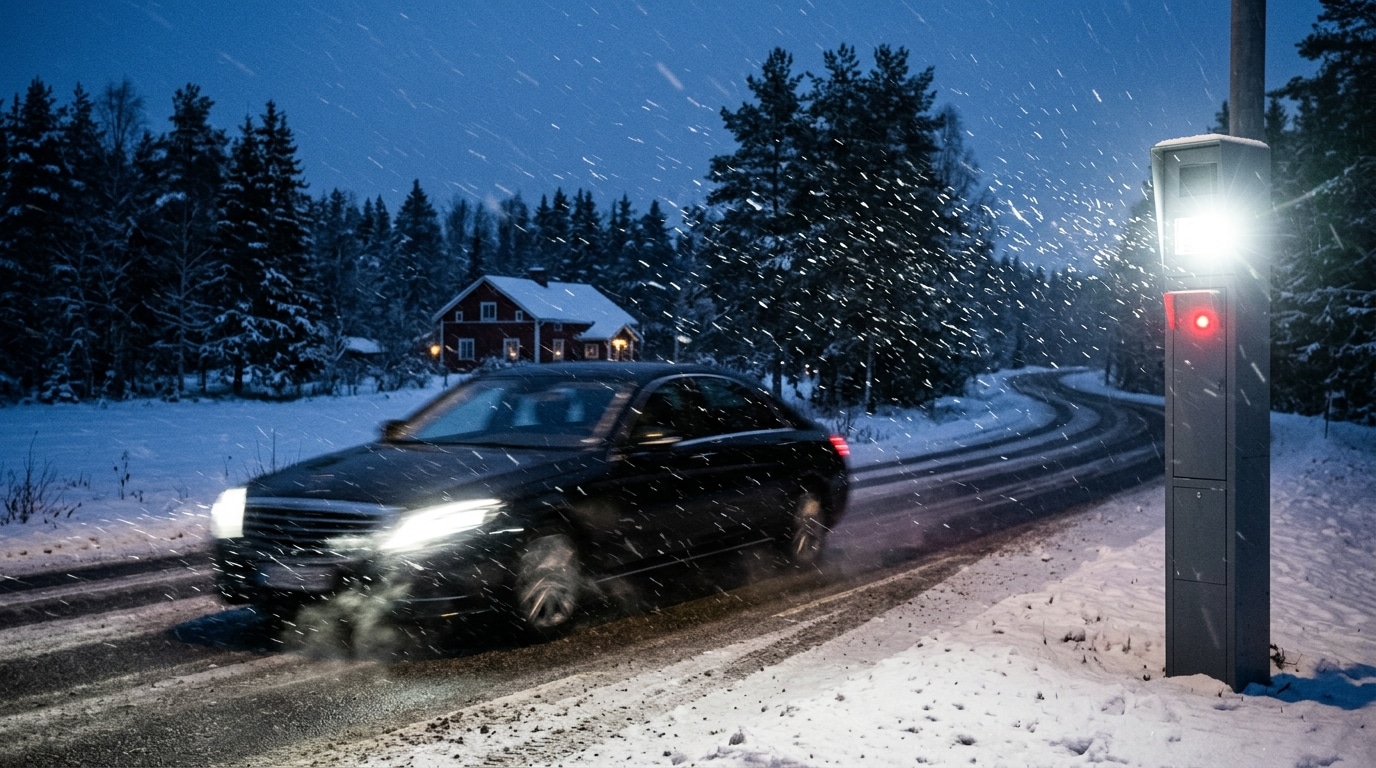
Speeding fines can range from a simple penalty to amounts that reach into the hundreds of thousands. It all hinges on one parameter: your paycheck. In Finland, two drivers caught at the same place at the same speed can be issued vastly different bills. This is the lesson the Åland Islands’ business climate is learning the hard way, a few times over.
- In Finland, speeding fines above 20 km/h over the limit are calculated as day-fines indexed to the offender’s net income, with no upper cap.
- In the Åland Islands, a business owner was fined 121,000 euros after a speed of 82 km/h in a 50 km/h zone, following two previous fines of 63,680 and 95,000 euros.
- The amount of a fine can be reduced if the offender’s income drops, as in the case of a Nokia executive whose 116,000-euro penalty was slashed by 95%.
- When speeding costs more than a luxury car
- Income, the sole criterion that determines the fine amount
- Two drivers, two fortunes, one offense: the wide gap in sanctions
When speeding costs more than a luxury car
The story unfolds in the autonomous Åland archipelago, affiliated with Finland but endowed with its own status. On Järsövägen road, heading toward Mariehamn, the archipelago’s capital, a driver was flashed at 82 km/h in a 50 km/h zone. A clear overstep, leaving no room for negotiation.
The penalty came down mercilessly: a fine of 121,000 euros, plus a ten-day license suspension. An amount that far exceeds the price of a brand-new high-end sedan, for a few seconds with the accelerator pressed a touch too hard.
Yet this was not a surprise for the offender. He had already incurred fines of 63,680 euros in 2018 and 95,000 euros in 2013. A costly habit, confirmed more recently by a new offense behind the wheel of his Bentley, caught at 59 km/h in a 30 km/h zone, again in Mariehamn, for a fine close to 120,000 euros.
What stands out is not so much the repetition of the deeds but the logic hidden behind these dizzying figures. In Finland, the fine does not punish the speed alone: it punishes speed relative to the offender’s financial means.
Income, the sole criterion that determines the amount of the fine
To understand these extraordinary amounts, we must go back to 1921. That year, Finland became the first Nordic country to introduce the day-fine system, a mechanism that links the criminal penalty to the offender’s income rather than a fixed scale identical for all.
The calculation, documented by Finnish police, rests on a fairly simple formula. Start with net monthly income, subtract a base deduction of 255 euros, then divide the remainder by 60. The result yields the value of a single day-fine, unique to each individual.
Not all speeding offenses trigger this mechanism. When the excess is below 20 km/h over the limit, the offense remains administrative and is settled with a fixed fee capped at 200 euros, similar to what French motorists experience. Beyond this threshold, it becomes a criminal offense, and that is where the day-fine system comes into play.
The scale fixes a number of days, not a monetary amount. A single offense can amount to up to 120 day-fines, and up to 240 in the case of multiple offenses. The floor price of one day-fine is set at 6 euros. But there is no monetary ceiling: as income rises, the bill can climb indefinitely, with no theoretical cap.
Two drivers, two fortunes, one offense: the wide gap in sanctions
It is precisely this lack of a ceiling that produces such dramatic disparities between two drivers caught at the same spot. A modest employee and a wealthy business leader, for the same speeding offense, will never pay the same amount. The Finnish day-fine system adjusts the sanction according to available income, which has already pushed a speeding violation to 121,000 euros.
Finnish history is full of similar examples. In 2004, one of the country’s wealthiest men was fined a little over 100,000 euros for driving at 80 km/h in a 40 km/h zone in central Helsinki, a record long remembered.
However, the mechanism is not fixed. In 2002, a Nokia executive saw his 116,000-euro fine reduced by 95% by the courts after demonstrating a significant drop in his income. The day-fine tracks the actual fortune at the time of the offense, not a static estimate.
This back-and-forth between colossal amounts and downward revisions illustrates the system’s philosophy: punish proportionally, so that the penalty truly weighs on the offender, whether they earn the Finnish average wage or own a fleet of Bentleys.
In essence, this Finnish model poses a simple yet rarely asked question elsewhere: is a fixed fine, identical for all, truly fair when it amounts to a pittance for some and a month’s salary for others? By indexing the punishment to income, Finland has embraced a radical answer that continues to generate amounts that leave people agape, well beyond Nordic borders.
👉 A small gesture for Space Group? Follow us on Google, add us to your bookmarks, and find us on Google News so you don’t miss any discoveries.
