
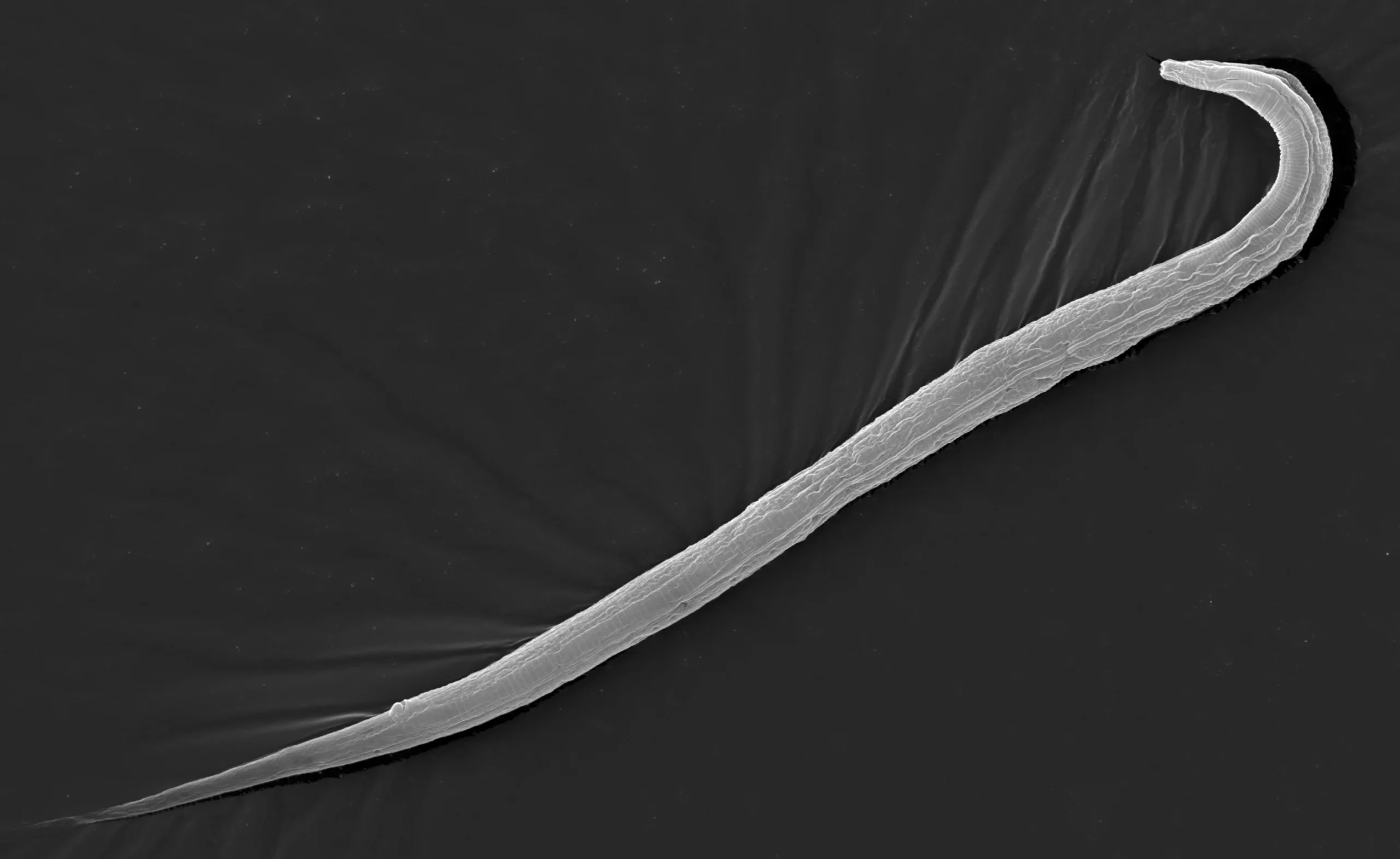
About fifteen years ago, scientists made an extraordinary discovery in a South African gold mine. At more than a kilometer below the surface, in an environment as hostile as can be, lives the “devil worm.” It is the deepest-living terrestrial animal ever found, whereas until then, science believed that only unicellular organisms could survive so far underground.
Excavations down to 3.6 kilometers deep
The Beatrix Gold Mine is a major underground mining operation located in South Africa, roughly 300 km southwest of Johannesburg. Opened in 1983 and still in operation today, the mine lies at a depth ranging between 700 and 2,200 meters. The operation is also well known due to a 2018 incident when a storm caused a blackout, trapping no fewer than 950 miners underground for 30 hours.
In 2011, two researchers—Gaetan Borgonie and Tullis Onstott—captured a tiny animal (0.5 mm in length) in the mine at a depth of 1.3 km, as revealed at the time by a National Geographic article, and then by a scientific publication in 2019. It was the worm of the species Halicephalobus mephisto (or “devil worm”), an extremophile nematode—thriving in environments lethal to most other species. The worm in question was extracted from rock fissures containing water isolated from the surface for 3,000 to 12,000 years.
Subsequently, the two scientists carried out expeditions down to 3.6 km deep in the TauTona gold mine, another operation in the region. During these investigations, experts did not manage to trap a living worm in their filters, but they did analyze the water flowing from the rock fissures. Those DNA analyses demonstrated that the devil worm — and potentially other very closely related species — live at more than 3,500 meters underground.
A suffocating heat, toxic water and little oxygen
Before this discovery, science believed that only unicellular organisms could survive at such depths. The environment is exceptionally hostile: total darkness, crushing pressure, water and rock temperatures reaching 48°C, and above all, air containing only 21% oxygen, i.e., about 1% less than the level in ocean water. Moreover, the water surrounding the animal was rich in methane and hydrogen, with high concentrations of highly toxic reduced sulfides. Let us also note a pH of the water between 5 and 6 (moderately acidic) and significant mineralization (salts).
“Imagine that you are a nematode living in the soil of your garden. One day, it becomes scorchingly hot. Suddenly, rain may pour down, flooding the ground and depriving it of oxygen. Each night the temperature drops, and in winter it freezes. In other words, terrestrial nematodes endure constant stress, from dawn to dusk, every day.”, had declared Gaetan Borgonie, a biologist and nematologist at Ghent University (Belgium).
At the time, the discovery of this famed worm obviously pushed the absolute limit of the biosphere, that is, the zone where life is considered possible on Earth. Furthermore, finding traces of biological activity more than 3.5 km deep demonstrates that animal life does not merely survive. Indeed, it has established itself in a lasting way for thousands of years.
