
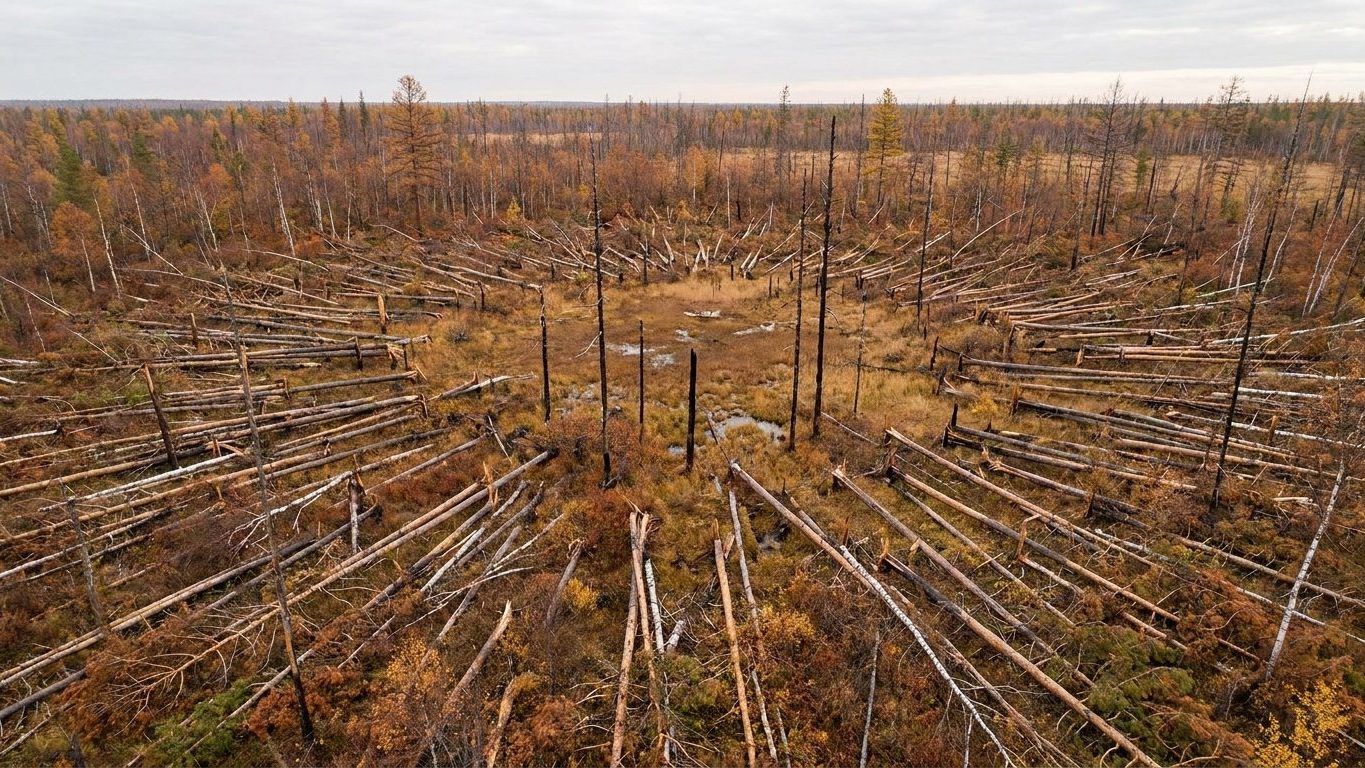
When the first scientific expedition finally reaches the site, several years after the events, the landscape before its members surpasses anything they could have imagined. Across a vast expanse, the Siberian forest lies flattened on the ground, each trunk pointing in the same direction, as if a giant hand had blown from a single point. At the center of this vegetal star, a handful of trees still stand, stripped of their branches, like posts planted in a mineral silence.
No one on site could understand what might have produced such a spectacle.
- A 1908 explosion in Siberia flattened 800 km² of forest without leaving a visible crater
- Scientists found no metallic debris nor ground depression at the presumed impact site
- A celestial body can disintegrate in the atmosphere and generate a devastating shock wave without touching the ground
An ordinary morning, up to that rumble
That morning in 1908, villagers living hundreds of kilometers away recount a blinding light blazing through the sky, followed by a roar so fierce that it knocked over passersby and shattered windows far beyond the devastated zone. The ground trembles, a wave propagates over a distance that astonished observers of the era. In the following nights, over Europe, the sky remains unusually clear, to the point that some can discern details at a time when darkness should have prevailed. None of these witnesses, no matter how distant, actually saw the explosion itself: they only recorded the blast, the light, and the echo.
In the region itself, no one reports the event to the scientific academies. News travels slowly, carried by fragmentary accounts rather than an official alert.
Why it took so many years to get there
The affected zone lies at the heart of a sparsely populated Siberian territory, difficult to reach even for seasoned travelers. Add a turbulent political climate that diverted authorities toward far more urgent priorities than a distant explosion. The rumor, meanwhile, climbs slowly, in fits and starts, before a scientist seriously contemplates going there.
The remoteness alone suffices to explain such a lengthy wait.
An explosion with no ground contact
On site, scientists logically search for a crater, a rocky mass, a metallic fragment that would prove something struck the soil. They find none. No depression in the terrain, no foreign block, not the slightest sign of a direct impact. The only tangible proof remains this forest laid out in an 800 km² star, oriented from a perfectly identifiable center but empty of any object.
Thus, an object can devastate a landscape without ever touching the ground.
The explanation adopted today holds that the body disintegrated directly in the atmosphere, before any contact with the ground. The shock wave produced by this altitude breakage was enough to erase the forest over such an extent, with no debris needing to reach the earth.
What the absence of a crater changed
This episode remains, even today, the reference point when considering what a celestial body that disintegrates above a populated area can produce. It prompted scientists to take atmospheric explosions seriously, distinct from conventional impacts, in their risk models. Near-Earth object monitoring partially built itself around this lesson: a danger can materialize without leaving any trace on the ground.
As for the exact nature of the body—whether a icy comet or a rocky asteroid—the debate continues unresolved. What remains certain is that no other documented event has razed a surface so extensive without leaving behind any rock fragment.
Sources: quebecnouvelles.com | blog.historiqly.com
