
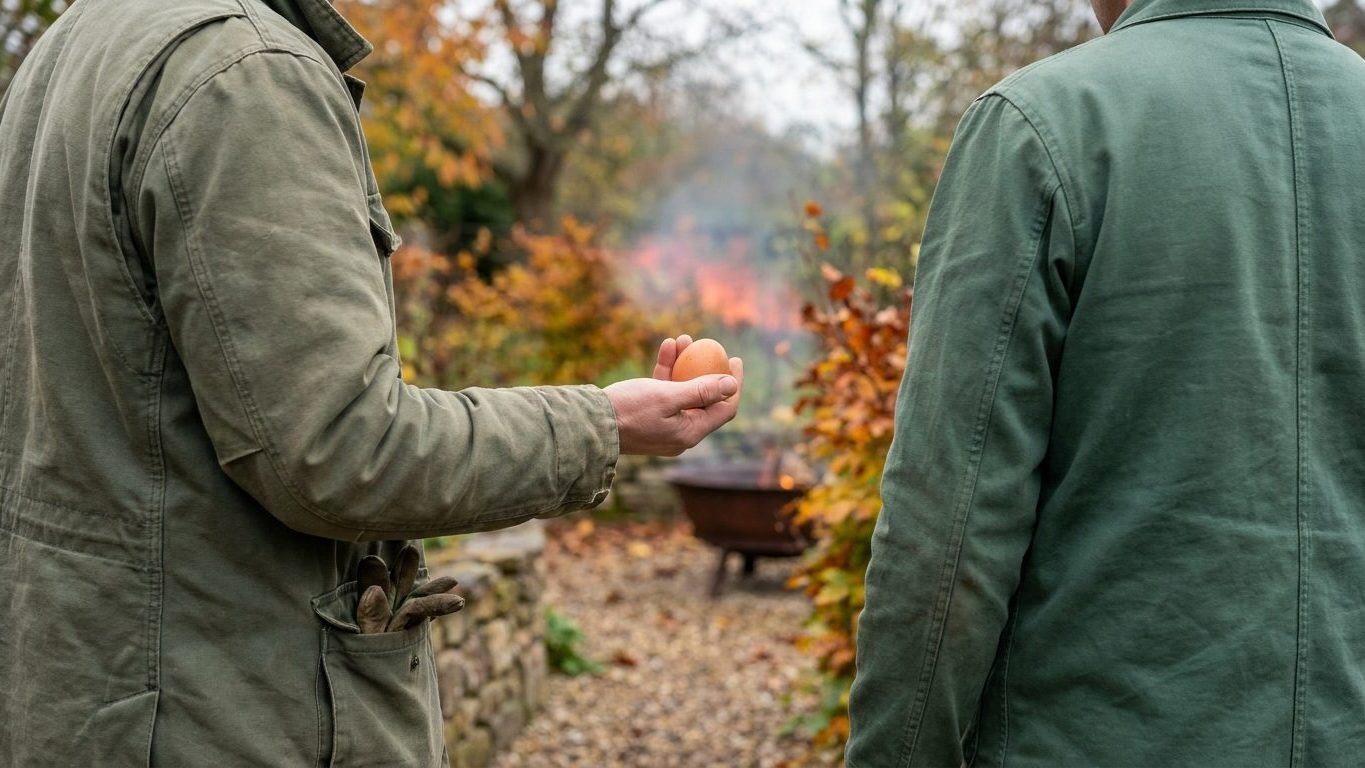
The blowtorch hisses, blue and white flame pressed against the shell of an egg for long minutes. Then the hand that had just grasped the torch closes its fingers around the egg, bare-handed, with no grimace. Inside, nothing has cooked.
The scene was filmed at the very start of the 1990s.
- A British hairdresser devised in 1990 a paste that protects objects from extreme heat by sacrificing itself layer by layer.
- The inventor refused to patent, sign nondisclosure agreements, or allow samples to be kept, fearing industrial theft.
- The material was never described publicly and its exact formula has remained lost since the creator’s death in 2011.
A hair salon, not a laboratory
The man behind this demonstration had no scientific training, no engineering degree, and no chemist’s background. He earns a living cutting hair somewhere in England and tinkers with chemical mixtures in his spare time, in his kitchen, with whatever tools he can scrounge. Nothing in his history pointed him toward the interest of defense laboratories or major industrial players. By the late 1980s, he nonetheless devised a paste that he applies to fragile objects before subjecting them to flame.
This paste allows anything it covers to resist exposure to extreme heat, without the object melting or catching fire. Demonstrations proliferate at the start of the 1990s, torch in hand, with an egg as the experimental subject.
What a non-burning material can do
A material of this kind does not block heat the way a simple insulating layer on a wall would. It works by sacrificing itself, layer after layer: its surface is consumed or locally transformed, absorbing the flame’s energy and preventing that heat from reaching the protected object. It’s the same principle that equips spacecraft thermal shields during atmospheric re-entry.
Under the paste, the egg remains cold.
It stayed raw, cool enough to be held with bare hands just after the torch passed. This kind of protection would interest anyone who must safeguard an object, a structure, or a suit against brutal, brief heat. A major aircraft manufacturer, a key contractor for space shuttles, even looked into the material’s potential to reduce flammable components in its devices.
The lock: a formula kept in one head
Industrial interest alone is not enough to push the invention beyond artisanal status. The inventor allowed scientists to test the material, but never permitted any sample to be kept, fearing it would be analyzed and copied. He also refused to sign any confidentiality agreements, fearing that companies would reverse-engineer a version for themselves. He died without ever filing a patent covering the entire process.
Repeated negotiations only strengthened his distrust over the years. Doors would open and then close, with no agreement lasting long enough to ensure the formula was transmitted within a framework that could truly protect it.
The inventor died in 2011.
At the time of his death, the complete formulation of the material had never been made public. Some groups claim to have recovered notes and equipment after his death and have been working since to reconstruct a viable product. Over the years, teams have produced materials with similar properties, without anyone being able to prove that they are the same product as the one filmed before that blowtorch in the early 1990s.
This story boils down to a simple truth about invention: finding something is never enough; one must also agree to share. A man without a laboratory, without a diploma, and without a network developed something that entire teams have not been able to reproduce identically decades later. The secret, often touted as protection, became a lock that ultimately closed in on itself.
Sources: franceinfo.fr | coiffea.com
