
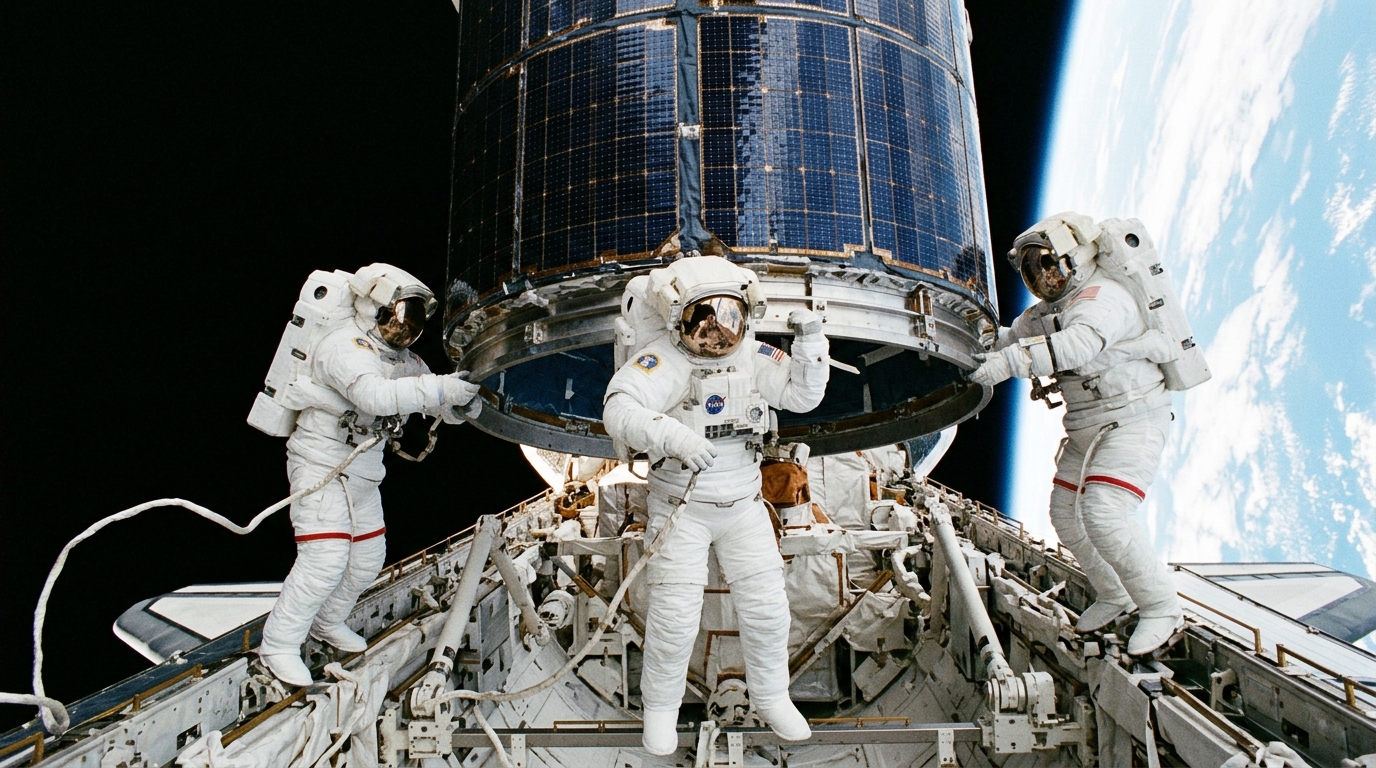
How can you reel in, solely by the strength of your arms, a multi-ton spacecraft racing at nearly 28,000 kilometers per hour through the emptiness of space? This challenge, which sounds almost like science fiction, was nonetheless tackled by three American astronauts during a mission that has forever stamped itself on the annals of space exploration. While the Space Shuttle Endeavour was on its very first flight, the STS-49 crew confronted an insoluble technical problem with the tools originally planned. The solution? An unprecedented extravehicular activity, performed simultaneously by three astronauts, to grasp a drifting communications satellite with their bare hands. A look back at a space rescue operation as bold as it was spectacular, blending a manufacturing fault, technical prowess, and human courage.
- A wiring fault prevented the Intelsat 603 apogee motor from firing, leaving the satellite stuck in low Earth orbit since 1990
- After the capture bar failed, astronauts Thuot, Hieb and Akers performed the only three-person extravehicular activity in history to grab the satellite by hand
- This EVA lasted 8 hours 29 minutes, a record for the era, and enabled the installation of a new engine allowing Intelsat 603 to reach geostationary orbit and remain in service until 2013
- A Satellite Held Hostage by a Wiring Fault Since 1990
- Two Failures That Force NASA to Improvise the Unthinkable
- Thuot, Hieb, and Akers: The Bare-Handed Capture That Made History
- 8 Hours 29 Minutes in Space: The Record That Saved Intelsat 603
A Satellite Held Hostage by a Wiring Fault Since 1990
It all begins with an industrial fault that could have cost its maker dearly. The Intelsat 603 satellite, designed to provide international telecommunications links, lifts off from Cape Canaveral aboard a Commercial Titan III launcher. But the burn to orbit goes awry: a wiring fault prevents the upper stage from separating properly, making it impossible to ignite the apogee motor intended to propel the craft to its final geostationary orbit. The result is a brand-new 4,215-kilogram satellite stuck in low Earth orbit, completely unusable—like a luxury car left by the roadside for lack of fuel.
For Hughes, the satellite’s manufacturer, the financial loss is enormous. Rather than abandoning this costly device, the company turns to NASA to consider an in-orbit recovery mission, a first in the history of commercial spaceflight. A contract valued at 90 million dollars is signed between the two parties. The goal is as straightforward to state as it is dizzying to accomplish: fetch Intelsat 603 in space, install a new engine, then release it so that it can join the orbit it was meant for from the outset.
Two Failures That Force NASA to Improvise the Unthinkable
Thus, with this rescue mission in mind, the Endeavour shuttle blasts off from Cape Canaveral’s Launch Complex 39B for its very first flight, designated STS-49. On board are seven astronauts, including mission commander Daniel Brandenstein, as well as Pierre J. Thuot, Richard Hieb, and Thomas Akers, who will soon become the faces of this feat. The initial plan calls for the use of a specially designed capture bar to latch onto Intelsat 603, stabilize it, and then bring it back into the shuttle’s payload bay.
But nothing goes as planned. A first attempt fails, then a second. Each time, contact with the tool pushes the satellite away and causes it to swing, making a successful capture with that tool impossible without risking damage or sending it tumbling out of reach for good. Faced with this deadlock, the engineers on the ground and the crew on orbit must find a makeshift solution at once. The result is a radical decision for the time: to attempt a manual capture, by hand, with not one but three astronauts exiting into the vacuum simultaneously—a configuration never tested before.
Thuot, Hieb, and Akers: The Bare-Handed Capture That Made History
The plan that unfolds commands genuine awe. Pierre J. Thuot, Richard Hieb, and Thomas Akers exit together from the shuttle’s airlock to approach the drifting satellite, executing a micrometrically choreographed sequence that they have rehearsed countless times in their minds ahead of the operation. The aim is to seize Intelsat 603 directly with their hands, cradle its frame to neutralize its residual spin, and then guide it by hand toward Endeavour’s payload bay where a robotic arm and a securing mechanism would take over.
That image—the three suited astronauts stabilizing a multi-ton craft with an outstretched arm in the darkness of space—remains one of the most striking episodes in the history of crewed spaceflight. It was, in fact, the only three-person extravehicular activity ever conducted in spaceflight history, a record that has never been surpassed due to the enormous logistical demands and risks involved. Once the satellite was secured, the crew proceeded to install a new apogee motor, the renowned Orbus-21S, to replace the motor that had remained unused since the failed launch.
8 Hours 29 Minutes in Space: The Record That Saved Intelsat 603
Beyond the technical achievement, this extravehicular activity set a remarkably long duration record for its era: 8 hours and 29 minutes spent in the vacuum of space, a figure that would remain unchallenged until the STS-102 mission nearly a decade later. When added to the three other spacewalks performed during the STS-49 mission, the Endeavour crew totaled 25 hours and 23 minutes of EVA activity, an absolute record at the time that underscored the scale of the physical and logistical effort required to carry out this rescue.
After the new engine was installed and the satellite released from the shuttle’s bay, Intelsat 603 finally managed to reach the geostationary orbit promised from the outset, thanks to the successful ignition of its correction engine. This spectacular rescue not only saved a colossal financial investment, it also granted the satellite a second life that lasted for more than twenty years, before it was finally deactivated in January 2013.
In hindsight, the STS-49 mission perfectly illustrates what human ingenuity can achieve when confronted with a technical problem that seems insurmountable. Where a simple wiring fault might have doomed an expensive satellite for good, the bold improvisation of three astronauts, together with hours of training and a cool head, transformed an industrial failure into a resounding success. A episode that, if needed, reminds us that space exploration remains, above all, a deeply human adventure, where even the most advanced technology never wholly replaces the intelligence and determination of those who wield it.
