
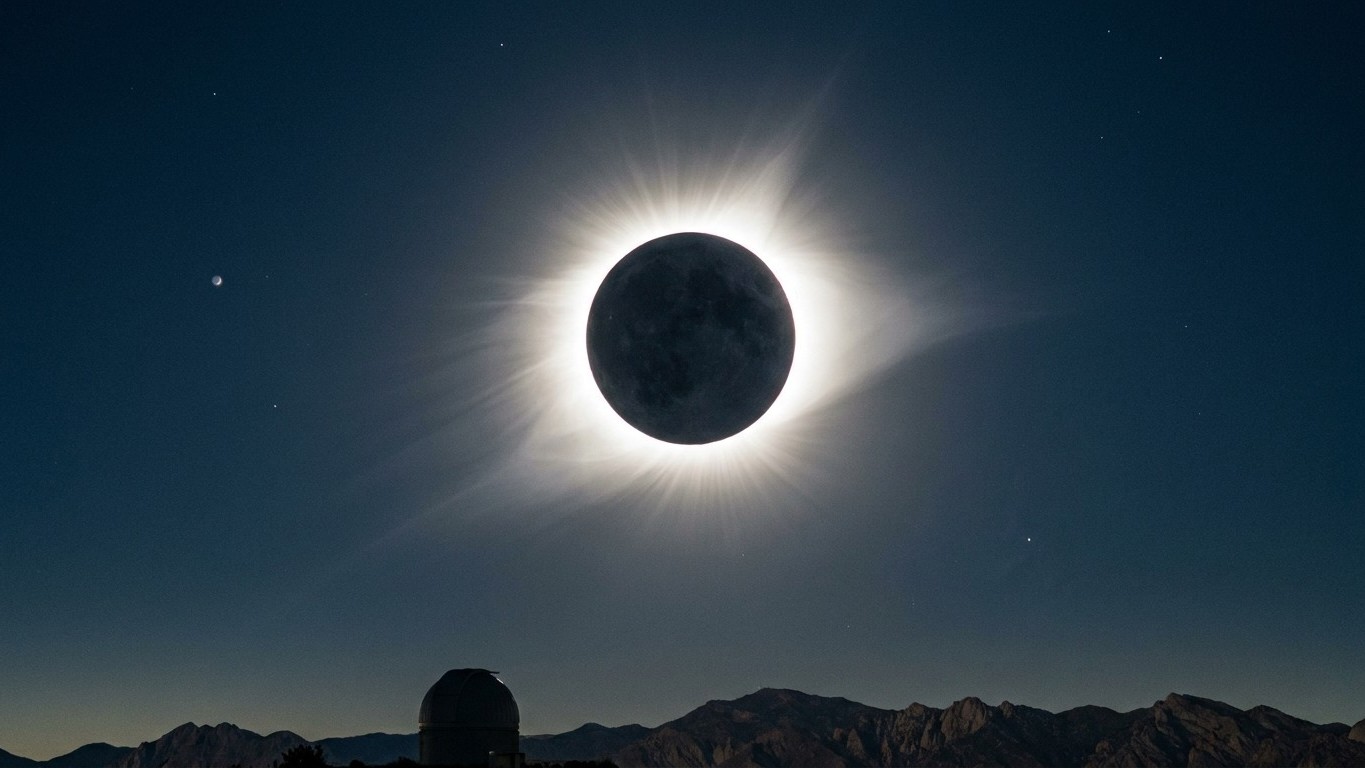
Each year, the Moon creeps away from Earth by about 3.8 centimeters. A movement imperceptible on the scale of a human life, yet one that will ultimately doom one of nature’s most breathtaking spectacles: the total solar eclipse. In several hundred million years, the lunar disk will be too small in the sky to completely cover the Sun. Total eclipses will give way to annular eclipses, that famous “ring of fire,” and this, forever.
This creeping separation is known by a name: lunar recession. It has been measured with remarkable precision thanks to reflectors laid on the lunar surface by the Apollo missions between 1969 and 1972. Lasers fired from Earth bounce off these mirrors, and the time it takes for the light to travel back and forth lets us determine the Earth–Moon distance to the millimeter. The result has remained constant across decades of observations: the Moon is receding by 3.8 centimeters per year, a fact confirmed notably by measurements from the University of Texas at Austin’s Lunar Observatory, which has been exploiting these retroreflectors for more than fifty years.
Key takeaways
- A satellite slowly slipping away: but what mechanism drives the Moon to drift apart?
- A fragile cosmic coincidence: how two bodies of radically different sizes create the perfect illusion
- A countdown measured in hundreds of millions of years: what will happen to the sky we know?
Why the Moon Is Escaping Our Planet
The driver of this drift is a mechanism known as tidal friction. The Moon’s gravity tugging on Earth’s oceans creates a bulge of water that rides ahead of the Moon’s passage. But Earth spins on its axis faster than the Moon orbits around it, so this bulge ends up slightly in advance of the Moon’s exact position. This displaced lump of water, in turn, exerts its own gravitational pull on our satellite, like a hand gently nudging an object forward. The result? The Moon speeds up along its orbit, and a basic law of physics says that an object accelerating in an orbit moves away from the body it orbits.
This energy transfer has a price for Earth as well: our planet slows its own rotation. Days lengthen, very slightly, by about 2 milliseconds per century. About 1.4 billion years ago, a day on Earth lasted only 19 hours, according to work published in the Proceedings of the National Academy of Sciences in 2018 by researchers at the University of Wisconsin–Madison, who studied ancient tidal layers to reconstruct this gradual slowdown.
The Cosmic Coincidence That Makes Eclipses Possible
What makes total eclipses possible today is an almost absurd geometric coincidence. The Sun is roughly 400 times larger than the Moon, but it is also about 400 times farther away from Earth. These two ratios cancel out almost perfectly, so from our planet the Sun and the Moon appear to be nearly the same apparent size in the sky, each about half a degree across. No other known planet in the solar system, with its moons, enjoys such a precise alignment.
This balance is already fragile today. The Earth–Moon distance naturally fluctuates over the Moon’s orbit, which is elliptical rather than circular. That is why some eclipses are total, while others—when the Moon sits farther along its orbit—produce only a ring of sunlight around the lunar disk, the annular eclipse. As the Moon gradually recedes on average, annular eclipses become more frequent at the expense of total ones, until a day comes when no configuration will permit a full occultation of the Sun.
In How Long Will the Sky Really Change
Astronomers place this tipping point at about 600 million years from now. That figure, cited by several celestial mechanics researchers, including NASA scientists working on the orbital dynamics of the Earth–Moon system, remains an estimate that depends on the exact rate of recession over such vast timescales. This pace has not always been constant: it has varied with the configuration of continents and oceans through geologic eras, as tidal friction depends strongly on the shape of ocean basins.
Six hundred million years is an unfathomable span on human scales. To put it in perspective, it roughly matches the interval separating the emergence of the first complex multicellular life from our present era. The countdown of total eclipses stretches over a period comparable to the entire history of animal life on Earth. Our distant descendants, should humanity persist in some recognizable form, will never again witness the moment when day suddenly turns to night, when animals fall silent, and when the solar corona bathes the sky around a perfect-black disk.
Until then, total solar eclipses will remain rare yet regular events, occurring two to five times per year somewhere on the globe, with only one or two at most being total. The Moon’s path, its orbital inclination, and Earth’s rotation ensure that each total eclipse sweeps only a narrow band of the globe, a width of only a few hundred kilometers at most. This explains why witnessing a total eclipse from one’s own location is often a stroke of luck, and why some enthusiasts travel thousands of kilometers to stand in the path of totality.
One question that almost makes one’s head spin remains: what if the opposite had happened? What if the Moon had formed farther away or closer to Earth than it did? Models suggest that after the giant impact that gave birth to our satellite about 4.5 billion years ago, the Moon orbited at merely 20,000 or 30,000 kilometers from Earth, compared with about 384,000 kilometers today. At that time, it would have appeared up to fifteen times larger in the sky, driving ocean tides to an intensity our planet no longer experiences. The total eclipses of that distant era, had eyes existed to observe them, would have plunged Earth into darkness far longer than the few minutes we know today.
