
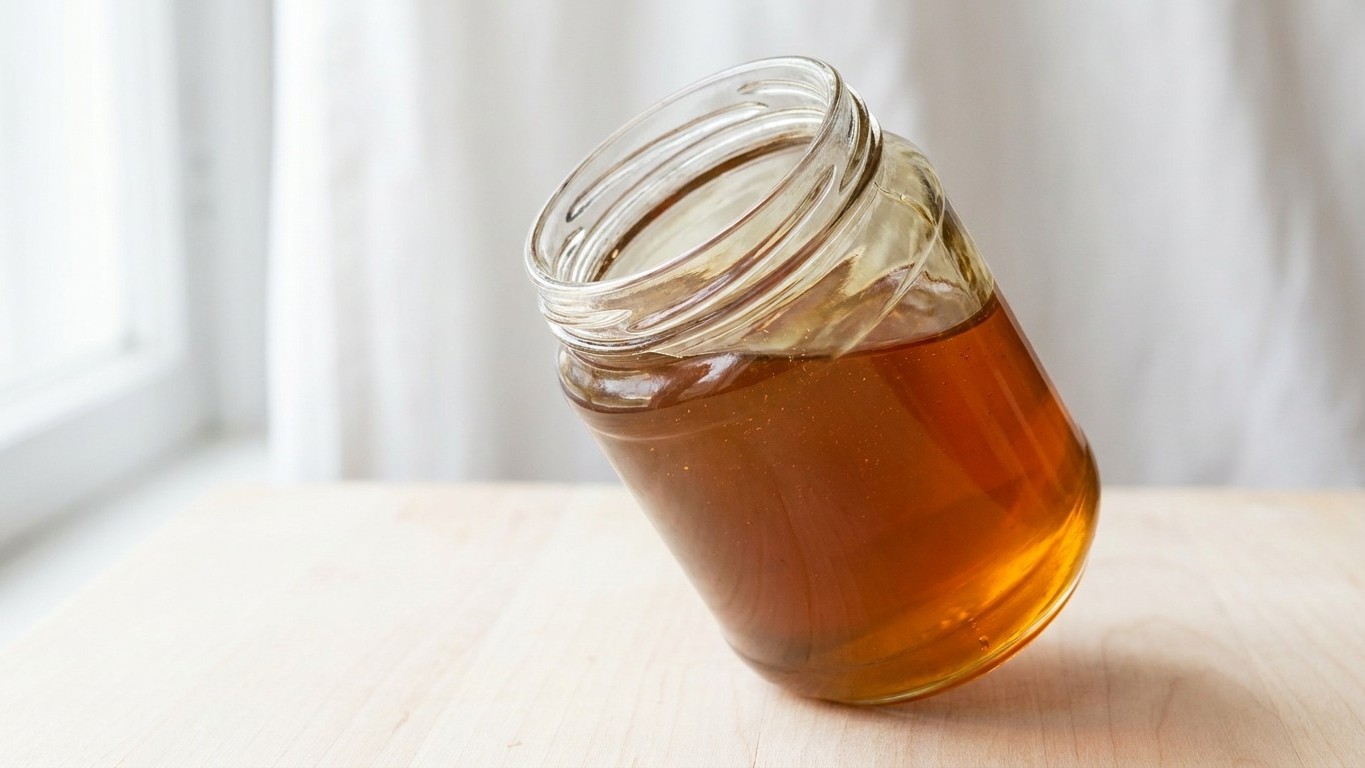
Forty-six percent. That is the share of honey jars imported into the European Union that, according to the survey From the Hives conducted by the European Commission, turned out to be suspected of fraud. In concrete terms, nearly one in two jars sold on shelves would not be what it claims to be: a blend diluted with sugar syrup, sold at the price of pure honey.
This revelation, published on 23 March 2023, details the results of the coordinated action against honey adulteration carried out by 18 EU member states under the leadership of the European Anti-Fraud Office (OLAF) between November 2021 and February 2022. Of 320 honey samples collected at EU borders and analyzed by the European Commission’s Joint Research Centre, 46% were strongly suspected of adulteration, notably through the addition of inexpensive sugar syrups. The figure looks enormous. It is all the more striking because it has jumped since the previous check: a rate far higher than that found in a prior control operation conducted in 2015, which detected only 14% non-conformities.
Key takeaways
- A figure that has tripled in less than ten years: how honey fraud has intensified
- Rice syrups to replace bees: the technological race between fraudsters and inspectors
- 80,000 tonnes of fake honey consumed each year in Europe: the equivalent of 13 Eiffel Towers
Rice syrup instead of bees
The fraud is not new, but it has become more refined. In the past, fraudsters diluted honey with sugar syrups based on starch from corn or sugar cane. Knowing they were being watched, they replaced these with syrups made primarily from rice, wheat, or sugar beet, which the JRC methods managed to detect. A technical cat-and-mouse chase, in short, where the cheats long held the upper hand over control laboratories.
The financial mechanics explain everything. On average, imported honey in Europe costs €2.17 per kilogram, while rice-based sugar syrups cost between €0.40 and €0.60 per kilogram. Injecting this kind of syrup into a jar of “honey” multiplies the profit margin with almost no risk: the product sells at the price of the real thing, costs four to five times less to produce, and physical checks remain scarce. Honey is classified as a low-risk product for public health, with only the obligation to present a set of documents. Between 1% and 4% of imported honeys undergo physical checks. In short, the merchandise crosses the border almost unimpeded.
Good news nonetheless for the concerned consumer: this deception does not pose a direct health hazard. There are few health risks for those who consume it, but it is simply forbidden. You pay for honey to eat, in part, rice syrup. It is an economic and gustatory fraud, not poisoning.
China, Turkey, United Kingdom: highly uneven profiles
Not all exporting countries are equal. Honeys originating from China and from Turkey are particularly flagged by the study, with 74% of the 89 Chinese honeys and 14 of the 15 Turkish honeys deemed suspect. Even more surprising, one European country shows the worst score of all: the results also indicate that 100% of samples processed and exported by the United Kingdom are suspect, which would be explained, according to investigators, by honey produced elsewhere and then mixed prior to re-export to the EU.
The scale of the phenomenon also stems from Europe’s structural dependence. Europe imports 175,000 tonnes of honey per year, making it the second-largest honey importer in the world after the United States, to cover 40% of its consumption. The European Union is therefore highly dependent on imports from third countries. Translated into volume, the NGO Foodwatch estimates that if 46% of imported honeys are potentially fraudulent, that amounts to more than 80,000 tonnes of counterfeit honey sold and consumed in Europe each year. A figure gives a sense of the scale: 80,000 tonnes of “fake honeys” consumed annually in Europe is the equivalent in weight to 13 Eiffel Towers consumed each year by consumers who thought they were buying a natural product.
For French producers, this competition is unfair and direct. France’s honey production cannot meet the annual domestic consumption, which stands at around 45,000 tonnes according to FranceAgriMer, and imports exceed 30,000 tonnes each year, mainly from Ukraine, Spain, but also from Asia. A Norman beekeeper who harvests his honey honestly, frame by frame, simply cannot match a price inflated by rice syrup at less than €0.60 per kilogram. There lies, more than in the consumer’s wallet, the real economic damage of this fraud.
Timid sanctions, traceability making progress
The investigation did not end there. Of the 63 operators who imported at least one suspicious lot, 44 were investigated, and 9 of them were sanctioned for honey adulteration practices. The investigations uncovered practices far beyond simply adding syrup: deliberate purchases of adulterated honey, mixing honey with sugar syrups within the European territory, using analyses in accredited laboratories to tailor honey/syrup blends to evade detection, the use of additives and colorants to imitate botanical origin, removal of pollen to mask geographic origin, or even falsification of traceability data. A true craftiness in cheating, in short, almost as sophisticated as that of the beekeepers it robs.
On the regulatory side, things are moving, albeit slowly. In France, since 2021, the labels on blended honeys must indicate the list of countries of origin in descending order of weight, under Decree No. 2020-1669 of 24 December 2020. At the European level, a dedicated tool has even emerged: the European Honey Platform created in 2024 is working to establish a single EU-wide reference laboratory, a tool honest producers have waited for a long time, and that fraudsters fear.
There remains a major gap, often neglected in the debate: even when fraud is confirmed by authorities, nothing obliges informing the consumer who has already paid a premium for their jar. The only reliable reflex, while awaiting truly dependable traceability, remains to beware of abnormally low prices and to systematically check the country of origin listed on the label, especially when it mentions a blend from several distant origins.
Sources: foodwatch.org | blog.untoitpourlesabeilles.fr
